What are we teaching when we teach writing?

Writing is really, really hard. Learning to write even more so.  Robert Kellogg – cognitive psychologist and author of The Psychology of Writing – describes writing as the cognitive equivalent of digging ditches. Learning to write is the hardest thing we ask children to do in schools, yet despite the resolute focus on curriculum in England, few schools have a well-developed writing curriculum. Schools might have a plan for when specific books will be taught and use these as a stimulus for devising writing tasks. However,  in terms of being really clear about what component writing knowledge is taught when, and why, and how this progressively builds in complexity over time, I venture to suggest that in many schools,  this is not yet as developed as it could be. There is a degree of the horse following the cart in having a writing curriculum developed to fit in with text choice rather than text choice  for writing  exemplifying increasing complexity over time of sentence construction, authorial voice and so on.

A central problem is a lack of clarity about what the components of the writing process actually are.  On top of that, there is the perhaps even more thorny issues of how to balance practising these components in relative isolation so that children can develop fluency and accuracy in their application alongside how to integrate these skills together in creative writing for a real audience. Education fashion waxes and wanes in emphasizing one or other aspect, when, to state the tiresomely obvious, children need both and need them taught in a way where the technical enables the creative. Teaching the technical without it feeding into the creative is pointless. Teaching the creative without building technical competence is futile.

Because writing is such hard work, motivating children to do the work necessary to learn how to do it well is a challenge. The profession tends to come up with one of two solutions to the motivation problem; either make sure children have all the tools they need with to be successful before expecting much by the way of cognitive ditch digging or try and make ditch digging seem irresistibly glamorous – ‘imagine all those crops you will irrigate!’ – so that the effort seems purposeful while skating over learning any tedious mechanics of how to wield your spade effectively.

If we focus too much on the allure of the final product without teaching children how to develop technical proficiency, then we risk demotivating children because it the whole process becomes impossibly hard. If we focus on developing one process at a time, we remove the motivational effects of producing an authentic piece of writing that someone else might find interesting. There is a sweet spot somewhere that harnesses the benefits of both. There is also a whatever the opposite of a sweet spot is– a sour spot? – where neither source of motivation is leveraged.

There are probably several reasons why schools might occupy this sour spot.  To give curriculum time to both the development of fluency in the various components of writing and  to the production of high-quality authentic pieces of writing consumes a hefty amount of a finite and already stretched timetable. The accountability measures processes in England, be they SATs at the end of year 6 or GCSEs at the end of year 11, do not obviously incentivise schools to conceptualise writing as a journey from the technical to the creative.   For example, primary schools might teach grammar in order for children to pass the SPAG test, without drawing sufficient attention to why an author might choose to use a fronted adverbial or embedded clause.  A primary school might also make the calculation that spending a lot of time teaching spelling is not a good investment since the marks awarded for spelling are relatively few.  Punitive accountability systems distort understanding of what the building blocks of developing as a writer actually are, with schools mistaking the requirements of high stakes assessments for a curriculum.  So for example, the Ofsted subject report for English described how ‘external assessments at both primary and secondary level unhelpfully shape the curriculum.’[1] 

  • Schools expect pupils to repeatedly attempt complex tasks that replicate national curriculum tests and exams. This is at the expense of first making sure that pupils are taught, and securely know, the underlying knowledge they need.
  • Some pupils are given considerable help to access these complex tasks, wasting precious time and resources on activities that do not result in them making progress.
  • [Secondary] schools do not always identify the grammatical and syntactical knowledge to be taught for writing, and so do not build on what has been taught at primary school. Instead, written tasks are often modelled on GCSE-style assessments.[2]

What is this underlying knowledge that children need to develop into competent writers? How to we teach this knowledge in a way that feeds into and enables the creative? When do we need to work on component knowledge in isolation and when do we integrate this knowledge within complex, creative tasks?  To understand this, I think it is useful to unpick what we mean by knowledge in term so the English curriculum and what the journey from knowledge to skills (aka procedural knowledge) looks like.

It’s not so long ago that teachers use to say things like ‘English is a skills subject. You can’t really talk about knowledge in English.’ These days teachers might accept this is not quite right but still struggle to unpick what the knowledge is within English and how it relates to writing creatively.

Let’s start by reminding ourselves about the different kinds of knowledge. The Ofsted subject report talk of foundational knowledge. However, I think it is useful to break this down further.  First of all we substantive knowledge. Substantive knowledge can be categorised as either conceptual knowledge or procedural knowledge – what is often referred to as a skill.  Conceptual knowledge is about knowing that…. and procedural knowledge is about knowing how to…. So for example, using learning about metaphors we could unpack this as follows:

 Substantive knowledge
Conceptual… know that… because…​Metaphors are ways of describing something by referring to something else which is the same in a particular way.
Procedural… know how to… and be able to…​ (Skills: involves a verb)Identify the use of metaphor in a text. Explain in what way a metaphor is the same as the thing it describes.

To be clear, children are not expected to be able to parrot the conceptual form of words above. They need to be able to understand what a metaphor is. They don’t necessarily need to use this exact formulation of words to explain what it is.

Or

 Substantive knowledge
Conceptual… know that… because…​A sentence must contain a subject and a verb.
Procedural… know how to… and be able to…​ (Skills: involves a verb)Write a simple sentence that contains a subject and a verb and identify both.   Identify a fragment and expand it into a sentence .

Or

 Substantive knowledge
Conceptual… know that… because…​When writing lower case h, the ascender needs to be tall enough to distinguish it from an n and that to form the letter you start at the top of the ascender.
Procedural… know how to… and be able to…​ (Skills: involves a verb)Be able to write the letter h correctly.

So far, so very technical. What about creativity and meaning, I hear you ask? This is where disciplinary knowledge comes in. Disciplinary knowledge in English pivots around the interactions of authors and audiences and can also be subdivided into conceptual and procedural knowledge.  To return to the examples above:

Substantive knowledgeDisciplinary knowledge
Conceptual… know that… because…​Metaphors are ways of describing something by referring to something else which is the same in a particular way.Know that the purpose of a metaphor is to help the reader understand something more clearly. Know that people may differ in their choice of metaphors to describe a particular thing (‘In English there are many right answers’).
Procedural… know how to… and be able to…​ (Skills: involves a verb)Identify the use of metaphor in a text. Explain in what way a metaphor is the same as the thing it describes.Evaluate the effectiveness of a metaphor in various authors’ work.   Use metaphor in their own writing to develop the reader’s understanding of character. Evaluate one’s own use of metaphor.

The teaching sequence is something like this – though some steps could probably be swapped around, particularly steps 1 and 2. A ‘teaching sequence’ could mean anything from a part of a lesson to a topic of work to something returned to again and again over many years. The basic concept of metaphor might be understood by a chid in year 2. However, over time, in a coherent, connected curriculum, the examples of metaphor to which  a child is exposed will illustrate increasingly more complex ideas. Without such enabling knowledge, the chance of children devising interesting or provocative metaphors themselves is remote.

 Substantive knowledgeDisciplinary knowledge
Conceptual… know that… because…​We start off sharing examples of metaphors and explaining what a metaphor is.While also explaining why they can help readers understand more clearly.  
Procedural… know how to… and be able to…​ (Skills: involves a verb)We then help children identify metaphors in texts.We then help children explain in what way a metaphor is the same as the thing it describes.We then evaluate the effectiveness of specific metaphors in selected texts.Then children use metaphors in their own writing to develop the reader’s understanding of character.   Then children evaluate the effectiveness of the metaphors they and their classmates have used, possibly making changes to their own work.

The sequence goes something like this:

  • Explain and exemplify a thing (substantive, conceptual knowledge)
  • Explain why it is important to readers (conceptual, disciplinary knowledge)
  • Practice identifying the thing and working with the thing on a technical level (procedural, substantive knowledge)
  • Use the thing to actually communicate meaning to an audience  (procedural, disciplinary knowledge)
  • Evaluate if what you’ve written does the job it is intended to do to help the reader (procedural , disciplinary knowledge)
  • Revisit all of this several times in different contexts
  • Later, consciously do this alongside a whole lot of other things you’ve learnt, when and only when it is appropriate for the reader (rather than the demands of the mark scheme) to do so

Here’s another example:

Substantive knowledgeDisciplinary knowledge
Conceptual… know that… because…​A sentence must contain a subject and a verb.Know that without both a subject and a verb, the reader will find it hard to make sense of what we are writing.
Procedural… know how to… and be able to…​ (Skills: involves a verb)Write a simple sentence that contains a subject and a verb and identify both.  Identify a fragment and expand it into a sentence.Write simple sentences for a communicative purpose.  Check that these make sense to a reader. Make changes where necessary.  

And here it is as a teaching sequence.

 Substantive knowledgeDisciplinary knowledge
Conceptual… know that… because…​We start off sharing examples of simple sentences, explaining they always have a subject and a verb and identifying these.  While also explaining the reader can’t make sense of what we are writing unless both are included.  
Procedural… know how to… and be able to…​ (Skills: involves a verb)We then help children identify subjects and verbs and where they are absent.We then help children expand fragments into complete sentences.Then children write simple sentences to describe a picture or animation to someone else who may not have seen it.   Then children evaluate the sentences they have written to check that they make sense (because they include both a subject and a verb), making changes where necessary.

The journey is one of developing technical proficiency as an enabler of creative communication.

Here’s another example:

Substantive knowledgeDisciplinary knowledge
Conceptual… know that… because…​When writing lower case h, the ascender needs to be tall enough to distinguish it from an n and that to form the letter you start at the top of the ascender.It is important to write letters clearly because readers want to read our writing. If it is hard to tell which letter is which, they might find it too hard and give up. If we have a stable seating position, effective pencil grip and form our letter correctly, with practice it will become easy for us to write.
Procedural… know how to… and be able to…​ (Skills: involves a verb)Be able to write the letter h correctly. Notice when my formation of the letter h is insufficiently clear and correct when practicing letter formation.Notice when my formation of the letter h is insufficiently clear and correct when writing independently. Write legibly when communicating in writing.

And another:

Substantive knowledgeDisciplinary knowledge
Conceptual… know that… because…​Know that in nonfiction writing a paragraph usually needs to start with a topic sentence and then include further sentences with supporting detail.Know that the topic sentence helps the reader understand what the paragraph is going to be about and the supporting detail explains the topic sentence more fully, by giving more evidence or explaining the reason why or the stages in a process.   Know that a plan can help us identify the supporting detail we need to include to ensure that our paragraph explains or topic sentence to a reader. And/or  Know that as we are writing, we should check that we are including sufficient supporting detail to explain our topic sentence to a reader.
Procedural… know how to… and be able to…​ (Skills: involves a verb)Given a series of sentences, identify which should be the topic sentence and which should be the supporting detail.  Given two topic sentences, select relevant supporting details from a list​.  Given a topic sentence, generate supporting detail.  Given supporting details, generate a suitable topic sentence[3].Be able to write a plan in note form for a paragraph. Be able to write a well-structured nonfiction paragraph and  evaluate its effectiveness in communicating meaning to the non-present reader.

 I think for this one, some of the conceptual disciplinary knowledge comes after practising the procedural disciplinary knowledge.

And just in case you are wondering what this might look like for reading:

Substantive knowledgeDisciplinary knowledge
Conceptual… know that… because…​Know that authors deliberately leave out information when they write for two different reasons: because they assume the reader already knows something and putting in too much obvious information would be boring; in order to make the story more interesting by keeping the reader guessing. Know that when we are reading, we should listen in our head to check that what we are reading makes sense. If it does not make sense to us, we should go back and reread the sentence or paragraph again.
Procedural… know how to… and be able to…​ (Skills: involves a verb)Identify in a paragraph where the author has left out information to keep the reader guessing.Check what we are reading makes sense to us when we are reading and take appropriate action when it doesn’t.

English teaching spans a variety of disciplines or, to use the language of Ruth Ashby and Christine Counsell, disciplinary quests:

Each subject is… a product and an account of an ongoing truth quest, whether through empirical testing in science, argumentation in philosophy/history, logic in mathematics or beauty in the arts.’[4]

Ruth Ashby expands further on this idea of disciplines as quests and identifies four different category of quest. English spans all of these:[5]

  • The descriptive quest seeks to describe reality using empirically derived facts and logic to either confirm or replace accepted theory. Its quest therefore is for a single, universally agreed though provisional truth. Truth seeking in much of science and maths follows a descriptive quest. Within English, phonics, letter formation, technical definitions and some aspects of grammar are givens. The pronunciation of the grapheme <e> may vary, but the set of variances is a bounded one, with limits.
  • The interpretive quest seeks to interpret reality through discussion and argumentation. There is no expectation of the possibility of a single truth around which all agree.  Truth seeking in much of history, religious education and human geography follows an interpretive quest, as does the interpretation of literature in English.
  • The expressive quest seeks to express truths, often through the medium of the arts. In English, creative writing follows an expressive quest. Here there are many truths and popular acclaim is as valid as scholarly opinion.
  • The problem-solving quest seeks to find solutions to problems, such as created within design and technology, computing and so on. Within English, a set of instruction that successfully enables a reader to accomplish a task is an example of English in problem solving mode.

This quotation by C.R Milne expresses how the descriptive and the expressive perform different roles, the one giving us a universal truth, the other an invitation to a more personal truth. Within the discipline of English, both have a valued place.

‘The astronomer may tell us something about the moon, but so too does the poet. The astronomer’s moon is everybody’s moon; the poet’s is very much his own and not everyone can share it.’[6]

Within English, there is substantive knowledge that is often descriptive in this sense  and not up for interpretation (‘everybody’s moon’).  Something either is or is not a sentence or a correct spelling or a metaphor or a paragraph. This is usually something everybody agrees on. Then there is disciplinary knowledge and this is quite different. This can be expressive, or interpretive or – and here I build on Ruth Ashby’s work – metacognitive. Here there are wrong answers, certainly but also many right answers (one’s own moon).  The substantive is the enabler of the disciplinary. The disciplinary puts the substantive to work and provides the rationale for learning it.

We can summarise this as follows:

Substantive knowledgeDisciplinary knowledge
 Knowledge as descriptive. (Often there is one, agreed answer)Knowledge as interpretive, expressive or metacognitive. (There may be many right answers)
Conceptual… know that… because…​Knowing various rules, techniques, structures, conventions and vocabulary that authors and speakers use to make meaning.Knowing that when we study English, we are studying how authors and speakers – including ourselves – try to make meaning to share with an audience.   Know that when writing, authors are usually communicating with a non-present reader and this brings particular challenges both when we write (as we have to bear in mind the needs of the non-present reader) and when we read (as we have to work to make sense of what the writer has written.)   Know that to  communicate meaning effectively, writing or speech needs to be clear and orientated towards its intended audience in a way that is either interesting, informative, persuasive or provocative. [7]  This is so that the audience thinks it is worthwhile putting in effort to try to understand what the author is saying.   Know that therefore we should monitor and evaluate our own writing and speech to check that the meaning is suitably clear, and its intended audience will find it interesting, informative, persuasive or provocative.   Know that the meaning an author intends is open to interpretation.
Procedural… know how to… and be able to…​ (Skills: involves a verb)Identifying these rules, techniques, structures and vocabulary in texts and in speech.   Using these component rules, techniques, structures and vocabulary in discrete tasks through developing accuracy and fluency rather than for a specific audience.   Procedural knowledge, or skills development, is about enabling subsequent creativity by ensuring learners have the necessary tools to communicate with an audience in a way that is clear and interesting, informative, persuasive or provocative.Engage in creative meaning produced for an audience through the interpretation and production of texts and talk that integrate rules, structures and vocabulary that is clear and either interesting, informative, persuasive or provocative.   Monitoring and evaluating our own meaning making both whether we are audience or author.   Interpretation and evaluation of the meaning making of others.

When I started teaching in the late ‘80s, teaching writing was exclusively focused on the disciplinary – having something to say and publishing your work for an audience, with a little bit of redrafting and refining thrown it (by writing work out ‘in best’). Writing was either to be made into a book or put on display – allegedly for peers to read. We did not teach spelling, derided as mere mechanics, but did teach handwriting – the visual appearance of texts being valued as a way of enticing the reader. We did not explicitly teach text structures though we did read to children a lot of really high-quality literature. Non-fiction did not feature very much.  Some children did very well. Some did incredibly badly and not having been taught phonics, were completely unable to write anything remotely comprehensible.  Thus their inner author was not set free, as the approach purported to enable, but was securely shackled by their ignorance and the ideological idealism of their teachers.

Then in 1996,  the National Literacy Taskforce was established, ushering in the National Literacy Project and then Strategy. This really focused on phonics for both reading and spelling,  text structures, including a whole gamut of non-fiction text types, and knowledge of written language.  For example, the excellent publication Grammar for Writing was a game changer, providing well thought out strategies for teaching children to write well at the sentence level.  These were exciting times. Levels of attainment shot up. However, this shift came with trade-offs, the school day only having a finite number of hours. Because teachers were spending more time on phonics, sentence and text structure, the emphasis on sharing texts with an audience beyond one’s teacher reduced.

There was, however,  a new ‘audience’ in town, and one that had demanding requirements. Writing standard assessment tasks – SATs were introduced in 1995, ushering in an era of the marker as  prime audience.  Being held accountable for standards of writing did help to improve attainment – but over time the emphasis on text structure – or genre – began to eclipse all other elements, aided and abetted by the requirements of the National Curriculum of the time.  The abolition of the writing SAT in 2012 did not actually change this, since it was replaced by a system of moderated teacher assessment that was just as heavily focused on genre. Even when the National Curriculum removed the requirement to study numerous genres, the focus of teaching multiple genres lingered on.

Over time, learning to write morphed into learning how to achieve the requirements of the teacher assessment framework.  This involved producing writing that ticked various boxes. Writing became an exercise in producing something that enabled boxes to be ticked. Teaching writing turned into a process where the teacher shared some writing and showed how it ticked various boxes – maybe with some discrete teaching on how to tick a particular box – and then children were given a shopping list of things that they had to include in order for their audience – the mark scheme – to be satisfied.  Redrafting work in order to rectify unticked boxed also became a big thing, accompanied by angst about how independently this had been done.

The dictatorship of the mark scheme as audience meant that a genuine sense of writing for an actual reader disappeared. Choices about vocabulary, syntax, structure or syntax were replaced by choices based on harvesting marks. When writing was assessed by Sats, spelling hardly contributed any marks at all, with a concomitant lack of emphasis in terms of curriculum time. Ditto handwriting.

The introduction of the SPAG test (that’s spelling, punctuation and grammar to those who do not know the joys of this assessment) did help shape teaching away from being almost exclusively focused on text level structure and coherence towards thinking a bit about the sentence. It did mean children were actually taught about grammar and about different ways of structuring sentences. This was an improvement. There were however two problems. The first was that the scope of the grammatical features 11-year-olds were meant to be able to identify strayed beyond the useful and into the abstruse. I’m old enough to have been taught grammar at school and to have learned Latin. However some of the knowledge children are tested on gets me second guessing myself. For example, the difference between a propositional or adverbial phrase or between an embedded  or relative clause does not come to me automatically but something I have to talk myself through. Linked to this is the second problem. The test is great at getting children to be able to feature spot. It is less good at getting children to be able to use features purposefully in their writing. It was however, eminently teachable. At the school where I was headteacher, despite our challenging demographic, our scores in the SPAG test were sky high. This did not translate to children deliberately choosing to use embedded clauses or prepositional phrases to make their writing clearer or more interesting for the reader. The sense of a reader as a reader – as opposed to marker – had completely disappeared. The inner author was better equipped and hence freer than when explicit teaching was frowned upon. It was, however, a rather limited kind of freedom.

The result of all these different approaches is that a relatively large minority of children are not very motivated to write because either they have not been given all the tools they need with which to be successful and the effort involves seems to far outweigh any reward or the enterprise lacks meaning – digging ditches in order to dig ditches.

There have been various approaches to motivate children to undertake the hard work necessary in learning to write.  The first of these involves the quest for the most irresistible stimulus about which children will be so desperate to write that, adherents of this approach believe, all other concerns fall away. Give something exciting to write about and the other barriers that make writing hard will magically fall away, or at least become less of a hurdle. A second is the reward of an audience who will appreciate and admire your work. A third is the satisfaction of producing something beautiful. A fourth is amplifying the importance of writing for future exams and employment success.  All of these will work to some degree for some children and all of them have some merit. However, collectively they fail to get to the root of the problem. They all try to motivate children to do something hard by dangling a reward at the end of the process. None of them seek to make the process less arduous in the first place.

Producing a piece of text involves doing several different things at once.  The cognitive load involved in trying to orchestrate all of these in rapid succession is immense. A different solution is to isolate each component, and teach these separately initially, so that finite cognitive resources are only having to focus on one thing at a time. Children experience success which is highly motivating. Then, when at least some of these processes have become automated, children can begin to integrate the various process together.

The drawback of this approach is the inverse of those outlined above. By focusing on one process at a time, it effectively removes the motivational effects of producing an actual piece of writing. For some processes, it also makes the reference point of the reader more tangential. Yes, when you are learning to spell, you are learning to spell in order that a reader can understand your writing. That’s less obvious that when you write an actual piece of text for a specific audience.

However, this drawback can be remediated by providing scaffolding that does the work of some of the processes for the learner, allowing learners to concentrate on just one or two processes at a time while still enjoying the motivational benefits of creating something worthwhile that is shared with others. For example, while Reception children need to focus a great deal of time in developing competence with the transcriptional enablers of technology, this should not mean that they are not also able to spend time  composing for an audience, whether orally or via using drawing and possibly emergent writing. For example, the app Chatta provides an easy way for children to record, replay and share  their early attempts at writing sentences. 

Striking a balance between devoting time to working on discrete components in isolation  and time to use components together in more complex tasks of meaning making is the key curriculum challenge when teaching writing. Different schools may come up with slightly different emphases. We should be wary of decrying those who deviate  ever so slightly from our preferred solutions with a little more or a little less of the component or the complex than our own answers to this problem.  For example, I would see both the work of Andrew Percival and Stanley Road Primary in Oldham and the work of Ross Young and Felicity Ferguson at The Writing for Pleasure Centre  as thoughtful responses to trying to give appropriate weighting to both  the technical and the creative, (though I tend more to Team Percival, for now at any rate.)


[1] Telling the story: the English education subject report – GOV.UK

[2] Telling the story: the English education subject report – GOV.UK

[3] This sequence is based on chapter X of The Writing Revolution

  • [5] Ashbee, R (2021) “Curriculum Theory, Culture and the Subject Specialisms” Routledge

[6] This whole section is indebted to Article: Substantive and Disciplinary knowledge – e-Qualitas Teacher Training with particular thanks for the C.R.Milne quotation.

[7] I could have added in further adjectives such as analytic but decided for the sake of clarity to restrict myself to just four. Balancing the non-present and unknown reader’s desire for clarity with their potential desire for nuance and comprehensiveness is always an authorial challenge!

What are we teaching when we teach writing?

Understanding oracy, understanding writing.

Talking floats on a sea of write

 ‘Writing floats on a sea of talk’ said James Britton in the 1970s.’  If you can’t say it, you can’t write it. This being the case, teaching children to write articulately will necessarily involve teaching children to speak articulately.

This is true but it is not the whole truth. Because the converse is also true; talking floats on a sea of ‘write.’  If you can’t write it, you can’t say it.

I can imagine you looking askance at his assertion and thinking, ‘Sealy’s lost it.’ After all, you are bound to know a four-year-old who doesn’t stop talking but can’t yet write very much.  And for thousands of years there have been pre-literate cultures and civilisations that thrived without having any form of writing. Socrates refused to write because he thought it was a pernicious invention that would erode memory. Clearly Socrates could talk!  So why the provocative assertion?

Britton’s  assertion that teaching children to write articulately necessarily involves teaching children to speak articulately assumes that writing is transcribed speech. First a child learns how to talk then later they learn ways of transcribing that talk. However, because speech and writing are produced in very different communicative situations, there are significant differences in how they are structured. What is more, writing enables a different type of more formal speech. Exploratory talk and presentational talk, to use the categories first proposed by Douglas Barnes and then expanded upon by Neil Mercer, are different from every day, conversational talk. More formal ways of talking are dependent upon writing.  If you can’t write it, you can’t say it.  Or as Quintilian said in the first century, ‘By writing we speak with greater accuracy and by speaking we write with greater ease.’ Talking floats on a sea of ‘write.’

Clearly, the ability to participate in everyday conversation is not dependent on being able to write. But if we are talking about talking in an educational context, talking about the place of oracy in the curriculum for example, then we probably mainly mean something different from the sort of informal, conversational language we use every day.  This is not to disparage the everyday vernacular, which is fundamental to our identity, to our sense of self.  If we had to choose between only being able to communicate in the everyday vernacular or only being able to communicate in formal, sentence-based academic idiom, then the everyday would win, hands down. Humanity has existed for 300,000 years but has had written communication for only about 8,000 years. Mass literacy is a very new phenomenon, less than two hundred years old and far from universal even now. But there is a reason why mass literacy is seen as desirable. Becoming literate not only involves learning to read and write, it also involves learning to

 In the same way that Michael Young talks about every day and powerful knowledge, we can distinguish between everyday vernacular and powerful disciplinary ways of talking. Some ways of powerful talking enable children to describe and elaborate, others to reason logically and yet others to empathise or imagine, to use the language functions outlined in the 70s by Joan Tough and revisited in Alex Bedford and Julie Sherrington’s EYFS: Language of learning. In the same way that Young’s powerful knowledge is specialised knowledge that gives students the ability to think about, and do things that otherwise they couldn’t, powerful talk is specialised talk that gives students the ability to talk about and hence think about things that otherwise they couldn’t. And these powerful ways of talking are inextricably linked to writing.

Differences between writing and speaking

There is one obvious difference between talking and writing that profoundly influences the nature of what each is able to communicate.  Talk is transient, fleeting, ephemeral.  Writing is durable; it has permanence. Spoken words appear and then disappear in the moment, vanishing without trace. Since working memory is fairly limited, the transience of speech means that it is challenging to articulate and organise complex thoughts or to revisit the complex thoughts of others. Speech is transient, ungraspable, intangible and therefore easily  forgettable.  The development of the technology of literacy extended working memory by outsourcing it to an external memory field – the written word – giving humans the ability to store and retrieve ideas efficiently and accurately.

Preliterate cultures had their own ways of hacking the limits of working memory. Through rituals, folktales, song, ballads, chants and poems, the transience of talk was captured and became memorable and transmissible via mnemonic tools such as repetitive and rhythmic language patterns. However, with nowhere[1] to store information outside of human minds, huge amounts of energy had to be devoted to keeping the oral culture alive. Socrates was opposed to writing because he could see that once culture could be stored externally, it would be evicted from the human mind.

The development of the technology of writing removed the limits on information storage and enabled information sharing across cultures and generations.  As a result, human consciousness was now able to devote more energy to thinking about what was remembered rather than keeping the information alive. This shift from the wetware of the human brain to the hardware of tablet, scroll, page (or latterly – screen) enabled knowledge to be shared, contested, refined, elaborated and refuted.

The very fact that writing could store and enable retrieval of ideas resulted in a new type of communication related to, but different from the spoken word. Because everyday speech and writing are produced in very different communicative situations, there are differences in how they are structured. Both types of communication involve trade-offs. Because writing is durable and has permanence, unlike speech, it does not usually involve live interaction with a listener. This has the advantage that it is possible to communicate across time and space – through writing even the dead can communicate with us! Though this distancing also has drawbacks. Whereas with face-to-face speech, the speaker receives immediate feedback and can add in more details should their listeners appear confused, writers receive no immediate feedback from their readers.  This places a responsibility on writers to explain things much more clearly and explicitly than when talking. Everyday conversation usually takes places between people who share a context. The speaker can make assumptions about what the listener already knows that a writer cannot.  The potential for differences of culture or history between author and audience has structural implications for writing as a mode of communication. Vernacular ways of speaking work fine in a local, immediate context. But for written material that may be read by a reader at some remove in time or space from the author, standardised ways of writing need developing that mitigate linguistic differences.

Spoken language has its own drawbacks. It’s transient nature places burdens on the working memory not only of the speaker but of the listener. Spoken language therefore includes characteristics that are there to work around the limits of working memory and help the listener understand what is being spoken. For example, when speaking, we build in thinking time both for ourselves and our listener by using voiced hesitations such as ‘um’ and ‘ah’. We pause, repeat and rephrase so that listeners have time to absorb the spoken message and to give ourselves time to plan our next utterance.  These hesitations are not only acceptable, they are necessary. The fixity of writing means these working memory workarounds are not necessary. The written word does not vanish once uttered. The reader can revisit written utterances. It is the reader who hesitates, who pauses, who rereads. Because writing is an asynchronous mode of communication, the reader can in effect ‘rewind’ the communication stream. The writer is expected to have already rephrased their thoughts into the clearest utterance possible prior to publication. Repetition, so necessary in spoken language, is frowned upon in writing.  Writers deliberately try and use synonyms rather than repeat the same word within a sentence.

Speaking involves thinking on the spot. Writing gives you take up time to monitor and edit your thoughts. You can write a sentence, pause, reread it, reword it, change the order, extent it, abridge it or delete it.  You have time to think about word choice, literacy devices, removing repetition, adding in rhetorical devices, changing sentence length. Writing can be polished in ways that conversational speech cannot. Writing is expected to be polished in ways that conversation speech is not.

To recap, writing needs to be clearer, more explicit, more standardised, less repetitive and more polished than spoken utterances.  Writing therefore uses syntactical structures that are quite different from those used in conversation. Fragments abound in conversational speech. In writing, the sentence rules. The basic unit of spoken language is what is called a tone group, not the sentence. A tone group is a group of words said in a single breath and carrying a single thought. The permanence of writing permits more complex sentences, including those with subordinate clauses. Sentences frequently carry more than one thought, so need ways of indicating to the reader the boundary between one thought and another. In speech, tone of voice, timing, volume, stress and timbre in spoken communication communicate not only meaning but also attitude and emotion. These have no direct correlate in writing. Instead, punctuation plays a crucial though not entirely straightforward role in communicating meaning and emotional intent. Adverbs and adjectives are also much more common in writing, since emotion and intensity cannot be inferred from tone, stress or volume.

The profound structural differences between writing and everyday speaking mean that that learning to write is really complex. Learning to write isn’t just about learning to transcribe transient spoken utterances into permanent representations, it is about learning to communicate differently, using a very different syntax.  When we learn to write, we are learning a new language, a language that is no one’s natal tongue. This language is what I’m a calling the language of ‘write.’ And it is a language we need to learn to speak not only in order to write – maybe AI will do much of that for us in the future – but in order to think the kind of complex, extended thoughts that writing makes possible. If you can’t write it, you can’t say it. So no, you don’t need to be able to write to be able to engage in everyday conversations. But learning to write is not just about actually writing. It is about learning an additional language, a language that allows the organisation and extensions of thought, a language that turbocharges the ability to think abstractly and analytically.[3] When we teach children to write, we are doing more than teaching them to represent their thoughts on paper. We are teaching them new ways of thinking.   As Gunther Kress has written, it involves ‘learning new forms of syntactical and textural structure, new genre, and new ways of relating to unknown addressees’.[4]  These new ways will be used not only when writing, but when discussing ideas in class.  This is why it is important to help children develop the ability to discuss ideas using full sentences. Sometimes this is criticised on the grounds that we do not use full sentences in everyday conversation. This misses the point. Learning to discuss in class is learning to express oneself using this new language, because this language is better suited to abstract and analytic thought than the vernacular. This is not to disparage the vernacular. It’s not inferior. It is just different and has different strengths. Vernacular, everyday speech is at the heart of being human. It is central to identity. It should be respected and cherished. But if we believe that all our children belong in academic spaces, then we need to empower them to speak the powerful language of ‘write’.[5]

In everyday speech, we use words like ‘right’, ‘so’, ‘well’ or ‘anyway’ ‘I mean’ ‘mind you’ ‘look’ as discourse markers to connect and organise our thoughts. When writing, we use different discourse markers: ‘first’ ‘in addition’ ‘moreover, ‘to begin with’ ‘on the one hand.’ Since spoken communication takes place in a social context, spoken rituals to establish and maintain relationships bookend interactions. Known as phatic communication, examples include ‘How are you?’  or ‘You’re welcome,’ or talking about the weather. Such phatic communication is present in written communication of a social nature – in emails or letters for example. But since writing chiefly exists to enable communication without social interaction, phatic communication is redundant in most writing events.

This language of ‘write’ can be spoken as well as written. If you are listening to a speech or a documentary or a talk at an educational conference, you are probably listening to the language of ‘write’. But at some point, maybe many years ago, this oral event was written before it was spoken.  There’s script or an article, or a blog or a book or a plan behind the spoken event. People just don’t talk at length in extended and coherently joined sentences without either having written it down first or having read and remembered the writing of someone else. Probably both. Our working memories are too small to enable us to talk in extended prose for long periods.  Or at least, to talk well.  Spontaneous, conversational speech uses vernacular forms of expression; prepared and planned speaking usually uses the language of ‘write.’ And of course, it is possible to write using the vernacular, particularly when the writing has a social purpose – a text message, an email, a letter, for example.

Having begun as a way of communicating at a distance, formal academic writing adopts language structures that assert this detachment through removing the grammar of the personal.  Far from perceiving the absence of social interaction as weakness, formal academic writing sees its deliberate impersonal stance as underpinning objectivity.  The focus is on what is written rather than the writer. Academic thought is  – or at least should be – an ongoing truth quest untrammelled by group loyalty or personal circumstance.[2]  It therefore explicitly rejects tell-tale signs of social interaction, codifying detachment from the sphere of social influence by such devices as writing in the third person, using  passive voice constructions and nominalised forms of verbs (invasion rather than invade, decision rather than decide) deliberately impersonal. Modal verbs convey the provisional, tentative and  challengeable nature of written thought.

Implications for teaching writing

When people talk about the importance of oracy in the curriculum, different people mean different things. Some people mean by this that there should be more place for spontaneous, informal, interactive talk. Others that we should give children the tools to be able to present their ideas orally to audiences.  Some people think that oral presentations should have more prominence than written work in the mistaken belief that because speaking is natural whereas writing has to be explicitly taught, allowing children to express themselves orally is easier and fairer. But when we ask children to articulate academic ideas, they need to be able to do so using academic syntax – the language of ‘write’. This is not easier orally. In fact, its harder. It’s expecting people to use complex language structures developed for communication expressed in durable and easily revisable form, in a spontaneous, unplanned manner, using a different language from that learnt in the home. No wonder many people find this kind of more formal speaking anxiety-inducing.  Indeed, some people even prefer text message to phoning, partly because writing gives you time to think and space to revise your thoughts.

The oracy skills framework – maybe better named as James Mannion says as the oracy knowledge and skills framework – goes some way to helping here. It describes four different dimensions of oracy: physical, linguistic, cognitive and social and emotional and describes some of the forms of knowledge each dimension necessarily includes. I think it is quite a useful starting point to think about oracy in curricular terms. (Mannion’s distinction between learning to talk and learning through talk in the above blog is also useful).  However, like many graphics representing different aspects within a curriculum, by having similar sized boxes, it is open to the misinterpretation that size of the box indicates relative important. So if  all the boxes are the same size, then all of these elements are equally important and demand equivalent curricular time. Whereas, since learning to speak the language of ‘write’ is akin to learning another language, the language aspects within the linguistic box is far more important and should take up much more time than many of the others. And by separating out oracy as a curricular thing, separate from writing, obscures the dependence of one with the other. Talk – or at least academic talk –  floats on a sea of writing. Learning about this interdependence is useful. Learning that why trying to talk ‘write’ is particularly challenging (given you are attempting to speak spontaneously in the medium designed for asynchronous communication) might be helpful.

When using exploratory talk in class, it may be appropriate to use vernacular spoken forms. Written idiom is too clunky for spontaneous, social interaction, and plain weird used within conversations. Exploring ideas with others in the moment means participants need the thinking time that voiced hesitations and repetitions provide. The choice of register is dependent on the communicative function. However, we may also want to help children take their spontaneous utterances and translate them into the more formal, more explicit, language of ‘write’, not because spontaneous language is inferior but because it is less suited to the extended thought of academic discourse. So this may involve spontaneous utterance, commitment of spoken utterance on paper or white board, and then recasting of that utterance into written idiom.  Once written in durable, revisable form, the utterance may then be spoken to an audience in a more formal way.

(One reason children like white boards is because they act as an ‘no man’s land’ between transient speaking and formally phrased sentence. It enables fleeting phrases to be captured, revised and recast into sentenced-based written idiom, and then – and I think it is this bit that is particularly appreciated – the evidence of that revision is erased.)

Learning to use the grammar and register of academic writing – whether writing or speaking, is going to take a lot of investment.  Children arrive in school speaking in tone groups, not sentences. No wonder so many children write in fragments. There is so much more to understanding and using sentence constructions than full stops and capital letters. In order to learn the language of ‘write’, children will need repeated exposure to the language patterns of writing through exposure to high quality children’s literature and  copious amounts of non-fiction. Learning through talk, though valuable, is not by itself going to be enough to enable children develop the syntax of the language of ‘write.’  That comes through hearing an adult read to you. Decodable texts are vital for learning to lift words of the page. They are not going to teach model the language patterns of writing – they are not intended to.

Alongside immersion in the language of ‘write’, children also need opportunities to focus in on its syntactical structures. If learning the language of ‘write’ has similarities with learning a new language, then it is useful to explore what might  be learnt from language teachers. In particular, from the ‘extensive processing instruction’ or EPI approach articulate by Gianfranco Conti and others. Clearly since learning to communicate in the idiom of written English is not exactly like learning to communicate in French, not every element applies.

The EPI approach provides learners with chunks of communicatively useful, highly patterned language and repeats these again and again, making tiny changes as the same structure is applied in minimally different contexts. Children are ‘flooded’ with simplified, repetitive, highly patterned, tightly controlled chunks of language. Unlike previous approaches to teaching modern foreign languages, there is little emphasis for beginners on encountering authentic texts.  The curriculum structure provides a scaffold to enable success. Language structures are at first modelled, then  reading and listening activities are provided that enable receptive processing, then highly structured opportunities to produce language in writing and orally. Only once all of this has been done to a point where all children are able to be successful are learners expected to use what they have learned autonomously and creatively.  Competence in receptive language – reading and listening – come before expecting competence in productive language – writing and speaking.

This ‘receptive before productive’ journey is useful thinking about how we might teach children the language of ‘write’. The reading curriculum in primary schools, and through embedding the reading of texts in subjects in the secondary curriculum (where this is disciplinarily appropriate), we can expose children to unfamiliar language structures of the language of ‘write.’  Then we can use sentence frames and sentence builders to provide highly structured opportunities for writing and speaking. Instead of rushing headlong into expecting children to produce unstructured extended writing or talking, the curriculum deliberately scaffolds learning. The early emphasis on extended writing in primary schools is misplaced. Being expected to use writing or speech to communicate extended though, when children are still novices in learning the syntax of this new language sets many up for failure.

It is not just syntax that early writers need to learn. The transcriptional elements of both handwriting and encoding sounds into words in spelling, both need – separately – to receive prime curriculum time alongside highly structured and short writing opportunities based on extensively modelled, communicatively useful language structures.

Like reading, writing is a multi-component process.  Scarborough’s reading rope graphic depicts the multiple components of reading as strands in a rope. As students develop skills in these components, they become increasingly strategic and automatic in their application, leading to fluent reading comprehension. Joan Sedita proposes that a similar “rope” metaphor can be used to depict the many strands that contribute to fluent, skilled writing, as shown in the graphic below.

I think this graphic is useful. However, like the oracy framework graphic, it could potentially mislead insofar as it could lead people to think that learning about all strands is equally important at every phase of learning. However, for novice learners, there are two key strands, the transcription strand (though I’d prefer this strand to be further split into two different strands since they need to be learnt separately[6]) and the syntax strand. The text structure and writing craft strands are developed through receptive language activities – through the reading curriculum rather than through the writing curriculum. Many primary schools expect children to write at length long before they have the tools necessary to do so well.  Not only does this undermine their ability to write, it also interferes with their ability to learn to use the language structures of writing that underpin much analytical and abstract thinking. While children should encounter a wide range of genres in their reading, it is counterproductive to teach them to write a wide variety of genres. Alongside learning how to spell and produce legible handwriting, children need explicit and systematic teaching about what it means to craft written sentences.

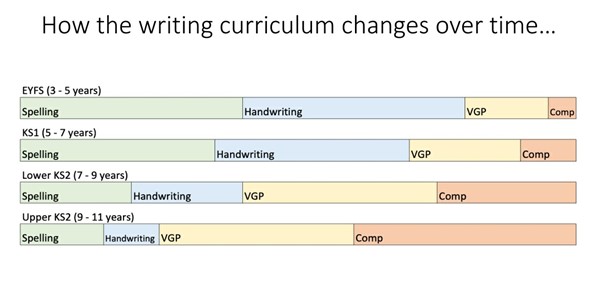
Andy Percival, deputy headteacher at Stanley Road Primary in Oldham, has developed a sentence knowledge curriculum, adapted from Step Academy Trust and available on completemaths.com. See here for the structured activities that help children internalise these structures. Andy has described how the emphasis on the different strands integral to learning to write might change from the Early Years Foundation Stage to year 6. VGP stands for vocabulary, grammar and punctuation and is where much of the sentence knowledge curriculum is taught. Comp stands for comprehension.

This writing curriculum is complemented by a reading curriculum that exposes children to high quality models of children’s literature and opportunities for oral development. Rather than expect children to write at length in ks1, composition opportunities could include the oral retelling of stories, possibly using story maps to scaffold memory of the plot (as in a Talk for Writing approach).

Another strategy for scaffolding sentence development  – the of Slow Writing – is described here by David Didau, this time in a secondary school context. David write that not only does this make students better at writing, it makes them better at thinking.

I rest my case.


[2] I’m not saying it always achieves this, but that is its aim.

[3] Some caution is need here. Anthropologists have demonstrated that abstraction and analysis is not the sole preserve of western literate societies. There is, for example, scientific thinking and non-scientific thinking within all societies.  However, the invention of writing not only enabled cross cultural and cross generation sharing of ideas, but also strengthened the belief that striving after the truth was an ethical endeavour

[4] Gunter Kress, Language of Writing, Routledge, 1993

[5] This phrase comes from Zaretta Hammond.   Thanks to Sonia Thompson for introducing me to it.

[6] Indeed, handwriting itself is a multicomponent process involving four different strands.

Understanding oracy, understanding writing.

The Handwriting Revolution

There is a reason some children dislike writing. Communicating through writing is a hugely complex, composite task that requires competence in each of the underlying component skills to do well. It is the most complex thing we ask children to do. Yet too often, children are expected to work on complex tasks before they have the necessary skills. While some children are fine with this and find the act of communicating motivating enough to put their fledgling skills into practice, for others it can result in frustration and demotivation.  

Joan Sedita’s Writing Rope describes 5 component strands that each need attention when learning to write.  One of these strands is transcription and that strand is composed by two further strands: spelling and handwriting/keyboarding. Handwriting is not something many teachers know a lot about. It’s a bit of a Cinderella area of the curriculum, both in terms of time allocated and teacher expertise.  Yet children in primary school spend a large amount of time with a writing implement in hand. So my hunch is this is a massively important area of learning that needs a revolution in teacher CPD.  And it so happens that Ofsted have just published a research review that argues that transcription in general and handwriting in particular needs much more attention if we are going to enable all children to be successful at writing.

This blog is my contribution to this revolution. Teachers deserve to be evidence-informed about what is most likely to work in this area of teaching. In order to understand what the evidence says, this blog in based on an interview I did with Margaret Williamson who is an absolute fount of knowledge of all things handwriting related. Margaret works for Kinetic Letters, a company that provides CPD for teachers and a teaching programme on handwriting. However, this is not intended as a puff piece for that particular product. It’s about helping teachers understand what handwriting entails and what to do so that children find it easy and it isn’t a barrier to learning. The rest of the blog is therefore written in question-and-answer format. Margaret and I did  this interview before Christmas – so long before the publication of the Ofsted research review – but it has taken us a while to whittle it down from the 80  pages of transcript into blog form!

CS: So, my first question is why is teaching handwriting important? The curriculum is really crammed and everyone’s fighting for their little piece. Probably handwriting is quite marginalised in many schools but here comes Margaret saying it needs to be brought out of the shadows and given a proper emphasis. Why does it deserve quality curriculum time?

MW: Handwriting is the fundamental foundation for writing success. Pupils need automaticity in handwriting so that when they are required to write, their brain is free to concentrate on what they’re wanting to say rather than being distracted by physical discomfort, or issues with producing the letters. It deserves quality curriculum time, since in order to master this complex interaction of cognitive and motor skills, pupils need careful, systematic teaching of the skills involved, and the time to practise them. In addition to promoting automaticity, psychological research confirms that handwriting actually develops connectivity patterns in the brain, producing optimal conditions for learning. And the physical dexterity acquired through handwriting helps pupils with handling tools and typing.

When pupils master the physical and written elements of handwriting, resulting in legible script, it not only benefits spelling development but also gives writing a genuine purpose. Their friends and teachers are able to read their thoughts and ideas which otherwise may have remained unexpressed or not acknowledged. Automaticity in letter production, combined with a strong, stable writing position and comfortable pencil hold, enable the speed and stamina to convey all their thoughts within the time allotted to the task. Teachers can then praise progress, assess their understanding, and plan next steps for their learning. All these factors boost the pupil’s self-esteem, encouraging further engagement and expression because they know that their ideas are important and valued.

In sharp contrast are those pupils who despite being able to express themselves well orally, when asked to write, their engagement and enthusiasm drops. For others, underlying anxieties may come into play- that they’re not going to be successful, or that writing makes their hand ache, or that it’s a pointless activity as no-one can read it. This may prompt them to start misbehaving, or simply try to avoid the situation.

CS: And do you think that is all down to handwriting or partly down to handwriting?


MW: I think handwriting is a huge factor. If pupils are engaged during verbal discussion, but enthusiasm dwindles when you ask them to write, then handwriting is going to be a significant player. Of course, there are other factors – are they finding it easy to spell the words, or construct sentences? However, these elements become moot if you can’t actually get your ideas down on paper. So I would say that handwriting is the foundation of writing, that then enables those other very important skills to begin to flow.


CS: I think that some people would agree with the diagnosis of the problem but have a different solution and say that therefore we should just do much more orally. I don’t agree with that myself.  Part of it is just practical. If it’s written down, the teacher can see what you’re thinking, but they can’t hear simultaneously what 30 people are saying, it’s just not feasible. It’s the difference between talk which is a synchronous communication mechanism, and writing which is asynchronous. The transient nature of speaking provides all sort of logistical challenges in the classroom. Whereas writing allows thought to be made permanent, or at least semi-permanent, which means more people can have access to your thoughts – your peers as well as your teachers. Which isn’t an argument against also developing and valuing oracy, but it can’t replace communicating through writing.

MW: Exactly, and of course there are some pupils for whom writing could become the easier way to communicate. Children who are slower at processing for example can find that by the time they are ready to say something, either somebody else has already done so, or the conversation has moved on. Others lack the confidence to speak out loud but writing gives them the way to rehearse and refine their ideas.

CS: Because writing is a tool for thinking extended thoughts.

MW: The ability to write helps you engage with education, develop as a person, and improve confidence in your own thoughts and arguments. Handwriting is communication- if it’s legible, others can read your ideas. If you can read your own writing, then you are able to edit and polish your work, expand, rephrase, and make your communication clearer.

CS: So what does learning to handwrite actually entail? I think teachers tend to think it’s learning a letter formation scheme. But it’s way more than that, isn’t it?

MW: That’s right, because it requires both motor and cognitive skills. The motor skills require postural strength in order to maintain an effective writing position; to sit still enough to concentrate and hold the pencil comfortably whilst controlling tiny movements accurately and at speed. The cognitive involves learning correct and consistent letter formation through systematic teaching, with sufficient time to practise and build automaticity. However, it also involves learning how to space letters properly. Incorrect spacing within and between words, or sentences that sprawl haphazardly over numerous lines, makes writing hard to scan or edit.

CS: This corresponds with what we know about saccades – the jumps that our eyes make when we read. Our eyes don’t move smoothly along text but make sudden jumps then fixate on a few characters then jump again. The spaces between words help us navigate those jumps. If they are the wrong size, or within words, then we make the wrong size of jump which is why incorrectly spaced writing is less legible.

MW: Spacing also helps the speed and flow of writing, and eventually joining. When letters are correctly spaced, it is easier to extend the finish into the next one without creating big loops in between, making it easier to read. This is also really important because another misconception in writing is that when you join letters, you join every single one.

CS: Yes- I was listening to handwriting expert Steve Graham a few weeks ago and he was saying that

exclusively cursive writing is not faster than non-cursive (manuscript). In fact, the fastest writing was a mixture of some joined letters, some not. Which is not what I have always been told – but apparently the idea that cursive is faster is a myth. Adults write faster than children because they’ve had more practice. Coincidentally they tend to use cursive but it’s the practice and not the cursive that’s behind the speed.

I don’t work in England anymore, so joining is not a problem here in Guernsey but in England cursive is in the National Curriculum. It’s in the assessment criteria. So there’s a real push to do it. Do you think that’s counterproductive?

MW: I think it’s completely counterproductive until the foundations of the formation, heights and spacing of letters are automatic. Once they are, and pupils are writing faster, they will often intuitively start to leave the pen on the page between letters, which of course is all joining actually is. At this stage other joins are simple and quick to teach, building systematically and progressively, rather than pupils thinking they have to learn a whole new way of writing.

CS: So, what should be going on in Reception for handwriting?

MW: It’s important to create enabling environments to build physical and cognitive foundations for writing. Modern life is becoming increasingly sedentary and so pupils need to build the postural strength and stability to be able to sit still and control writing implements. Hand and finger strength is dependent upon postural strength; it enables manipulation and dexterity of the fingers, and this again needs targeted provision to systematically develop children’s control. Manipulation of different sizes and resistances of tools and materials, increasing the complexity of their use, builds this organically.

CS: It’s like the STEP approach in PE, where you change the space, task, equipment, or people to increase or decrease challenge. So it’s not just saying ‘Oh yeah, they’re doing that for gross motor or fine motor’. In the same way that the profession over the last few years has really thought about the granular detail of the knowledge that a child might need to know in geography or whatever, it is fundamental to know the granular detail of what physical progression for handwriting looks like.

MW: Yes, exactly. The progression is essential. One of the biggest questions I always get asked by teachers of older pupils is, ‘how can we break the bad habits they’ve acquired in handwriting?’ Well, the answer is not to inadvertently encourage the bad habits in the first place, by rushing to provide writing activities for which they don’t yet have the skills!  It’s counterproductive, and it tends to be an adult desire, rather than the child’s. However, children love making marks, and there are many ways to provide for this, for example simply using hands or huge brushes rather than writing tools that require a tripod grip, before they have the physical skills and have been explicitly taught how to do that. Then, when tools become appropriate, they should be slim to suit small hands, and long enough to be supported across the hand. Also, there should be limits to how long pupils use them for until they have built the stamina to maintain the tripod grip. The initial scaling down of letters from whole body movements, can be achieved by writing with their fingers in shaving foam, or shallow sand trays. If we think in terms of cognitive load, with this approach they’re able to focus on the formation, grounding, and heights of the letters, before having to also control the writing tool.

CS: I can envisage some people thinking this is dumbing things down- if we say we are not going to have a writing table too early and not to trace over letters, but it’s not. You can’t microwave children to develop physically quicker than they’re going to. I mean, you can help by providing environments and contexts that are very focused on specific strengthening of certain areas of the body. But thinking about handwriting in this way means that everything becomes purposeful. Adults trained in this method actually develop children who learn to write very quickly.

MW: Precisely. In my experience, when all this is taught systematically in line with their development, children are beginning to put letters into words, and even words into simple sentences, by the end of the first term of Reception.  So in fact you’re actually going to prompt significantly faster progression.

CS: Writing is always the aspect of the Early Learning Goals where more children struggle. Because results are lower, the temptation is to push children to try and write with a pencil. But it doesn’t work like that. Yes, we want them to do it, but there are some prerequisites, the developmental steps that just have to be there.

MW: Yes, and of course Reception is in fact a very long period of time in a child’s development. I believe that we should break the year down into smaller units with regards to handwriting expectations. In the autumn term, teachers provide very firm foundations in all of the aspects mentioned previously: gross and fine motor skills, and learning letter formation through movement of varying scales, first without tools and then with them. During the spring term, most can maintain a tripod grip to write correctly formed letters, and combine them into words and simple sentences which they can read themselves. Thus, by the summer term, handwriting automaticity is developing well. Writing speed and stamina can then be the focus in Year 1.

CS: What about phonics and handwriting?

MW: There is a helpful quote from the DfE Reading Framework which states that, ‘Some practices may confuse children, make it more difficult than necessary for them to learn or discourage them. Such as when the teacher asks children to write independently before they have the necessary skills.’So we don’t want them writing in a phonics session until they have the necessary skills. Throughout this blog we’ve been talking about the importance of pupils acquiring these systematically: the physical skill of positioning their bodies for holding the pencil, knowledge of how the letters are formed, placement of the letters correctly together in a word, and the understanding of comparative heights to avoid confusion when they try to read their work.

Early in the first term the cognitive load is more manageable if handwriting and phonics are taught and practised separately. After a few weeks, once pupils are writing letters that they themselves recognise as being the same as those they see the teacher writing, they will be able to benefit from writing in the phonics session. And equally of benefit, they will be able to use both handwriting and phonics skills in writing in the wider curriculum.

CS: My last question is what about learning to type on a keyboard? I’d argue that instead of obsessing about learning cursive we should teach children typing in key stage 2. Do you agree?

MW: I do, we need to teach typing, but in addition to handwriting, not as a replacement. Most children can master automaticity before they can master touch-typing. And there are practical problems with typing such as where do you buy a keyboard that fits a young child’s hand size.

Also due to research, we now understand more about the benefits of each. Studies using MRI scans or EEF recordings show how when writing by hand, the brain connectivity patterns are beneficial for general learning. Other studies indicate that children write faster and with more ideas, and students make more effective notes when writing by hand rather than typing. It benefits memory, recall and creativity when you’re handwriting a stream of consciousness that isn’t interrupted as it might be when typing, where the temptation is to keep pausing to edit individual sentences.

So it is clear that because in this digital age we have more choices for how to produce writing for different purposes, it is essential to equip our pupils with the skills to access both- by teaching automaticity in both typing and handwriting.

The Handwriting Revolution

 Don’t mix the six! Thinking about assessment as six different tools with six different jobs.


With the very best of intentions, assessment has gone rogue.

It’s hard to imagine now, but when I started teaching in the late 80s, we didn’t really do assessment. We didn’t do much by way of marking, there were no SATS, no data drops and GCSE results didn’t get turned into league tables.  A few years later I remember being incredibly excited by the idea that school improvement should be based on actual data about what was and wasn’t going well, as opposed to an unswerving belief in triple mounting as the benchmark of best practice. That seemed such a modern, progressive idea that would really help schools focus on the right kind of things.  Around about the same time came ideas about the power of assessing for learning.  Now we would actually know, rather than just assert, what really was effective practice.  Henceforth we would teach children what they really needed to learn. A bright new future beckoned. I was an enthusiast.

The ‘father’ of sociology Max Weber talks about routinisation. All charismatic movements have to change in order to ensure their long-term survival. But in changing they must give up their definitive, charismatic qualities. Instead of exciting possibilities we get routines, policies and KPIs as the charisma is, of necessity, institutionalised.

Exciting ideas are all very well, but of course they need, to use a ghastly word ‘operationalising.’ But what happens over time is that the originally revolutionary impulse becomes so well established in systems and routines that they become more important than the original idea. Powerful ideas arise to address specific problems. Once routinised, the specific problem can get forgotten. Instead, we get unthinking adherence to a set of practises, divorced from reflection on whether or not those practises actually serve the purposes they were set up to address.

One of the things that has gone wrong with assessment is that it has morphed into a single magical big ‘thing’ that schools must do rather than a repertoire of different practices thoughtfully employed in different circumstances. The performance of assessment rituals is perceived as creating the reality of educational ‘righteousness’ – by doing certain things, like data drops and targets and marking and so on and so forth, a school becomes good, or at the very least avoids being bad. Not having some big system comes unthinkable.

But assessment is not one thing. It is not a ritual to be performed. Assessment is a tool, or rather set of tools, not an end in itself. Assessment is the process of doing something in order to find something out and then doing something as a result of having that new information. Because there are lots of different things we might want to find out, and lots of different ways we might seek to find that information, assessment cannot be one thing. The term assessment covers a range of different tools, all with different purposes. Whenever we are tempted to assess something, we should ask ourselves what is it we are trying to find out and what will be done differently as a result of having this information? If we can’t answer those two questions, we are on a hiding to nothing.

So what are these different purposes? The familiar language of formative and summative assessment – or more correctly – formative and summative inferences drawn from assessments is a helpful starting point. Formative assessment helps guide further learning; summative assessment evaluates learning at the end of a period of study by comparing it against a standard or benchmark.

But if we are to remind ourselves about the actual reasons why we might want to assess something, I think we need to expand beyond these two categories. I’ve come up with six, three that are different kinds of formative assessment and three that our summative.  By being clear about the purpose of each different type and not mixing them up we can get assessment back to being a powerful set of tools, that can be used thoughtfully where and when appropriate.

Formative assessment includes:

Diagnostic assessment which provides teachers with information which enables them to diagnose individual learning needs and plan how to help pupils make further progress.  Diagnostic assessment is mainly for teachers rather than pupils. If a pupil does not know enough about a topic, then they do not need feedback, they need more teaching.  Feedback is for the teacher so they can adapt their plans.  Trying to teach a child who does not know how to do something by giving the kind of feedback that involves writing a mini essay on their work is not only incredibly time consuming for the teacher, it is also highly unlikely to be effective. Further live teaching that addresses problem areas in subsequent lessons is going to do much more to address a learning issue than performative marking rituals.

Diagnostic assessment involves checking for understanding:

  • In the moment, during lessons, so that teachers can flex their teaching on the spot to clarify and address misconceptions.
  • After lessons, through looking at pupils’ work, in order to plan subsequent lessons to meet pupil needs.
  • At the end of units of work, in order to evaluate how successful the teaching of a particular topic has been and what might need to be improved the next time this unit is taught. An end of unit assessment of some sort is one possible way of doing this. Another might be looking through children’s books or using a pupil book study approach.
  • In the longer term, in order to check what pupils have retained over time, so that we can provide opportunities for revisiting and consolidating learning that has been forgotten.

Diagnostic assessment should not be conflated with motivational assessment or pupil self-assessment. A lot of the problems with assessment have arisen because the various kinds of formative assessment have been lumped together into one thing alongside a huge emphasis on evidencing that they have taken place.  This has led to an obsession with teachers physically leaving an evidence trail by putting their ‘mark’ on pupils’ work – in rather the same way that cats mark out their territory through leaving their scent on various trees.

Diagnostic assessment is assessment for teaching. The next two forms of formative assessment are assessment for learning.  Assessment for teaching is probably the most powerful of all forms of assessment and yet has been overlooked in favour of afl approaches selected mainly for their visibility.

Motivational assessment provides pupils (or their parents/carers) with information about what they have done well and what they can do to improve future learning. For motivational assessment to be effective in improving future learning, it must tell the pupil something that is within their power to do something about. Telling a child to ‘include more detail’ when they do not know more detail is demotivating and counterproductive. To use the familiar example from Dylan Wiliam, there is no point in telling a child to ‘be more systematic in their scientific enquires’ because if they knew how to be systematic, they would have done it in the first place.

Only where the gap between actual and desired performance is small enough for the pupil to address it with no more than a small nudge, can feedback be motivating.  On the other hand, feedback about effort, attendance, behaviour or homework could provide information that may have the potential to motivate pupils to make different choices.[1]

Pupil self-assessment: Pupil agency, resilience and independence can be built by teaching subject-specific metacognitive self-assessment strategies.  Teaching pupils about the power of retrieval practice and how they can use this to enhance their learning is a very powerful strategy and should form a central plank of each pupil’s self-assessment repertoire. Retrieval practice is not one thing. There are a range of ways of doing it. Younger pupils benefit from a degree of guided recall, whereas as children get older, more emphasis on free recall is more likely to be effective.

 Pupils should also be taught strategies for checking their own work – for example monitoring writing for transcription errors, reading written work aloud to check for sense and clarity, using inverse operations in maths to check for answers, monitoring one’s comprehension when reading and then rereading sections when one notices that what you’ve read does not make sense.  Pupils need be given time to use these tools routinely to check and improve their work.

Summative assessment includes:

Assessment for certification.  This includes exams and qualifications. Some of these – a grade 5 music exam for example, state that a certain level of performance has been achieved. Others, such as A levels and to an extent GCSEs, are rationing mechanisms to determine access to finite resources in a relatively fair way. Unfortunately, some of these assessments have been used evaluatively.  This is not what these qualifications are designed for and all sorts of unhelpful and unintended consequences fall out of using qualifications as indicators of school quality. In particular, it distorts the profession’s understanding of what assessment looks like and leads to the proliferation of GCSE-like wannbe assessments used throughout secondary schools.

Evaluative assessment enables schools to set targets and benchmark their performance against a wider cohort. Evaluative assessment can also feed into system-wide data allowing MATs, Local Authorities and the DfE to monitor and evaluate the performance of the schools’ system at an individual school and whole system level.

It is perfectly reasonable for large systems to seek to gather information about performance, as long as this is done in statistically literate ways. This generally means using standardised assessments and being aware of their inherent limitations. Just because we want to be able to ‘measure’ something, doesn’t mean it is actually possible. (Indeed, I have a lifelong commitment to eradicate the word ‘measure’ from the assessment lexicon.) Standardised assessments have a degree of error (as do all assessments – though standardised assessments at least have the advantage of knowing the likely range of this error). As a result, the inferences we are able to make from them are more reliable when talking about attainment than progress because progress scores involve the double whammy of two unreliable numbers.[2] They are also far more reliable at a cohort level than for making inferences about individuals since over and under performance by individuals will balance each other out when considering the performance of a cohort as a whole.

Since standardised assessments do not exist for many subjects, it is not possible to evaluate performance for say geography in the same way it is possible as it is for maths. Non standardised assessments that a school devises might give the school useful information – for example they could tell the school how successfully their curriculum has been learnt, but they don’t allow for reliable inferences about performance in geography beyond that school.

Given these limitations – the unreliability at individual pupil level, the unreliability inherent in evaluating progress and the unavailability of standardised assessments in most subjects, schools should think very carefully about any system for tracking pupil attainment or progress. By all means have electronic data warehouses of attainment information but be very aware of what the information within can and can’t tell you. I’d recommend reading  Dataproof Your School to make sure you are fully aware of the perils and pitfalls involved in seeking to make inferences from data.

What is more, summative assessment in reading is notoriously challenging since reading comprehension tests suffer from construct-irrelevant variance. In other words, they assess things other than reading comprehension such as vocabulary and background knowledge. More reliable inferences could be made were there standardised assessments of reading fluency. However, the one contender to date that could do this – the DIBELS assessment – explicitly rules out its use to evaluate performance of institutions.

Evaluative assessment is just one type of assessment with a limited, narrow purpose. It should not become the predominant form of assessment.

Informative assessment enables schools to report information about performance relative to other pupils to parents/carers, as well as information to help older pupils make choices about the examination courses, qualifications and careers.  This is the most challenging aspect to get right when seeking to develop an assessment system that avoids the problems of previous practice. Often, schools use the same system that is used for evaluative assessment for accountability purposes. But evaluative assessment is most reliable when talking about large groups of pupils, not individuals, so  where schools share standardised scores, they need to caveat this with an explanation about the limits of accuracy.

Let’s ask ourselves, what it is that parents what to find out about their child?

Most parents what to know

  • Is my child happy?
  • Is my child trying hard?
  • How good are they compared to what you would expect for a child of this age?
  • What can I do to help them?

However, parents do not necessarily want to have the answer to all of these questions in all subjects all of the time.

The first question is obviously important and schools will have a variety of ways of finding this out. It is probably most pressing when a child starts at a school. For example, it would be an odd secondary school that didn’t seek to find out if their new year 7s had settled in well at some point during the autumn term.

The second question involves motivational assessment.  Schools sometimes have systems of effort grades. These can work well where the school has worked hard with staff to agree narrative descriptors of what good effort actually involves and what it means to improve effort. For example, as well as attendance and punctuality, this could include the extent to which pupils

  • Monitor their own learning for understanding and ask for help when unsure or stuck
  • Contribute to paired or group tasks
  • Show curiosity
  • The attitude to homework
  • Work independently

Thus they create a metalanguage that allows a shared understanding of what it means for a child to work effortfully. This can then be shared with pupils and parents.  This metalanguage is portable between subjects. To a large degree, to work effortfully in Spanish involves the same behaviours as working effortfully in art. The metalanguage provides a short cut to describe what those behaviours are and where necessary how they could be further built upon. If there is a disparity between subjects, it allows for meaningful conversation about what is it specifically that the child isn’t doing in a particular subject that they could address.

If this work developing a shared understanding work does not take place and individual teachers are just asked to rate a child on a 4-point scale, then inevitably some teachers will grade children more harshly than others. I am sure I am not the only parent who has interrogated their child as to why their effort is only 3 in geography, yet it is 4 in everything else? When maybe the geography teacher reserves 4 for truly exceptional behaviour whereas the others score 4 for generally fine?

But it’s the third question that is really challenging. Schools sometimes avoid this altogether and talk about effort and what wonderful progress a child had made which is all well and good but can go horribly wrong if no one has ever had an honest conversation with parents about how their child’s performance compares with what is typical. It shouldn’t come as a surprise to parents if their child gets 2s and 3s at GCSEs for example. This might represent significant achievement and brilliant progress but parents should be aware that relatively speaking their child is finding learning in this subject more challenging than many of their peers.

However many schools often go to the other extreme and give parents all sorts of numerical information that purports to report with impressive accuracy how their child is doing. The problem being this accuracy is not only entirely spurious but rests on teachers spending valuable curriculum time on assessment activities and then even more valuable leisure time marking these assessments. And why? Just so that parents can be served up some sort of grade or level at regular intervals.

Grades or levels are important for qualifications because they represent a shared metalanguage, a shared currency that opens – or closes – doors to further study or jobs. Pandemics aside, considerable statistical modelling goes into to making sure grades have at least some sort of consistency between years. Schools however do not need to try to generate assessments that can then be translated into some kind of metalanguage that is translatable across subjects.  The earlier example of effort worked because effort is portable and comparable. It is possible to describe the effort a child habitually makes in Spanish and in DT and be talking about the same observable behaviours. This is not the same for attainment. There isn’t some generic, context-free thing called standards of attainment that can be applied from subject to subject.  We can measure length in a variety of different contexts because we have an absolute measure of a metre against which all other meters can be compared. There isn’t an absolute standard grade 4 in a vault at Ofqual. Indeed, some subjects, such as maths, assess in terms of difficulty whereas others, such as English, assess in terms of quality. Even within the same subject it is not straightforward to compare standards in one topic with another. Attainment in athletics might not bear any relating to attainment in swimming or dance for example, let alone meaning the same sort of standard of attainment in physics.  So even if it were desirable for schools to communicate attainment to parents via a metalanguage, it wouldn’t actually communicate anything of any worth.

 Yet in many schools the feeling persists that unless there is a conditionally formatted spreadsheet somewhere, learning cannot be said to have taken place. Learning is not real until it has been codifed and logged.  But schools are not grade farms that exist to grow crops of assessment data.  What we teach children is inherently meaningful and does not acquire worth or value through being assessed and labelled, let alone assessed and labelled in a self-deceiving, spurious way.

But if we do not have a metalanguage of some sort, how can we communicate to parents how well their child is doing?

First of all, the idea that telling parents that their child is working at ‘developing plus’, at a grade 3 or whatever other language we use is helpful because it uses a shared language is fanciful. The vast majority of parents will have not idea whether a grade 3 or developing plus or whatever is any good.  Even if they do, we are very likely misleading parents by purporting to share information with an accuracy that it just can’t have. If we tell parents that their child is grade 3c in RE but grade 3b in science, does that actually mean their RE is weaker than their science? If in the next science assessment the child gets a 3c, have they actually regressed? Do they really know less they than they did previously? And in any case, is a 3b good, bad or indifferent?

Nor is the use of metalanguage particularly useful for teachers. What helps teachers teach better is knowing the granular detail of what a child can and can’t do. Translating performance into a metalanguage by averaging everything out removes exactly the detail that makes assessment useful. Teachers waste time translating granular assessment information into their school’s metalanguage then meeting with leaders who want to know why such and such a child is flagging as behind. They then having to translate back from the metalanguage into the granular to explain what the problem areas are.  All this just because conditionally formatted spreadsheets give an illusion of rigour and dispassionate analysis.  

While most parents will probably want to know how well their child is doing relative to what might be typical for a child of their age, this does not mean parents want this information for every subject every term. Secondary schools in particular seem to have been sucked into a loop of telling parents every term about attainment in every subject. Not only is this not necessary, it also actively undermines standards in subjects with lesser teaching time. Take music for example. A child might get 1 lesson a week in music and 4 lessons a week in maths. If both music and maths have to summatively assess children at the same frequency, then a disproportionate amount of time that could be used for teaching music will be used instead to assess it.

Instead, school could have a reporting rota system. For example, in a secondary school context it might look something like this:

October year 7: information about how the child is settling.

Effort descriptors for 4 subjects

December year 7: attainment information for English, maths and history

Effort descriptors for 4 other subjects

Music concert

March year 7: attainment information for science, geography and languages

Effort descriptors for 4 other subjects

Art and DT exhibition.

July year 7: attainment information for RE and computing, plus English and maths standardised scores

Effort descriptors for all subjects

with a similar pattern in year 8 and year 9, though with information for all subjects coming earlier in the year for year 9 to inform children making their options.

This reduces workload and allows teaching time to focus on teaching rather than generating assessments to feed a hungry data system.  It does not mean that teaches can’t round off a topic with a final task that brings together various strands that have been taught over a series of lessons if this would enhance learning. It makes this a professional decision. It may be that writing an essay or doing a test or making a product or doing a performance gives form and purpose to a unit of work. And it may be that the teacher then gives feedback about strengths and areas to work on. But the timing of such set pieces should be determined by the inner logic of the curriculum and not shoehorned into a reporting schedule. And they may not be necessary at all. Some subjects by their very nature need to be shared with an audience. Rather than trying to grade performance in art or music or drama, have events that showcase the work of all that parents are invited to. As well as celebrating achievement, this should give parents the opportunity to see a range of work and make their own conclusions about well their child is doing compared to their peers.

There is one metalanguage that could potentially be used to report attainment that is portable between subjects: the language of maths. If we are trying to provide a meaningful answer to the question ‘how good is my child compared to what you would expect for a child of this age?’ then we are taking about making a comparative evaluation. Where they exist, standardised assessments can be used. These allow parents to understand not just how their chid is doing in comparison to their class but in comparison to a national sample.  There is no point in doing this though unless the assessment assesses what you have actually taught them. This sounds obvious but I’ve heard many a conversation with parents about how they got a low mark because lots of the test was on fractions, but we haven’t taught fractions yet!

For those subjects which don’t have standardised assessments and where it makes sense to do so, assessments of what has actually been taught can be marked and given a percentage score or score out of ten. There will be a range of scores with the class or year group. Where the child lies within that range can be communicated by sharing the child’s score, the year group average, and possibly the range of scores. In the same way, standardised scores – which is their raw form may not make much sense to most parents – can be reported in terms of where the child lies on the continuum from well above average to well below average.

Some reading this part may flinch here, especially for children who find learning in a subject more challenging.  Yet if we want to give parents information about how well their child is doing compared to what we might typically expect, we can’t get away from the fact that some children are doing much less well than their peers. What we can do, and should do, is not let this kind of reporting dominate what we understand assessment to be. It has its place, but it is just once tool among a range. Other tools, such as those that  enable responsive teaching, share information about motivation, or that equip students with tools to assess and improve their own learning, are much more likely to actually make a difference.


[1] Some children may face additional barriers that make it much more challenging to make improvements in one or more of these arears. Young children are not responsible for their attendance for example. Some children with SEMH need more than information to help them improve their behaviour.

[2] See Dylan Wiliam p35 in The ResearchED Guide to Assessment

 Don’t mix the six! Thinking about assessment as six different tools with six different jobs.

Cognitive load: a case study

This is a shortened version of the talks I gave at ResearchED Durrington and ResearchED Rugby

When we are taught something, the information our teacher is sharing passes first into our working memory. The working memory is the place where we think.  What many teachers do not realise is that the capacity of the working memory is fixed and limited; as a result, it can only think about a very small number of things at a time.  Once the working memory is full, it can only take on more information by ‘dropping’ something, in the same way that you might be able to juggle with two balls easily enough, but add a third into the mix and everything would go pear shaped. The technical term in cognitive science for ‘going pear shaped’ is cognitive overload. 

Fortunately, there is a work-around. Unlike the teeny-tiny working memory, the long-term memory is vast. I like to think of it a bit like the Room of Requirement in Harry Potter.  The long term memory is the place where things go when we have thought hard about them. The great thing about this is, once something makes it to the long-term memory, we can bring that memory back into the working memory when we want to think about something. We can remember things. With things we have thought about over and over again,  retrieval of memories  can become completely effortless and automatic.  For example, you can read these words with minimal effort because reading for you has become automatic. This means you have cognitive capacity to spare in your working memory to think about what these words are actually saying. You don’t have to use any of you capacity trying to work out what the words say.

This cognitive architecture has implications for teachers. We will need to consider the cognitive load involved in what we are teaching  and be keenly aware of the limited nature of working memory. This means we will need to present information in really small steps. Another implication is that we will need to make sure that students have to think hard about what we want them to remember (rather than thinking hard about something else, like the format of the lesson).  A third implication is that because we want students to remember what we taught them, we will need to give them lots and lots of opportunities to retrieve what we have taught them from their long-term memories, as this will make the memories stronger.

Some things we learn form the building blocks of much of our later thinking so secure recall of these is vital. They must be practised over and over until they are so automatic, it is impossible to forget them. We need these tools to be available to us in our working memory whenever we want them, without any conscious effort. We don’t want to have to remember how to read before we can read anything  or have to resort to counting on our fingers in the middle of our maths GCSE. (For more about how we remember things, see here.)

However, we don’t always bear these implications in mind. For example, we don’t break things down into small enough steps because we are experts in the things were are teaching. Things seem easy to use, precisely because various steps in the learning process have become so automated and unconscious, we don’t even recognise all the different things we are doing at once.  Wiemann called this ‘the curse of knowledge’[1].

I’m going to explore this using a case study approach. I’m going to explore how we learn to tell the time. However, since I am assuming that you probably can already tell the time using a conventional, analogue clock, I am going to teach you using a kind of clock I’m pretty sure most people who read this won’t be familiar with.   Please let me introduce the Fibonacci clock.

fib clock

The Fibonacci clock uses the Fibonacci sequence, rather than the more conventional numbers 1-12.  To work out the Fibonacci sequence, start with 0 and 1, and add them together. Obviously this is equal to 1, which now forms the third number in our sequence of 0,1,1. To get the next number, add the last number in the sequence to number to the one before it. So the next number will be 2. The number after that will be 3, then 5 and so on. If you really want to get into the spirit of things, you might wish to pause and work out the next few numbers in the sequence for yourself.  For ease of reference, I’ve put them here.[2]

However, for the purposes of our clock, we only need to first 5 of these (the first 5 after zero that is, so 1,1,2,3,5). Another property of Fibonacci numbers is that if you draw squares whose sides equal the numbers in the Fibonacci sequence, you can arrange these squares into an ever expanding spiral, known as the golden spiral or the Fibonacci spiral.

fib sprial numbers

For our purposes, we only want to look at the rectangle formed when 1,1,2,3,5 are placed together in this spiral formation. This rectangle will form our clock face.

fib 1 to 5

fib clock numbers

The panels on the face light up different colours and the pattern of colours is what tells us the time. (They are only accurate to 5 minutes.) These are the rules for telling the time on a Fibonacci clock

  • The hours are displayed using red and the minutes using green.
  • To work out the minutes just add up the green squares and multiply by 5

That seems simple enough, so let’s have a go (answers at the end as footnotes)

a)[3]

7 oclcok


b)[4]

6 30 1

That’s not so bad. The hours are quite straightforward. The minutes are a little but more clunk to work out – worth remembering when we expect children to grasp that with the minute hand you also have to count in 5’s.

However, it isn’t quite as straightforward as that. Here is the full set of rules.

  • The hours are displayed using red and the minutes using green.
  • When a square is used to display both the hours and minutes it turns blue.
  • So to work out the hours just add up the red and blue squares.
  • To work out the minutes just add up the green and blue squares and multiply by 5

Ok, let’s try telling the time now

c)[5]

545

d)[6]

6 30 2

e)[7]

6 30 3


There’s more than one way to display the same time on a Fibonacci clock.


f)[8]

925.PNGI’m hoping that you are finding this a bit taxing. There’s a lot to think about and you are a good way off being able to ‘read’ the time in the same way you can read your watch without thinking.

Now let’s contrast the rules for telling the time on a Fibonacci clock with those for telling the time on an analogue clock.

fib rules

There are actually more complicated rules for the analogue clock. Yet we expect children to pick this up with a couple of three week block in year 2 and year 4, and then wonder why so many of them can’t tell the time! Because there are 4 different rules that all need orchestrating simultaneously, the cognitive load is too high for many children, so learning fails. The ones that get it probably had already had a fair bit of practice at home, so some of the rules were already automated and didn’t need to be consciously worked through. This meant these pupils had more space left in their working memories to think about those rules that were new to them. So, extrapolating from telling the time, we should consider that whenever children struggle with something, it is worth asking ourselves if we have overwhelmed their working memory by underestimating how complex something is? More often than not, the answer will be yes.

If we really did teach the time using a Fibonacci clock, what would be an effective way to do it? We’d break it down into small steps, one rule at a time, practising that lots and lots, before introducing the next rule. So we would start off just telling the time in hours, using red only. if we did this lots and lots, the children would start to benefit from what is known as the ‘chunking effect.’ If we gave children plenty of time to practise each component aspect separately, this step would become stored in the long term memory as a ‘chunk’.

Have you ever tried to carry a large bundle of washing upstairs.  First of all, you drop a sock. When you pick this up you then drop some pants. Precariously balancing your pants on top of the pile causes yet more socks to cascade to the floor. Then consider the same load, packed into 5 carrier bags. You easily manage to climb the stairs without depositing underwear on the landing or hosiery in the corridor. A similar thing happens in our brains with chunking. The classic illustration of this effect is to ask someone to try and remember a sequence of letters or numbers. For example, look at this sequence for a few seconds (or even better, have somebody else read you this sequence) then look away and try to recall it.

TCV  QBM  TBI  NTS

Now try this sequence which has exactly the same letters

BBC ITV NQT SMT

British readers should find this much, much easier as the groups now form instantly recognisable chunks (for non-Brits, BBC is obviously the more usual name of the British Broadcasting Company TV channel, ITV is another TV channel, NQT stands for ‘newly qualified teacher’ and SMT stands for ‘senior management team’ – the leadership team in a school.)

Each of these ‘chunks’ of meaning only take up one slot in the working memory, so in the second example we only have to remember 4 things, not 12. We use chunking when we read a clock face. When we read a watch, we don’t count round in 5’s, we automatically ‘read’ the time from the position of the hands. We can even do it when the numbers are missing!

watchface.PNG


In the same way we no longer consciously sound out every letter when we read but can just ‘see’ what a word says, given sufficient practice, children will be able to just’ read’ a clock or watch. So now let’s practise reading our Fibonacci clock sticking just to red for the moment.  You may find you begin to just recognise certain patterns if you do this a few times.

a)[9]

1oc

b)[10]

2oc 1

c)[11]

2oc 2

d)[12]

3oc

e)[13]

4 oc

f)[14]

5oc

g)[15]

5 oc 2

h)[16]

6oc

i)[17]6oc 2

j)[18]

7oc 2

k)[19]

7

l)[20]

8oc

m)[21]

9oc 2

n)[22]

9oc

o)[23]

10oc


p)[24]

10 oc


q)[25]

11 oc


r)[26]

12oc

s)[27]

12 oc 2

When we were able to just read all these red clock faces automatically, we could move on to reading hours using a mixture of red and blue. When that was completely fluent we would concentrate on minutes, first of all just using green and when that was very secure, green and blue minutes. Eventually we would be in a position to put it all together.  This would take a lot of time and a lot of short but frequent practice.

If we translate this into how we teach children to tell the time using an analogue clock, it is little wonder children find it so hard and teachers so frustrating to teach. We don’t break it down enough and don’t do nearly enough practice once we’ve finished teaching the unit on time. In fact, it’s a miracle anyone learns to tell the time at all! If you want to find out about a better way of teaching time, I suggest you look at my blog here, where I advocate teaching using the hour hand only at first, and then subsequently teaching the minute hand separately. When both of these can be read fluently, read two clocks side by side, one showing hours, the other minutes. Finally, after all this practice, you can introduce a standard two hand clock.

As I said earlier, there are some things we learn as in the early years and key stage one that form the building blocks of much of our later thinking. If we want children to have the mental capacity to be independent, critical thinkers, we need to move heaven and earth to make sure as many  as possible of these crucial building blocks become completely automatic so that precious working memory space can be used for more creative thinking. These key skills must be practised over and over until they are so automatic we cannot forget them and don’t need to think about them. Drivers may well remember how difficult it was when first learning to drive to change gear, steer, signal and read the traffic all at the same time.  A year or so later, the process is so automatic, you can arrive at home without even remembering much of your journey. Instead, you’ve been able to think about other, more important things on the way home.

In the same way, our children have an entitlement to be given time and encouragement to commit the basic building blocks of thinking into their long term memories. Primary schools owe it to the children they teach to make sure that as a  bare minimum, all of these are learnt to automaticity.

  • Number bonds
  • Times tables
  • Phonics
  • Handwriting
  • Telling the time
  • Full stops and capital letters.
  • Weeks and months
  • Recognising map of UK and beyond

Yet there is a reluctance to spend time practising basic skills. It is derided as ‘meaningless rote learning.’  Nothing could be farther from the truth.  What is really meaningless is condemning children to a lifetime of having to count on their fingers when we could have set them free from the bondage to counting by making such they knew their number bonds to automaticity. What could hinder problem solving more than not being able to manipulate numbers effortlessly because you were never given the opportunity to learn your tables by heart, because your teacher described that sort of thing as ‘regurgitation’?  What could be less creative than not being able to read fluently because your teaching thought phonics was boring? It is our duty as educators to ensure that we help children move as much information as possible to long-term memory, so that their cognitive load can be utilised on the fun stuff, the clever stuff, the important stuff.


[1] Wiemann, C. (2007) ‘the curse of knowledge’. Or why intuition about teaching often fails’. APS News 16 p.9

[2] 0,1,1,2,3,5,8,13,21,34,55,89…


[3] 7 o’clock

[4] 6:30

[5] 5:45

[6] 6:30

[7] 6:30

[8] 9:25

[9] 1 o’clock

[10] 2 o’clock

[11] 2 o’clock (those annoying duplicates!)

[12] 3 o’clock

[13] 4 o’clock

[14] 5 o’clock

[15] 5 o’clock

[16] 6 o’clock

[17] 6 o’clock

[18] 7 o’clock

[19] 7 o’clock

[20] 8 o’clock

[21] 9 o’clock

[22] 9 o’clock

[23] 10 o’clock

[24] 10 o’clock

[25] 11 o’clock

[26] 12 o’clock

[27] This is also 12 o’clock. I forgot to tell you that rule, in the same way we forget to tell children that 12 is also zero on an analogue clock

Cognitive load: a case study

Oven-ready, Hello Fresh or Just Eat? What’s the beef about pre-planned lessons?

Another weekend, another Twitterstorm. The Policy Exchange have just released a paper arguing for more availability of ‘coherent curriculum programmes’ which include, among other things, lesson plans, text books and lesson resources such as worksheets. Unfortunately the TES reported this as ‘The solution to the workload crisis? Stop teachers designing their own lessons’  which, understandably, has gone down like a bucket of cold sick on Twitter.  The fear being that this augers the triumph of the neo-liberal take-over of education, with lesson plans direct from Pearson delivered straight to the classroom by Amazon drone.  Or, to refer to my possibly obscure title, delivered by motorbike by Just Eat, with the teacher’s role limited to opening the plastic cartons and serving them out; lamb bhuna tonight, whether you want it or not.

Having read the entire article, what the article is actually proposing is something much more reasonable: debatable, but reasonable. The argument goes that the 2014 National Curriculum is not being implemented as well as it possibly could because the appropriate resources and training to implement it well either don’t exist, or if they do exist, are hard to locate among the myriad of online resources. It bemoans the current situation where many teachers trawl through online resources, of possibly dubious quality, late into the night, as they attempt to plan each and every lesson ‘from scratch,’ although in reality, probably ‘from Twinkl.’[1]   This is wrong, the report argues, because the ‘lesson by lesson’ approach is highly unlikely to result in a coherent curriculum that hangs together across the year groups, or that provides sufficient provision for revisiting previous learning. The workload argument is more of a side issue in the report, not its main thrust. Its main thrust is about having a coherent curriculum.

I’m all in favour of coherent curriculum. Indeed, in this blog I argue for curriculum design that has coherence not only within each specific subject, but across subjects.  Yet the type of ‘3D’ curriculum I’m advocating is extremely time consuming to write. We’ve been at it for almost 2 years and it’s not where I want it to be yet. The same situation is being replicated across the country. In my ideal world, the DfE would pay me and my selected Twitter mates to devote ourselves to this task, but since (doubtless due to unintended oversight) the report fails to mention me explicitly by name, it comes up with the suggestion that the Government should have a curriculum fund that brings ‘teachers with curriculum planning ideas together with institutions who can provide quality assurance and wider scale distribution.’p36  The kind of institutions it posits as being in a position to do this are multi-academy trusts, learned societies, subject associations and museums.  What about schools not in MAT’s, I’d argue? As otherwise that means the vast majority of primary schools would be overlooked, and surely some of us have something to offer? And what about the BBC?

So, while I might argue with the detail about who might and might not secure funding to write detailed, coherent curriculum programmes, I think this is an excellent idea. I’d much rather use a curriculum resource written by a bunch of teachers in partnership with, say, a museum than by most educational publishers.  Especially if there existed a range of quality assured, kite marked resources that schools could choose to use, if they wanted to. Many primary schools already use ‘off the peg’ curriculum packages, usually for discrete subjects but occasionally across the curriculum. [2]  What is lacking is the all-important question of quality assurance. At the moment, schools buy in all sorts of ready-made packages for aspects of their curriculum.  With Ofsted signalling its intention to scrutinise the quality of the curriculum (which in a primary school context is shorthand for ‘everything other than English and maths’), primary headteachers are tearing their hair out trying to rustle up a coherent curriculum offer for the foundation subjects while secondary heads fret about ks3. Just off the top of my head, I can think of the following resources that primary schools of my acquaintance use.[3]  Jolly Phonics, Third Space Learning, Cornerstones Curriculum, White Rose, Literacy Shed Plus, International Primary Curriculum, Developing Experts, Jigsaw PHSE, Discovery RE  Val Sabin PE, Rigolo, Discovery Education Coding, ReadWriteInc, Maths Mastery, Charanga.

The thing that strikes me going through this list is that there are lots of different resources out there for maths and phonics and plenty for those really specialist areas of the primary curriculum where many primary teachers are more than willing to ‘fess up to having little to no subject knowledge and welcome explicit handholding; PE, music, computing.  But for geography and history, I know of nothing except for Cornerstones and IPC, which offer many subjects. I think it is fair to say to both parties that the IPC is not quite what the authors of the 2014 National Curriculum quite had in mind. And neither of these curriculum packages have the sort of horizontal, vertical and diagonal links that  I would argue  an excellent curriculum should be striving to build within and across subjects.

However, I really do understand the horror some teachers are expressing on Twitter today about having the planning of lessons taken away from them. The two main objections are that no ‘off the peg’ lesson can ever hope to meet the specific learning needs of the diverse classes we all teach and that planning lessons specifically for one’s children was one of the best bits of teaching, part of what made the job rewarding.

So, finally, let’s get back to the title.  In the report, the author John Blake suggests that coherent curricular programmes could be thought of as ‘oven-ready’ – presumably a sort of educational ready meal that just needs a bit of warming up. He argues that these would be especially useful for teachers new to the profession or new to a particular subject. And to be honest, even those of us who love lesson planning probably don’t mind using ‘ready meals’ for some subjects where they lack subject knowledge. If you told most primary school teachers that they were not allowed to use externally produced resources for computing, MFL or music, for example, and had to plan every lesson entirely from scratch, then there would be tears. (Except for the highly knowledgeable minority, of course, who might not understand what all the fuss was about).

Blake then goes on to talk about ‘the final foot.’  What he means here is how teachers could take an ‘oven ready’ resource and then use their professional expertise to adapt it as necessary for the realities of their class. Much of the groundwork having already been done, the teacher is freed up to tweak the lesson to fit their children.  This is what I meant by the ‘Hello Fresh’ approach. Hello Fresh is one of those companies that delivers boxes of food with all the ingredients you need to make the particular recipes it also provides. Everything is already in exactly the right quantity, all the cook needs to do is chop, peel, and actually cook the ingredients. Unlike a ready meal, this gives you scope either to follow the recipe slavishly, or, for those who feel confident, add or omit ingredients according to your family’s preferences, play about with cooking times (because you know your cooker best, right) or even go completely rogue and use the ingredients in a completely different recipe, maybe adding in other ingredients bought elsewhere and chucking others.

Yet I understand that some teachers will still object and see this as an assault on their professional autonomy and creativity.  When I was a class teacher, I loved lesson planning. So it was with some trepidation that 4 years ago we tried out a particular maths scheme that has very detailed, partially scripted lesson plans. I’m not going to say which one because I’m not specifically arguing for the merits of that particular programme or not, but about the idea of using very detailed plans written by others. (Besides which, many of you will either already know or be able to guess).  Anyway, we got funding with one class. The class teacher was happy to give it a go, though she was already an experienced, skilled teacher.  The reason why she soon loved it was because it wasn’t a ready meal, it was more of a ‘Hello Fresh’ kind of thing.  In fact, you had to tweak the lessons because, as the programme makes quite clear, they are aimed towards the average child and your actual children aren’t average. Some will need more challenge, more depth, others will need more support. So the teacher needed to think about how to adapt every lesson for the particulars of their class. The teacher also needed to decide whether or not to spend more time on a particular lesson, skip over lessons if the class didn’t need them, swap suggested manipulatives for something else, and had the freedom to design their own worksheets or to not use any worksheets at all.

What made this possible was that the programme wasn’t really a set of resources, it was a training programme, of which resources were a part.  Each unit of work included a video explaining key concepts, an overview, links to articles and research, as well as the lesson plans and flipchart slides to go with it. These resources are excellent and go far beyond what any of us in school would have been able to offer. And ours is a school unusually blessed with knowledgeable maths teachers.  There was also some central training and the expectation that the maths leader was regularly coaching teachers new to the programme. Indeed, during the first year, our maths leader, a year 6 teacher, had to teach year 1 maths once a week using the programme, so that she became familiar with it.  Without this training, the resource would not have had half the impact it did.

Now you may argue, if you had to do all that tweaking, what on earth is the point? You might as well have designed the whole thing yourself. Well no, even with the tweaking, lesson planning was much quicker. But why our first teacher really loved it, and why the subsequent teachers to use it also love it, is because it is so clever.  The progression and the way it comes back to topics again and again, the way it builds in reasoning at every step, the way it moves children away from reliance on counting and towards reasoning based on known facts is excellent. We might rate ourselves as excellent maths teachers who can plan fantastic lessons, but we simply do not have the expertise or time to develop a scheme of such quality. What really struck me doing lesson observations one week was how brilliantly progression is planned into the scheme. I saw addition lessons in year 1, 3 and 4 and in each lesson exactly the same structure was used, but with increasing complexity. Given its obvious superiority to anything we could produce, it would be foolish and arrogant to insist that we had the ‘freedom’ to plan our own lessons, just because we liked it. Nor do teachers feel reduced to mere delivery bots. I really feared they might, but that just didn’t happen. Because the lessons made sense. And where, very occasionally, a lesson didn’t seem to work, they had the freedom to teach it again, their way.

That’s not to say we don’t occasionally do things differently. For example, I think this way of teaching telling the time is better, so we don’t use all of their resources for that – just some. And we are encouraged to comment on lessons and suggest improvements which are listened to. Because the resource is online, rather than a textbook, when they adapt the programme, we don’t have to throw out costly resources. Were there to be similar quality programmes in other areas of the curriculum, I would buy them like a shot.

However, I also really understand that many teaches love the creativity that planning affords and would be loath to relinquish it.  On the other hand, just because you love doing something, doesn’t mean everybody does. As Michael Fordham says:

michael f

Instead, as an alternative to moving into leadership, more experienced teachers should have the option to move into curriculum design themselves. This is what happens in Singapore, where experienced teachers have options to move into senior specialist roles that work on areas such as curriculum design, testing, educational research or educational psychology.

With talk here of sabbaticals for teachers, maybe one sabbatical opportunity could be to work within a curriculum development team, producing resources for others to use?


[1] The report doesn’t mention Twinkl, that’s me, being facetious.

[2] I can only comment in detail on primary schools. Maybe it’s different in secondary schools where teachers are subject specialists?  But from talking to many secondary teachers, I don’t think it is as different as all that.

[3] Inclusion in this list does not mean I think the resource is either good or bad. We use some of these; some I wouldn’t touch with a bargepole.

Oven-ready, Hello Fresh or Just Eat? What’s the beef about pre-planned lessons?

The 3D curriculum that promotes remembering

In my previous blog I explained about how memory works, and how teachers can use strategies from cognitive science such as retrieval practice to promote long term learning. After all, the learned curriculum is the only curriculum that actually counts in the end.

The curriculum is the means by which we ensure that all our children get their fair share of the rich cultural inheritance our world affords.  A good curriculum empowers children with the knowledge they are entitled to: knowledge that will nourish both them and the society of which they are members. Because, as Angela Rayner, Labour shadow education secretary says, knowledge belongs to the many, not the few.

But if children don’t remember what we have taught them, then even the richest curriculum is pointless. Knowledge can’t empower if it is forgotten. So as well as thinking about what is the richest, best material to put into our curriculum, we also have to structure our curriculum in a way that make remembering almost inevitable. This blog relies very heavily on the thinking of Christine Counsell, so much so I did ask her if it was alright to use her ideas about building a memorable curriculum. She was much more concerned that the ideas got ‘out there’ than to claim ownership of them, but much of what follows is a result of her sharing her vision of a memorable, knowledge rich curriculum with me. The actual examples from different year groups come from me, so if you find the specifics lacking, that’s my fault, not hers.

Schools tend to spend a lot of time thinking about how children are going to learn, rather than what. Then when schools start to think about what they want children to learn – when they start to think hard about their curriculum – they overlook planning systematically how they can build their curriculum so that children remember it.

When I first started teaching there was no National Curriculum, or SATS and no Ofsted.  Schools were completely free to teach whatever they liked. Indeed, it was often down to the individual teacher to choose what they wanted to teach. My mother was a primary teacher and her colleague said she didn’t like maths so didn’t teach it. That’s pretty extreme. But it really was more or less up to you. The school I started in was more prescriptive than most – we had maths scheme and a reading scheme which means it was ultra-traditional for its time, but I was still asked what I wanted to teach for my first ‘topic’. Your topic drove the curriculum. The idea was that under the umbrella theme, you tried to find bits of learning from each subject that linked with it. So, for example, I decided for my first topic that I would do ‘the weather’ – actually quite a good topic, as it goes.  So we made rain gauges and wind socks and measured rainfall, wind direction and temperature, we learnt about wind speeds and the Beaufort scale in a geography/science combo.  We made mobiles with the symbols from weather forecasts. (I think that was art but it might have been DT). We wrote stories about storms. We played percussion instruments to make a storm. RE? well Noah’s Ark, obviously. We didn’t do any history that term. Not in a deliberately planned way, but just because it didn’t fit. Well I suppose I could have done the history of umbrellas or something.

This approach hasn’t completely died out either. Not long ago, some poor year 6 teacher on Twitter asked for help in planning what to teach in history that term to fit with her topic. Her topic was roller coasters. A topic chosen not by her but by some senior manager who decided that since going on a roller coaster was fun, learning about them would be too.

Actually planning a topic like this was quite fun and the best teachers were really inventive and taught good stuff. The rationale behind this approach was that by linking stuff together, it would be more interesting and hence more memorable than teaching a series of atomised, unrelated subjects. Strong links between the subjects was its raison d’etre. The problem was that it was just so arbitrary.  It was quite possible for children to do the same topic twice (or even three times) because it was just down to the individual teacher. Whole subjects could be left untaught for term after term after term, just because they didn’t ‘fit’ with the topic, and not because a strategic decision had been made to concentrate on something else. Or, in a desperate attempt to shoehorn a subject into a topic, tenuous links were made. I once joked that my topic that term was ‘tenuous links across the curriculum’. I was chatting to Christine Counsell the other day about this and she told me about a teacher who was doing a topic on colours. Desperate to fit in some history, the teacher plumped for teaching them about the Black Death!

But actually, this emphasis on links wasn’t completely misguided. If we want to build a curriculum that promotes remembering, we will absolutely need to build links in. In fact, we will need to build in those links in a far more systematic and structural way than the ‘topic web’ approach ever imagined. The very bones of our curriculum across the years and across subjects will need to link up in a highly well thought out way, so that knowledge taught in one subject is explicitly reinforced and revisited in a not only in other subjects, but in subsequent years. In this way, key concepts and vocabulary are reinforced because new words and concepts are encountered repeatedly in meaningful contexts. I am calling this way of building a curriculum a 3D curriculum, for reasons which I hope will become obvious.

First of all, vertical links should be deliberated constructed within a subject so that over the years, key ‘high yield’ concepts are encountered again and again. Not only are these concepts practised again and again through retrieval practice while the unit of work is being taught, the curriculum design provides planned opportunities to revisit the concept in subsequent years.

So, for example, let us consider the word ‘tyrant’ and its associates ‘tyranny’ and ‘tyrannical’ in the context of teaching history.

We first meet a ‘tyrant’ in year 1, when our students encounter King John (of Magna Carta fame) and learn that he was (until the barons got him) a tyrant. We don’t meet any tyrants in history again until in year 5 when we encounter Dionysius of Syracuse (the definitive tyrant) where his tyranny is counterpoised with the democracy of Ancient Greek city states.  While its quite a stretch to expect that children will remember the word ‘tyrant’ from 4 years previously, it provides an opportunity to remind students about the Magna Carta and how power is limited in Britain. Then in year 6, we can compare Hitler with Churchill. By now, we also know the adjective ‘tyrannical.’

Alongside this, we need to develop horizontal links between subjects in a year. These are the sort of links we loved back in the old days of topic webs.  In year 3 students learn about rivers in geography and the importance of the river Nile when learning about the history of Ancient Egypt.  In year 4 we learn that Vikings invade England, microbes invade bodies and about invasion games in PE.

Important grammar concepts, such as nominalisation – so important for academic writing – are also addressed when children write a non-chronological report or an explanation about something they have learnt in another subject. For example, children are taught that rather than writing that the Nazi’s invaded Poland we teach it is more effective to write about the invasion. Instead of saying the French were defeated we write about the defeat of the French and later about the opposition and resistance of the French.

Finally, we need to map out the diagonal links. That is to say, links that join concepts across both year groups and across subjects. So when in year 3 children learn in RE the story of the Exodus and encounter the brutality of Pharaoh they are reminded that he is behaving like a tyrant – a term they learnt in history in year 1!  To give another example, the word ‘source’ is the place where a river begins when studying the River Nile in year 3, but is also the person or book that provides information for a news story or for historical research when we discuss primary and secondary sources in later years. In English in year 6, students revisit our beloved word ‘tyranny’ when they encounter the Warden in ‘Holes’ and her tyrannical regime. A later study of the biography of Harriet Tubman affords the opportunity to describe slavery as being a form of tyranny, but of one group of people who ‘rule’ over another.

Each time a concept is encountered within a different context, not only is the concept more likely to be remembered, the understanding of that concept becomes more nuanced.

What is really important is that this revisiting is done in a deliberate, planned way and not as an inconsequential aside along the lines of ‘remember when you learnt about plants’ without explicitly reminding the students exactly what it is about plants that you want them to link with what they are learning now. So for example, explicitly revisiting the different types of plants that grow in different biomes when learning about adaptation. References to previously studied content need to build on or develop previous learning, as well as strengthening students’ ability to remember the terms. None of this should be ad hoc. These links form the bones of the curriculum. That’s why we can talk of the curriculum as the progression model.

I’m not saying building such a curriculum is easy. Primary school teachers are not used to knowing what children have learnt in foundation subjects in previous year groups, let alone which key concepts might provide fruitful opportunities for development. In other words, which key concepts really are ‘key’.  Indeed, in my experience, most primary schools are only just beginning to map out the kind of knowledge they think children should be learning, let alone thinking about the route map of key concepts within and across years and subjects.

Yet imagine the incredible head start our children would have if they arrived at secondary school will a sophisticated understanding, grounded in different contexts of the following concepts that I’ve lifted from our knowledge organisers: I’ve tried to give the word in its nominalised form where possible but obviously we need to make sure they know the other words in the ‘family’ too.

(Primarily from history) Ruler, king, monarch, monarchy, reign, democracy, election, tyranny, dictator, opposition, resistance, rebellion, invasion, conquest, triumph, parliament, government, tribe, emperor, empire, defeat, occupation, exploration, taxation, civilisation, citizen, culture, state, military, conflict, alliance, treaty, coalition, surrender, warrior, poverty, flee, exile, hostility, community, migration, persecution, oppression, liberation, neutral, eye-witness, source, archaeologist, expedition, navigation, exploration

(Primarily from RE) Creation, gratitude, compassion, victim, sacrifice, sacred, holy, pagan, monotheism, polytheism, immortal, salvation, forgiveness, sin, incarnation, reincarnation, prophet, liberation, obedience, commandment, prayer, worship, wisdom, commitment, faith, belief,

(Primarily from geography) Climate, weather, temperature, erosion, fertile, irrigation, meander, crop, trade, settlement, environment, abundance, scarcity, resources, habitat, adaptation, population, predator, prey, immigration

(Primarily for science) Flammable, conductor, insulator, dissolving, soluble, solvent, evaporation, condensation, pitch, volume, circuit, particle, reversible, irreversible, extinct, orbit, reflection, reproduction, sexual, asexual, friction.

This list is self-evidently far too long. We are only at the beginnings of building our 3D curriculum.

I gave a talk partly based on this blog at the conference at Reach Academy last Monday and someone asked me the very sensible question, am I talking about Isabel Beck’s tier two words? In case you haven’t read her work (and you really should, it’s all about vocabulary), Beck divides words into 3 categories; tier 1 are everyday words like table, cup, house; tier 3 words are technical, subject specific words such as photosynthesis or glacier; tier 2 are where we find words that provide a more precise or mature ways of referring to ideas they already know about. For example, knowing the word benevolent as well as kind or fortunate as well as lucky. See here for more. Tier 2 words are the words teachers should really concentrate on, argues Beck, because they lend a sophistication and maturity to communication that many child may not encounter at home and hence need explicit instruction.

While I agree with this, I think the key concepts we need to build a 3D curriculum from a set I’m going to call tier 2.5!  I’m still reflecting on this but I think the key concepts we need are ones that although often grounded in a specific subject domain (so tier 3) are also used in a metaphorical or looser way outside that domain (so tier 2 possibly?) For example, meander has a very specific – in fact tier 3 – usage in geography yet is useful word to use to describe thoughts or route through shopping malls. It’s probably not quite rich enough to from part of the endoskeleton of our curriculum, though ideally all our teachers will know that in year 3, children learn about meanders so that should the occasion occur where meander would be a useful verb, they will explicit reference river bends in their explanation.

Looking at my long list, it seems that the humanities afford more words able to be co-opted for use in other domains, whereas science vocabulary is more likely to be hyper-specific and domain bound. I also note that most of my history words tend to be about power and a fair few geography words about economics. I’m not sure if that’s by lefty bias coming into play or not? But since power and money are such powerful drivers, it is no wonder that words which formally mean one thing in once context – empire, for example – are pressed into service to describe more the commonplace human interactions of the power crazy. English teachers, I presume, would look on that long list of words first encountered in history lessons and be delighted to think that children would come to English lessons already with an understanding, albeit in a very specific context, of the word; an understanding is exploited when authors use words figuratively.  This is much less likely to happen with scientific words such as isotope. There are however still links to be made: coalition/coalesce for example.

Much of the detail of this approach is still tentative. I welcome comments.

The 3D curriculum that promotes remembering

Education and Stockholm Syndrome: the road to recovery

In 1973, 4 bank employees in Stockholm were taken hostage and held by their captors for 6 days. Yet when they were released, not one of them would testify against their captors; on the contrary, they raised money for their defense.

In June of this year, at the Festival of Education, Amanda Spielman released the English educational establishment from its captivity to a narrowly data-driven paradigm of educational excellence. Yet so strongly has this paradigm held us in its grasp for so many years, it is hard to let it go.  More than that, it is difficult to appreciate quite how perniciously this paradigm has permeated into our psyches, so that we find it difficult to detect just how far its corrupting influence distorts what we do. We suffer from a data-induced myopia. There are a myriad of possibilities we cannot ‘see’ because our focus is firmly fixed elsewhere. Our sense of what ‘good’ looks like has been so warped, we flounder when challenged to concentrate ‘on the curriculum and the substance of education, not preparing your pupils to jump through a series of accountability hoops.’ Surely ‘good’ looks like good results? Take away this guiding light and we are all at sea. You mean, my good results aren’t enough anymore? You mean I can have good results and still be bad? Those wicked jailers have taken away our security blanket; no wonder we want it back!

The penny is slowly beginning to drop. Now we don’t know what ‘bad’ looks like. Before, as long as we cleared those hoops, we were ok. If we cleared them in spectacular style, we might even be double ok with a cherry on the top. But unless we did something really horrific like having out of date plasters or the wrong type of fencing, we could be pretty sure we weren’t actually bad, as long as our results held up. Until now.

Of course we’ve always said there’s too narrow a focus on data and there’s more to education than English and maths and what about the arts and personal development and so on and so forth.  But when our jailers not only agree with us but blow up the jail, without this familiar reference point we find it hard to negotiate the landscape.  We keep looking back to where the jail once was to orientate ourselves.

In May, a month before Amanda’s talk, we held a governor away day to think about our ‘vision’. It was a good day. We spent much more time looking at our values than our results and ended up with our vision statement, which at the time I was really please with. It went like this:

Our Vision 

‘Learning to live life in all its fullness’ 

  1. Maintain and improve pupil progress and achievement within a responsibly balanced budget.
  2. Reduce educational inequality through maximising progress for all.
  3. Encouraging personal development in line with the school’s values.
  4. Working in collaboration and not competition with local schools for the good of all our pupils: ‘all pupils are our pupils’.

But now, when I look through it with Spielman-spectacles, is see how prison bound it is.  3) and 4) are ok, it’s 1) and 2) I have the problem with. Let’s look at 1).   (Forget the bit about the budget, that’s just an acknowledgement of the challenge of maintaining provision in the face of a drastically reduced budget)

Maintain and improve pupil progress and achievement.

We all know what this is code for. What it really means is ‘get good Sats results’ in English and maths. Now I’m not saying that Amanda thinks for one moment that getting good results isn’t important, of course it is. But we’ve forgotten that these results are an imperfect proxy for being suitably literate and numerate rather than an end in themselves. This is compounded by 2)

Reduce educational inequality through maximising progress for all

This is code for ‘make sure pupil premium children get good results too.’

Which is a worthy aim, as far as it goes, but it’s all just a bit reductionist.   Amanda’s speech, on the other hand, shared a vision of education ‘broadening minds, enriching communities and advancing civilization.’ Now getting good Sats results will contribute to that to a certain degree; let’s not understate the case. Minds are not going to be broadened very much unless children can read and write well and are confident in their use of maths.  There are many things that might enrich a community and advance civilization, but most of them are greatly helped by agents who are literate and numerate.

It’s the fixation on measuring things (implicit here) that’s the problem. To an outsider, ‘progress’ and ‘achievement’ sound like perfectly good things to aim for. But we all know that progress ain’t progress as the lay person might understand it. It’s Progress™, something quantifiable, something on a spreadsheet, something with the illusion of tangibility.  Our vision statements may be vague and aspiration, but that’s ok because pretty soon they will be translated into smart targets with numbers and everything. But, as the saying goes, measure what you value because you will value what we measure.  Our jailers measured us relentlessly and soon we valued their measurements above all things. We may have denied this with our words but our actions spoke louder.

Of course we want to broaden minds, enrich communities and advance civilisation. That’s a dream job description!  But mark my words, before long someone will invent a ‘broadened mind’ rubric so we can report how many microGoves of Progress™ we have made in the mind broadening business.

Grade Descriptor
9 A superlatively broad mind. Sublime community enrichment. Establishment of heaven on earth.
8 An extremely broad mind. Excellent community enrichment. Rapid advancement of civilisation.
7 An impressively broad mind. Impressive community enrichment. Notable advancement of civilisation.
6 A broad mind. Community enriched. Civilisation advancing.
5 A mainly broad mind with occasional narrowness. Community showing fledgling signs of enrichment. Civilisation inching forwards.
4 Some narrowness with outbreaks of broadening. Community just about managing, civilisation in two minds whether to go forwards of backwards
3 Quite a narrow mind, community a bit impoverished, civilisation retreating slowly
2 A narrow mind, community impoverished, civilisation in retreat
1 A very narrow mind, community very impoverished, civilisation put to rout.

(With thanks to Alex Ford for the inspiration and this great blog, written about those who, like Hiroo Onoda, are behind with the news)

A few people have asking me recently about curriculum development and wanting to know more about our attempts to create a knowledge rich curriculum that builds cultural capital. A question that sometimes comes up is, ‘Why are you doing this? How is it contributing to rising standards?’ ‘Standards’ of course being another code word for ‘great Sats results in English and maths.  As if everything has to be justified – especially major initiatives – in terms of the payback in test results. Cos that’s what the prison guards used to fixate on, so that’s what we find it hard to think beyond.

But surely, I hear you saying, a broad, knowledge-rich curriculum will result in higher standards across the board. Why, I said this myself here.  I argued that because inference depends on broad general knowledge ‘cutting back on foundation subjects to improve reading is a false economy.’   This is true, of course, of improving reading in a qualitative sense. However, while knowledge is essential for the comprehending of reading, the kind of knowledge gaps that thwart children in the Sats Reading Comprehension tend to be about why cats appear well looked after because they have shiny coats – not the sort of stuff you study in history and geography or science for that matter. The idea that curriculum time and financial and human resources might be poured into something that might not make that much impact on our data, on Standards,  is one that is going to take some time for schools to get their head around. It seems reckless, profligate when looked at from a prison perspective.

Although if we dare lift our eyes above the accountability horizon and contemplate the impact of a broad, knowledge-rich curriculum on the longer term achievement of our pupils at secondary school and beyond, we will see that we have given them the intellectual nourishment they need to thrive. We need to think hard about what words like ‘standards’ and ‘achievement’ and ‘progress’ might mean, when liberated from data-jail. Maybe it looks like broadening minds, enriching communities and advancing civilization?

Education and Stockholm Syndrome: the road to recovery

The highs and lows of knowledge organisers: an end of year report

In January, after one term of us using knowledge organisers, I posted this blog about how our experiment with them was going. 6 months later, the academic year over, I thought it might be useful to share my reflections upon what we’ve learnt along the way.  Since January, the importance of schools taking a good, long look at the curriculum they offer has really come to the fore, thanks to those trend setters down at Ofsted Towers. Amanda Spielman’s talk at the Festival of Education underlined what Sean Harford has been talking (and tweeting) about all year – stop obsessing about data (sort of) and the inevitable narrow focus on English and maths that necessitates[1], the curriculum is where it is at these days guys. So there is a lot of waking up and smelling the coffee going on as we begin to realise just how iconoclastic this message really is.  The ramifications are huge and startling. It’s a bit like the emperor with no clothes suddenly berates us for our poor fashion sense. We feel indignant (the data nonsense was Ofsted driven after all), pleased (we always wanted a broader curriculum), terrified (are asking to have their cake and eat it – schools side-lined the rest of the curriculum for a reason and not on a whim – how possible is it to really go for quality in the other subjects when getting good sats /gcse results is still such a monumental struggle?) and woefully ill-prepared.

I’m going to focus on the ‘pleased’ bit. It’s not that I don’t share the indignation and the terror. The indignation we will just have to get over. A broader curriculum will only happen if Ofsted want a broader curriculum – such is the power they wield – so let’s try and move on from the exasperation we feel when the curriculum poachers turn curriculum gamekeepers. As for the terror, let’s keep on letting Amanda and Sean know why we are so scared. I wrote another blog a while back about the triple constraint – the idea (from engineering project management) that the three variables of time, cost and scope (a term which embraces both quality and performance specification) are constrained by one another.  If you wish to increase the scope of a project by wanting quality in a broader range of areas than previously, then that will inevitably either cost you more time or more money. Time in education is relatively inelastic.  We can’t just deliver the ‘project’ later.  We can’t say we will get high standards across all areas of the curriculum by doing our GCSE’s when the ‘children’ are 20 (though this school did try something along those lines. It didn’t end well.)  So that leaves spending more on our project as the only other option. Mmmm, few problems with that.

But I digress. Back to being pleased. I am really pleased. After all, we started on revamping our ‘afternoon’ subjects well before Ofsted started banging on about this. We did so not because of Ofsted but because a) developments from cognitive science make a very strong case for ensuring children are explicitly taught knowledge if they are to become critical thinkers and creative problem solvers and b) children are entitled to a knowledge-rich curriculum.  I have become convinced of the moral duty to provide our children with a curriculum that ensures that they get their fair share of the rich cultural inheritance our nation and our world affords, an inheritance hitherto seen as the birth right of the rich and not the poor.

By sharing our experience so far, I hope I can save other schools some time (that precious commodity) by helping them avoid making the mistakes we did when we rolled out knowledge organisers and multiple choice quizzes last September.

A quick recap about what we did. We focused on what I am going to call ‘the big four’ i.e. the 4 ‘foundation’[2] subjects: history, geography, RE and science.  In July 2016 I shared some knowledge organisers from other schools with the staff – almost all from secondary schools as I could only find one example from a primary school at that point. Staff then attempted to write their own for these 4 subjects for the coming academic year.  It seemed to me at the time that this would be a relatively straight forward thing to do. I was wrong but more of that later. Our afternoon curriculum had been timetables into 3 week blocks, with strict cut offs one the 3 weeks had elapsed. This worked extremely well. It tightened planning – much less faff – much more deciding up front what really mattered, hitting the ground running with specific coverage in mind. It gave an excitement to the learning. Neither the children nor the teacher got bored by a topic that drifted on and on, just because that half term was quite long. It also meant that subjects did not fall off the edge of the school year never taught because people had run out of time. I would highly recommend this way of structuring the delivery of most of the foundation subjects. Obviously it doesn’t work for PE (though a good case can be made for doing it in swimming), MFL or PHSE, which need to be done at least weekly, but that still leaves at least 3 afternoons for the other stuff.

The weekend before each block started, the children took home the knowledge organiser for the new block.  The idea being that they read the KO, with their parents help where necessary. Then on Monday, the teacher started to teach them the content, some of which some of them would have already read about at the weekend. The next weekend, the KO’s went home again, along with a multiple choice quiz based on it, the answers to which were all (in theory) in the KO. These didn’t have to be given in and the scores were not recorded, although in some classes children stuck the KO and each quiz in a homework book.  The same procedure was repeated on the second weekend of the block. Then on the final Friday of each block, a multiple choice quiz was done and marked in class. The teacher took notice of the scores but we didn’t track them on anything. This is something we are changing this September with a very simple excel spreadsheet to record just the final end of unit quiz score.

Since we didn’t have KO’s for computing, art or DT, I suggested that during these curriculum blocks, children should take home the KO from a previous block and revise that and then do a quiz on it at the end of the art (or whatever) block. The ideas being that by retrieving the knowledge at some distance from when it was originally taught, the testing effect would result in better long term recall.  However, as it was a suggestion and I didn’t really explain about the testing effect and teachers are busy and the curriculum over full, it just didn’t happen. From this September, I’ve explicitly specified what needs to be revisited when in our curriculum map. Towards the end of last year, I also gave over some staff meeting and SMT time to studying cognitive psychology and this will continue next term with the revamp of our teaching and learning policy which is being rewritten with the best insights from cognitive science explicitly in mind.

Then, in the dying days of term, in mid July, the children took an end of year quiz in each of the 4 subjects which mixed up questions from all the topics they had studied that year. In the two weeks prior to this, children had revised from a mega KO, in effect a compilation of all previous KO’s and quizzes that year. They had revised this in lessons (particularly helpful at the end of term when normal service in interrupted by special events, hand over meetings and so forth) and at the weekend for homework. It hadn’t really been my intention to do this at the start of the year, but I confess to being a bit spooked by Ofsted reports that had (the lack of) assessment in the foundation subjects down as a key issue, something I wrote about here.  But having done so, I think it is a good idea. For one, it gives the children another chance to revisit stuff they’ve learnt several months previously, so improving the likelihood that they will be able to recall this information in the longer term.  Secondly, it gives these subjects status. We did the tests after our reports were written and parents meetings held. Next year I want to get the end of year scores (just a simple mark out of 10 or 15) on reports and shared with parents.  The results from the end of year tests were interesting. In the main, almost all children did very well. Here are the results, expressed as average class percentages. I’m not going to tell you which year group is which as my teachers might rightly feel a bit perturbed about this, so I’ve mixed up the order here, but it represents year groups 2-6.

History RE Science Geography
86% 93% 85% 84%
79% 85% 91% 82%
83% 95% 87% n/a
75% 75% 67% 74%
70% 76% 66% n/a

One class was still studying their geography block when we took the tests and another did Ancient Egypt as mixed geography/history block, geography coming off somewhat the worse in this partnership, something I may not have noticed without this analysis, and which we are now changing for next year.

From this I notice that we seem to be doing something right in RE and that by contrast, science isn’t as strong.  The tests threw up some common errors; for example, children confusing evaporation and condensation, something we can make sure we work on. Looking at the class with the lowest results, it is striking that the average is depressed by a few children scoring really badly (4 out of 10, 5 out of 15) but these are not the children with SEN but generally children with whom we already have concerns about their attitude to learning.  All the more reason to share these results with their parents.

Even so, the lowest score here is 66%, and that is without doing any recap once the block has finished until the very end of the year, something we will do next year.  I don’t have anything to compare these results with but my gut instinct is that in previous years, children would be hard pressed to remember 2/3’s of what they had learnt that year, let alone remembering 95% of it. As Kirschner and co remind us, if nothing has  been changed in the long term memory, nothing has been learned.[3] Or as Joe Kirby puts it ‘learning is remembering in disguise.’  So next year, I’d like us to aim for average around the 90% mark – mainly achieved by going back over tricky or easily confused content and by keeping a close eye on the usual suspects. Are they actually doing their revision at home?

So, after that lengthy preamble, what are the main pitfalls when using KO’s and MCQ’s for the first time.

  1. Deciding which knowledge makes it onto a KO is hard, particularly in history and sometimes RE. One teacher did a KO on Buddhism that had enough information for a degree! In general, the less you know about something, the harder it is to make judicious choices because you simply do not know what is and isn’t really important. In science it is pretty easy, go to BBC bitesize for the relevant topic and use that. For history you actually have to decide how to cut a vast topic down to size. Who will do this deciding? The class teacher, the subject co-ordinator, the SLT or the head teacher? For what it’s worth I’d start with the class teacher so they own the learning, but make sure that is scrutinised by someone else, someone who understands what is at stake here[4]. Quite a few primary schools have developed KO’s this year, so look at these and adapt from there, rather than starting from scratch. I’m going to put ours on @Mr_P_Hillips one  https://padlet.com/jack_helen12/czfxn9ft6n8o once I’ve removed any copyright infringing images. It’s one thing using these images on something just used in one school, quite another putting these up on the web. There are some up already by other people, so do take a look. I definitely think this hive-mind approach ton developing KO’s at primary level is the way ahead.  We are unlikely to have subject specialists for all the subjects in the curriculum in our individual schools, let alone ones who are up to date with the latest debates about makes for a good curriculum. However, by combining forces across the edu-twittersphere, I’m sure we can learn from each other, refining each other’s early attempts until we get something we know is really good. We’ve revised ours twice this year, once in January after a term of writing ones that were too long and then again in July with the benefit of hindsight
  2. Seems obvious but…if you are using quizzes, make sure the answers are in the KO! Someone – a secondary school teacher I think – tweeted a while back that KO’s are only KO’s if they can help children self-quiz. I think he was alluding to the grid sort of KO that looks like this (here’s an extract)
When did the ancient Greeks live? about 3,000 years ago
When was Greek civilisation was most powerful Between 800 BC and 146 BC.
Ancient Greece was not a single country but was made up of many city states
Some examples of city states are Athens, Spartan and Corinth
City states used to fight each other a lot. But if enemies not from Greece attacked they all joined together to fight back
The first city states started About 800 BC
All Greeks Spoke the same language and worshipped the same gods.
Ancient Greece is sometimes called the ‘cradle of Western civilisation’
Cradle of Western civilisation means The place where European culture all started
The climate in Greece is Warm and dry
In ancient Greece most people earned their living by Farming, fishing and trade
The two most powerful city states were Athens and Sparta


As opposed to the same information presented as continuous prose like this.

The ancient Greeks lived about 3,000 years ago

Greek civilisation was most powerful between 800 BC and 146 BC.

Ancient Greece was not a single country but was made up of many city states such as Athens, Spartan and Corinth; but all Greeks spoke the same language and worshipped the same gods.

City states used to fight each other a lot. But if enemies who were not from Greece attacked, they all joined together to fight back.

Ancient Greece has been called ‘the cradle of Western civilisation’ because writing, art, science, politics, philosophy and architecture in Europe all developed from Greek culture.

Ancient Greece had a warm, dry climate, as Greece does today. Most people lived by farming, fishing and trade

The idea with the grid being that children cover one half and write the answers (or questions) as a way of revising.  I get this for secondary children but it doesn’t seem suitable for primary aged children – especially the younger ones. The grid is just too forbidding to read. And we don’t expect them to write out answers for homework to check themselves. Again for younger children that would turn it into such as chore rather something we have found our children actually like doing.  Maybe we might develop a grid alongside the continuous prose? (I did both for Ancient Greece to see which worked better, but went for the prose version in the end).  Maybe for years 5 and 6 only?

When we audited the KO’s against the quizzes we found that the quizzes sometimes asked questions that weren’t on the KO! We spend a couple of staff meetings putting that right so I think that’s all sorted now, but if you spot any omissions when I finally do post our KO’s and quizzes, do let me know. Keep thinking hive mind.

  1. If you think KO’s are hard to write, wait until you try to write quizzes! The key to a good mcq is that the other answers – the distractors as they are known in the trade, are suitably plausible. Maybe some of our high scores were down to implausible distractors? However a really good distractor can help you spot misconceptions so are really useful formatively.

Polar explores (year 4,  joint history/geography topic)

Question Answer A Answer B Answer C
Which one of these is NOT a continent? North America Europe Russia
Which on of these is NOT  a country? Argentina Africa Hungary
Pemmican is… an animal that lives in water and has wings. high energy food made of meat and fat. high energy food made out of fish and protein.
Great Britain is surrounded by water so it is an.. island Ireland continent
If you travel north east from the U.K you will reach… Norway Belgium Austria
Shackleton’s ship was called… The Antarctica The Elephant The Endurance
When did Henson and Peary make a mad dash for the North Pole? 1909 1609 1979


I think this example has good distractors. I particularly like the way the common misconception that Africa is a country is addressed. With the dates, you may argue that children are using deduction rather than recall. I don’t think at this point that is a problem. Besides the fact that by having to think about the question their recall will have been strengthened anyway, we all know hard it is for children to develop a sense of time. 2009 was the year many of year 4 were born so if they think that happened a mere 40 years before they were born – when possibly their teacher was already alive, then we know their sense of chronology is still way out. But I would hope that most children would automatically dismiss this date and then be faced with a choice between 1609 and 1909. Some will just remember 1909 of course. But others might reason that since that 1609 is a really long time ago before the Fire of London whereas 1909 is only just over 100 years ago and appreciate that while the story is set in the past, it’s not that long ago and the technology needed to make the voyage far outstripped that around even in 1666. On the other hand, if the can reason that well about history they probably already know it was 1909! When at primary level we try to get children to remember dates, it is in order to build up their internal time line and relate events relative to one another. By the time children study this in year 4, they have previously learnt about the Magna Carta, Fire of London, the Crimean War and World War 1 (yr 2 ‘nurses’ topic on Florence Nightingale, Mary Seacole and Edith Cavell), the Stone Age, The Iron Age, Ancient Egypt, the Romans, the Anglo Saxons and the Vikings as well as knowing that Jesus was born 2017 years ago (and hopefully beginning to understand BC and why the numbers go backwards). I would hope they would be able to group these into a sequence that was roughly accurate – that’s something else we should develop some assessments for. Elizabeth Carr and Christine Counsell explored this with ks3 children; I’m going to adapt it for ks2 next year.

  1. I had hoped to bring all the KO’s and quizzes together into a nicely printed and bound book ready for revision before the final end of year assessments. In fact, ideally this booklet would be ready at the start of next year, so that children could revise from it at spare moments –not only at home and during specific revision lessons, but also when they had a supply teacher for example (for part of the day) , or in those odd 20 minute slots you sometimes get after a workshop has finished or before it starts. I wanted it to be properly printed and spiral bound to look ‘posh’ and look important. However, I really underestimated how much paper all this generates. There was I worrying we weren’t covering enough content – when we gathered it all together it took up 36.4MB. The price for getting a hard copy printed for each child (for their year group only) came to over £1500 – well beyond our budget. So a member of the admin team spent a whole day photocopying everything. By copying stuff back to back we were able to make it slim enough for the photocopier to staple. These were then put into those A4 see-through plastic pouches – we call them ‘slippery fish’ at our school.  They didn’t have anywhere near the gravitas that I’d hoped for – stapled at one corner only with pages inevitably tearing off. The teachers didn’t let them home until the final weekend because they were scared they would get lost. So much for the lovely idea that we would present leavers with a bound copy of all the KO’s and quizzes they had since year 2. So unless you have a friendly parent in the printing business or can get someone to sponsor you – be prepared for a low tech, photocopier intensive solution. In hindsight if every class had had a homework book the KO’s and quizzes went into as we went along, that would have been problem solved.

So there we have it. The top tip is to learn from what is already out there, adapting and honing what others have already done. Then please share back.

[1] I’m talking from a primary perspective here. The message to secondary schools being similar, but more along the lines of ‘forget your PiXL box of magic tricks and start making sure your kids are really learning important stuff.’

[2] Yes, I know, officially RE and science are ‘core’ subjects. They are not really though, in practice, are they. That’s partly what Amanda and Sean are getting at

[3] Kirschner A., Sweller J. and Clark E., 2006. Why Minimal Guidance During Instruction Does Not Work: An Analysis of the Failure of Constructivist, Discovery, Problem-Based, Experiential, and Inquiry-Based Teaching, Educational Psychologist, 41(2), p77

[4] I had intended to write about what is at stake in this blog but its long enough already. Another time, maybe. I do talk about the issues in my intial blog on KO’s mentioned at the start though, if you are looking for help .

The highs and lows of knowledge organisers: an end of year report

Beyond the blame game –  the trouble with transfer

It’s a laugh a minute in the Sealy household at dinner as two teachers swap amusing anecdotes about their day while our sons listen on enthralled. Yes, I’m lying. The sons are sticking pins in their eyes in a vain effort to MAKE IT STOP while we drone on to each other about the trials and tribulations of our respective days.  My partner is a maths intervention teacher and trainer who mainly spends his time training other teachers and TA’s how to teach maths to children who are struggling.  The interventions he trains people in are all very effective and have tonnes of evidence to back them up (albeit too expensive to staff for most of us in these cash-strapped times when having a class teacher and the lights on at the same time is considered a luxury). Among his top ten moans[1] is the situation when class teachers fail to recognise that ex-intervention students are now actually quite good at maths, instead seating them in the 7th circle of hell that is ‘orange table’, where there might as well be a sign saying ‘despair all who enter here’ and where the cognitive challenge is low.  When the intervention teacher tries to argue their case, the class teacher, who does not consider their colleague to be a ‘real’ teacher, argues that ‘she might be able to do place value (or whatever) with you, but she can’t do it in the class room where it really matters.’  The unspoken assumption being that intervention teachers – who are not real teachers anyway – don’t really know what they are doing and are easily tricked into thinking that a child has got something because they’ve played a nice game with their not-real teacher who doesn’t understand about important things like Sats and tests and being at the expected level and obviously couldn’t hack it in the classroom. Indeed, a quite senior teacher, worried for her value added, once said to him that he ‘artificially inflated’ pupils learning by teaching them stuff.   To which he countered that all teaching ‘artificially’ inflates learning – that’s what we’re paid to do! We are employed to use artifice to achieve learning.

It occurred to me recently that cognitive science provides an explanation as to why this conflict happens; an explanation that blames neither teacher and also explains equally well why every September, class teachers shake their heads in disbelief at the assessment information provided by their colleague,  the former teacher, a disbelief that is amplified on the transfer from primary to secondary school.

Transferring learning is, quite simply, a bitch.  There are three cognitive hurdles to overcome on the journey from the pupil’s first encounter with an idea to them being able to understand whatever it is in a flexible and adaptable way. First, they need to be presented with the idea in an understandable way that make them think hard[2] about what they are learning. If they think hard about it, it is more likely to make that all important journey from their short term memory to their long term memory. Sometimes teachers try and make ideas memorable by making them exciting in some way. This can backfire if the ‘exciting’ medium becomes more memorable than the actual message the teacher wants to get across. I recall one child who was finding learning to count really tricky, so to engage him we used gold paper plates and toy dinosaurs. He was totally absorbed, but not on the maths, unfortunately – and did much better with plain paper plates and cubes.  But hurdle one is not where the intervention vs class teacher fault line lays.

The second hurdle lies in overcoming the ‘I’ve taught it therefore they know it’ fallacy, particularly common among less experienced teachers.  But even if our panoply of afl strategies tell us that a particular child has grasped a particular concept, it is highly likely that by the next day they will have forgotten most of what we taught them. That is just how our brains work. But that does not mean we labour in vain; the forgetting is an important part of remembering.  The forgotten memory is not really forgotten, it’s floating about somewhere in our long term memory, ready to be reactivated. All it takes is for us to re-teach the information and on second encounter, the material is learned much faster. By the next week it is all mostly forgotten again but with a third presentation, the material is learned very quickly indeed.  And so on.  Each time we forget something, we relearn it more quickly and retain it for longer.

This means that teachers need to build into our lessons routine opportunities to revisit material we taught the day before, the week before, the month before, the term before and the year before.  This is known in the trade as ‘spaced repetition.’  Each time we do so, we enhance the storage strength of memories. Ignorance of this phenomenon accounts for part of the professional friction between colleagues. It wasn’t wishful thinking on behalf of the ‘sending’ teacher.  The pupil genuinely did really know how to partition 2-digit numbers, for example, but has now forgotten. That’s an inevitable part of how our brains work and not some other professional’s ‘fault’.  When faced with a conflict between what it is reported that a student can do and what they appear actually able to do, the most charitable and scientifically probable explanation is that they have forgotten how to do something that they once could do well; with a bit of input it will all come back fairly quickly. If we remind ourselves on this each September and expect to have to cover a lot of ‘old’ ground, that will be better for our students, for our blood pressure and for professional relationships.

However, hurdle number three has, to my mind, the best explanatory power for this aggravating situation.  To understand this, I will have to explain the difference between episodic and semantic memory.  Episodic memory remembers…episodes…events….experiences. It is autobiographical, composed of memories of times, places and emotions and derived from information from our 5 senses.  Semantic memory is memory of facts, concepts, meanings and knowledge, cut free from the spatial/temporal context in which it was acquired.  Generally, especially where teaching is concerned, memories start off as episodic and then with lots of repetition, particularly in different contexts with different sensory cues, the memory becomes semantic and can be recalled in any context. This is the destination we want all learning to arrive at.

So when we learn something new, we remember it episodically at first.   We’ve all had those lessons when we remind our class about the previous lesson and they can recall, in minute detail, that Billy farted, but not what an adverb is.  Or they’ll remember that you spilled your coffee or that Samira was late or even that ‘we used highlighter pens.’  But anything actually important…gone!  Of course, when you recap on yesterday’s lesson, it will all come flooding back.  See hurdle two.  However, the problem for transferring this knowledge beyond working with this teacher in this classroom is that with episodic memories, environmental and emotional cues are all important.  Take these cues away and the memory is hard to recall. We don’t want a situation, for many reasons, where our children can only recall what an adverb is if prompted by the environmental cue provided from Billy’s posterior.  We are a proud profession, we aim a little bit higher than that. We want what we teach to be transferable to any context.  Until that has occurred, how can we say learning has successfully happened?

So, back to our maths intervention teacher. The pupil has learnt a whole heap of maths and made many months of progress in a short space of time.  However, although their teacher has got them to think hard about this material and got them to apply their new knowledge in many different situations, and although the teacher has also used the principles of spaced repetition and revisited previously taught material many times, there is still the very real possibility that the memory of some of this material is still mainly episodic, still mainly dependent on familiar environmental cues for recall.  It is not that the child is emotionally dependent on the familiar adult to boost their confidence – thought that can also happen – but that the academic memory is bundled with the sound and sight (and possibly, the coffee breath of) their intervention teacher and the room in which the intervention happened.  Without these, the memory is inaccessible.

This problem is only exaggerated when the transfer is from one year group to another – with the added difficulty that the student is unlikely to have been doing much hard thinking about either denominators or adverbs over the six weeks summer holiday. It is even more of a barrier when students are transferring to a completely different school, such as at secondary transfer, with all the other attendant changes that brings.

To counter this, when teaching material, we need to try and play about with the environmental conditions to lessen the impact of context cues. So when an intervention teacher asks to come and work in class alongside a pupil as part of their weaning off intervention, that is not some namby pamby special snow flake treatment by a teacher who clearly is too attached to their pupils, but a strategy rooted in cognitive science to help the pupil access episodic memories with most of the familiar context cues removed. Class teachers can try and break the dependence on context cues with material they teach by, at the very least, getting pupils to sit in different seats with different pupils from time to time.[3]  Year 6 teachers, now faced with the post sats quandary of what to teach now, would do well to teach nothing much new and instead ensure over learning of what pupils already know but within as many different  physical contexts as possible  – maths in the playground, or hall or even just by swapping classrooms for the odd lesson.  If pupils are used to sitting next to the same group of pupils in every lesson, now is the time to mix things up, to lessen the dependence on emotional cues (again, episodic) gained from the sense of familiarity of sitting with the same people day in, day out[4].

Transfer can also be facilitated by applying learning in different parts of the curriculum, using maths in DT for example, or in art lessons or maths through drama and also by applying the learning in open ended problem solving.  Indeed, the very sort of ‘progressive’ teaching strategies that card carrying traditionalists usually eschew, are fine for transfer, once the learning is securely understood, but probably still remembered episodically. It’s the use of these methods for the initial teaching of ideas that’s a bad idea – explicit teaching does that job so much better. Whizzy bangy stuff early on – or even in the middle – of a sequence of learning, runs the very real danger of getting children to think hard about the whizz bangs and not the content – so the whizz bangery will be what gets remembered in the episodic memory. See hurdle one. But that’s a whole other blog post.

Accepting the inevitability of the difficulties of transferring learning from one context to another can help us plan better for that and be less frustrated by it both in preparing to say goodbye to pupils in July and when saying hello to students in September.   It’s not that learning slumps as such in September, it’s that it is being reawakened and then transferred from episodic to semantic memory. Once memories have made this journey, they are so much stronger and more flexible, so worth the frustration.  So this September, when your new pupils don’t seem to be able to remember anything their assessment information would indicate they should know, take a deep breath, remember the three hurdles and that is just how learning and memory works. It probably isn’t their former teacher’s fault at all.  Maybe you just don’t smell right.

[1] Just in case a colleague of my partner is reading, he insists I make it abundantly clear this has not happened for a long while where he teaches. It does happen to some of the people he trains (in other schools) though – it is an occupational hazard of being an intervention teacher.

[2] Memory being the residue of thought, as Daniel Willingham explains in this book you really should read.

[3] I am relying heavily on chapter 6 of ‘What every teacher needs to know about psychology’ by David Didau and Nick Rose for all of this. This is also a very good book for teachers to read. If you read both this and the Willingham one above, you would be well set up.

[4] Not that I would recommend this in the first place, but if that is how you do things, shake them up for the last few weeks of term in the interest of better transfer

Beyond the blame game –  the trouble with transfer