What are we teaching when we teach writing?

Writing is really, really hard. Learning to write even more so.  Robert Kellogg – cognitive psychologist and author of The Psychology of Writing – describes writing as the cognitive equivalent of digging ditches. Learning to write is the hardest thing we ask children to do in schools, yet despite the resolute focus on curriculum in England, few schools have a well-developed writing curriculum. Schools might have a plan for when specific books will be taught and use these as a stimulus for devising writing tasks. However,  in terms of being really clear about what component writing knowledge is taught when, and why, and how this progressively builds in complexity over time, I venture to suggest that in many schools,  this is not yet as developed as it could be. There is a degree of the horse following the cart in having a writing curriculum developed to fit in with text choice rather than text choice  for writing  exemplifying increasing complexity over time of sentence construction, authorial voice and so on.

A central problem is a lack of clarity about what the components of the writing process actually are.  On top of that, there is the perhaps even more thorny issues of how to balance practising these components in relative isolation so that children can develop fluency and accuracy in their application alongside how to integrate these skills together in creative writing for a real audience. Education fashion waxes and wanes in emphasizing one or other aspect, when, to state the tiresomely obvious, children need both and need them taught in a way where the technical enables the creative. Teaching the technical without it feeding into the creative is pointless. Teaching the creative without building technical competence is futile.

Because writing is such hard work, motivating children to do the work necessary to learn how to do it well is a challenge. The profession tends to come up with one of two solutions to the motivation problem; either make sure children have all the tools they need with to be successful before expecting much by the way of cognitive ditch digging or try and make ditch digging seem irresistibly glamorous – ‘imagine all those crops you will irrigate!’ – so that the effort seems purposeful while skating over learning any tedious mechanics of how to wield your spade effectively.

If we focus too much on the allure of the final product without teaching children how to develop technical proficiency, then we risk demotivating children because it the whole process becomes impossibly hard. If we focus on developing one process at a time, we remove the motivational effects of producing an authentic piece of writing that someone else might find interesting. There is a sweet spot somewhere that harnesses the benefits of both. There is also a whatever the opposite of a sweet spot is– a sour spot? – where neither source of motivation is leveraged.

There are probably several reasons why schools might occupy this sour spot.  To give curriculum time to both the development of fluency in the various components of writing and  to the production of high-quality authentic pieces of writing consumes a hefty amount of a finite and already stretched timetable. The accountability measures processes in England, be they SATs at the end of year 6 or GCSEs at the end of year 11, do not obviously incentivise schools to conceptualise writing as a journey from the technical to the creative.   For example, primary schools might teach grammar in order for children to pass the SPAG test, without drawing sufficient attention to why an author might choose to use a fronted adverbial or embedded clause.  A primary school might also make the calculation that spending a lot of time teaching spelling is not a good investment since the marks awarded for spelling are relatively few.  Punitive accountability systems distort understanding of what the building blocks of developing as a writer actually are, with schools mistaking the requirements of high stakes assessments for a curriculum.  So for example, the Ofsted subject report for English described how ‘external assessments at both primary and secondary level unhelpfully shape the curriculum.’[1] 

  • Schools expect pupils to repeatedly attempt complex tasks that replicate national curriculum tests and exams. This is at the expense of first making sure that pupils are taught, and securely know, the underlying knowledge they need.
  • Some pupils are given considerable help to access these complex tasks, wasting precious time and resources on activities that do not result in them making progress.
  • [Secondary] schools do not always identify the grammatical and syntactical knowledge to be taught for writing, and so do not build on what has been taught at primary school. Instead, written tasks are often modelled on GCSE-style assessments.[2]

What is this underlying knowledge that children need to develop into competent writers? How to we teach this knowledge in a way that feeds into and enables the creative? When do we need to work on component knowledge in isolation and when do we integrate this knowledge within complex, creative tasks?  To understand this, I think it is useful to unpick what we mean by knowledge in term so the English curriculum and what the journey from knowledge to skills (aka procedural knowledge) looks like.

It’s not so long ago that teachers use to say things like ‘English is a skills subject. You can’t really talk about knowledge in English.’ These days teachers might accept this is not quite right but still struggle to unpick what the knowledge is within English and how it relates to writing creatively.

Let’s start by reminding ourselves about the different kinds of knowledge. The Ofsted subject report talk of foundational knowledge. However, I think it is useful to break this down further.  First of all we substantive knowledge. Substantive knowledge can be categorised as either conceptual knowledge or procedural knowledge – what is often referred to as a skill.  Conceptual knowledge is about knowing that…. and procedural knowledge is about knowing how to…. So for example, using learning about metaphors we could unpack this as follows:

 Substantive knowledge
Conceptual… know that… because…​Metaphors are ways of describing something by referring to something else which is the same in a particular way.
Procedural… know how to… and be able to…​ (Skills: involves a verb)Identify the use of metaphor in a text. Explain in what way a metaphor is the same as the thing it describes.

To be clear, children are not expected to be able to parrot the conceptual form of words above. They need to be able to understand what a metaphor is. They don’t necessarily need to use this exact formulation of words to explain what it is.

Or

 Substantive knowledge
Conceptual… know that… because…​A sentence must contain a subject and a verb.
Procedural… know how to… and be able to…​ (Skills: involves a verb)Write a simple sentence that contains a subject and a verb and identify both.   Identify a fragment and expand it into a sentence .

Or

 Substantive knowledge
Conceptual… know that… because…​When writing lower case h, the ascender needs to be tall enough to distinguish it from an n and that to form the letter you start at the top of the ascender.
Procedural… know how to… and be able to…​ (Skills: involves a verb)Be able to write the letter h correctly.

So far, so very technical. What about creativity and meaning, I hear you ask? This is where disciplinary knowledge comes in. Disciplinary knowledge in English pivots around the interactions of authors and audiences and can also be subdivided into conceptual and procedural knowledge.  To return to the examples above:

Substantive knowledgeDisciplinary knowledge
Conceptual… know that… because…​Metaphors are ways of describing something by referring to something else which is the same in a particular way.Know that the purpose of a metaphor is to help the reader understand something more clearly. Know that people may differ in their choice of metaphors to describe a particular thing (‘In English there are many right answers’).
Procedural… know how to… and be able to…​ (Skills: involves a verb)Identify the use of metaphor in a text. Explain in what way a metaphor is the same as the thing it describes.Evaluate the effectiveness of a metaphor in various authors’ work.   Use metaphor in their own writing to develop the reader’s understanding of character. Evaluate one’s own use of metaphor.

The teaching sequence is something like this – though some steps could probably be swapped around, particularly steps 1 and 2. A ‘teaching sequence’ could mean anything from a part of a lesson to a topic of work to something returned to again and again over many years. The basic concept of metaphor might be understood by a chid in year 2. However, over time, in a coherent, connected curriculum, the examples of metaphor to which  a child is exposed will illustrate increasingly more complex ideas. Without such enabling knowledge, the chance of children devising interesting or provocative metaphors themselves is remote.

 Substantive knowledgeDisciplinary knowledge
Conceptual… know that… because…​We start off sharing examples of metaphors and explaining what a metaphor is.While also explaining why they can help readers understand more clearly.  
Procedural… know how to… and be able to…​ (Skills: involves a verb)We then help children identify metaphors in texts.We then help children explain in what way a metaphor is the same as the thing it describes.We then evaluate the effectiveness of specific metaphors in selected texts.Then children use metaphors in their own writing to develop the reader’s understanding of character.   Then children evaluate the effectiveness of the metaphors they and their classmates have used, possibly making changes to their own work.

The sequence goes something like this:

  • Explain and exemplify a thing (substantive, conceptual knowledge)
  • Explain why it is important to readers (conceptual, disciplinary knowledge)
  • Practice identifying the thing and working with the thing on a technical level (procedural, substantive knowledge)
  • Use the thing to actually communicate meaning to an audience  (procedural, disciplinary knowledge)
  • Evaluate if what you’ve written does the job it is intended to do to help the reader (procedural , disciplinary knowledge)
  • Revisit all of this several times in different contexts
  • Later, consciously do this alongside a whole lot of other things you’ve learnt, when and only when it is appropriate for the reader (rather than the demands of the mark scheme) to do so

Here’s another example:

Substantive knowledgeDisciplinary knowledge
Conceptual… know that… because…​A sentence must contain a subject and a verb.Know that without both a subject and a verb, the reader will find it hard to make sense of what we are writing.
Procedural… know how to… and be able to…​ (Skills: involves a verb)Write a simple sentence that contains a subject and a verb and identify both.  Identify a fragment and expand it into a sentence.Write simple sentences for a communicative purpose.  Check that these make sense to a reader. Make changes where necessary.  

And here it is as a teaching sequence.

 Substantive knowledgeDisciplinary knowledge
Conceptual… know that… because…​We start off sharing examples of simple sentences, explaining they always have a subject and a verb and identifying these.  While also explaining the reader can’t make sense of what we are writing unless both are included.  
Procedural… know how to… and be able to…​ (Skills: involves a verb)We then help children identify subjects and verbs and where they are absent.We then help children expand fragments into complete sentences.Then children write simple sentences to describe a picture or animation to someone else who may not have seen it.   Then children evaluate the sentences they have written to check that they make sense (because they include both a subject and a verb), making changes where necessary.

The journey is one of developing technical proficiency as an enabler of creative communication.

Here’s another example:

Substantive knowledgeDisciplinary knowledge
Conceptual… know that… because…​When writing lower case h, the ascender needs to be tall enough to distinguish it from an n and that to form the letter you start at the top of the ascender.It is important to write letters clearly because readers want to read our writing. If it is hard to tell which letter is which, they might find it too hard and give up. If we have a stable seating position, effective pencil grip and form our letter correctly, with practice it will become easy for us to write.
Procedural… know how to… and be able to…​ (Skills: involves a verb)Be able to write the letter h correctly. Notice when my formation of the letter h is insufficiently clear and correct when practicing letter formation.Notice when my formation of the letter h is insufficiently clear and correct when writing independently. Write legibly when communicating in writing.

And another:

Substantive knowledgeDisciplinary knowledge
Conceptual… know that… because…​Know that in nonfiction writing a paragraph usually needs to start with a topic sentence and then include further sentences with supporting detail.Know that the topic sentence helps the reader understand what the paragraph is going to be about and the supporting detail explains the topic sentence more fully, by giving more evidence or explaining the reason why or the stages in a process.   Know that a plan can help us identify the supporting detail we need to include to ensure that our paragraph explains or topic sentence to a reader. And/or  Know that as we are writing, we should check that we are including sufficient supporting detail to explain our topic sentence to a reader.
Procedural… know how to… and be able to…​ (Skills: involves a verb)Given a series of sentences, identify which should be the topic sentence and which should be the supporting detail.  Given two topic sentences, select relevant supporting details from a list​.  Given a topic sentence, generate supporting detail.  Given supporting details, generate a suitable topic sentence[3].Be able to write a plan in note form for a paragraph. Be able to write a well-structured nonfiction paragraph and  evaluate its effectiveness in communicating meaning to the non-present reader.

 I think for this one, some of the conceptual disciplinary knowledge comes after practising the procedural disciplinary knowledge.

And just in case you are wondering what this might look like for reading:

Substantive knowledgeDisciplinary knowledge
Conceptual… know that… because…​Know that authors deliberately leave out information when they write for two different reasons: because they assume the reader already knows something and putting in too much obvious information would be boring; in order to make the story more interesting by keeping the reader guessing. Know that when we are reading, we should listen in our head to check that what we are reading makes sense. If it does not make sense to us, we should go back and reread the sentence or paragraph again.
Procedural… know how to… and be able to…​ (Skills: involves a verb)Identify in a paragraph where the author has left out information to keep the reader guessing.Check what we are reading makes sense to us when we are reading and take appropriate action when it doesn’t.

English teaching spans a variety of disciplines or, to use the language of Ruth Ashby and Christine Counsell, disciplinary quests:

Each subject is… a product and an account of an ongoing truth quest, whether through empirical testing in science, argumentation in philosophy/history, logic in mathematics or beauty in the arts.’[4]

Ruth Ashby expands further on this idea of disciplines as quests and identifies four different category of quest. English spans all of these:[5]

  • The descriptive quest seeks to describe reality using empirically derived facts and logic to either confirm or replace accepted theory. Its quest therefore is for a single, universally agreed though provisional truth. Truth seeking in much of science and maths follows a descriptive quest. Within English, phonics, letter formation, technical definitions and some aspects of grammar are givens. The pronunciation of the grapheme <e> may vary, but the set of variances is a bounded one, with limits.
  • The interpretive quest seeks to interpret reality through discussion and argumentation. There is no expectation of the possibility of a single truth around which all agree.  Truth seeking in much of history, religious education and human geography follows an interpretive quest, as does the interpretation of literature in English.
  • The expressive quest seeks to express truths, often through the medium of the arts. In English, creative writing follows an expressive quest. Here there are many truths and popular acclaim is as valid as scholarly opinion.
  • The problem-solving quest seeks to find solutions to problems, such as created within design and technology, computing and so on. Within English, a set of instruction that successfully enables a reader to accomplish a task is an example of English in problem solving mode.

This quotation by C.R Milne expresses how the descriptive and the expressive perform different roles, the one giving us a universal truth, the other an invitation to a more personal truth. Within the discipline of English, both have a valued place.

‘The astronomer may tell us something about the moon, but so too does the poet. The astronomer’s moon is everybody’s moon; the poet’s is very much his own and not everyone can share it.’[6]

Within English, there is substantive knowledge that is often descriptive in this sense  and not up for interpretation (‘everybody’s moon’).  Something either is or is not a sentence or a correct spelling or a metaphor or a paragraph. This is usually something everybody agrees on. Then there is disciplinary knowledge and this is quite different. This can be expressive, or interpretive or – and here I build on Ruth Ashby’s work – metacognitive. Here there are wrong answers, certainly but also many right answers (one’s own moon).  The substantive is the enabler of the disciplinary. The disciplinary puts the substantive to work and provides the rationale for learning it.

We can summarise this as follows:

Substantive knowledgeDisciplinary knowledge
 Knowledge as descriptive. (Often there is one, agreed answer)Knowledge as interpretive, expressive or metacognitive. (There may be many right answers)
Conceptual… know that… because…​Knowing various rules, techniques, structures, conventions and vocabulary that authors and speakers use to make meaning.Knowing that when we study English, we are studying how authors and speakers – including ourselves – try to make meaning to share with an audience.   Know that when writing, authors are usually communicating with a non-present reader and this brings particular challenges both when we write (as we have to bear in mind the needs of the non-present reader) and when we read (as we have to work to make sense of what the writer has written.)   Know that to  communicate meaning effectively, writing or speech needs to be clear and orientated towards its intended audience in a way that is either interesting, informative, persuasive or provocative. [7]  This is so that the audience thinks it is worthwhile putting in effort to try to understand what the author is saying.   Know that therefore we should monitor and evaluate our own writing and speech to check that the meaning is suitably clear, and its intended audience will find it interesting, informative, persuasive or provocative.   Know that the meaning an author intends is open to interpretation.
Procedural… know how to… and be able to…​ (Skills: involves a verb)Identifying these rules, techniques, structures and vocabulary in texts and in speech.   Using these component rules, techniques, structures and vocabulary in discrete tasks through developing accuracy and fluency rather than for a specific audience.   Procedural knowledge, or skills development, is about enabling subsequent creativity by ensuring learners have the necessary tools to communicate with an audience in a way that is clear and interesting, informative, persuasive or provocative.Engage in creative meaning produced for an audience through the interpretation and production of texts and talk that integrate rules, structures and vocabulary that is clear and either interesting, informative, persuasive or provocative.   Monitoring and evaluating our own meaning making both whether we are audience or author.   Interpretation and evaluation of the meaning making of others.

When I started teaching in the late ‘80s, teaching writing was exclusively focused on the disciplinary – having something to say and publishing your work for an audience, with a little bit of redrafting and refining thrown it (by writing work out ‘in best’). Writing was either to be made into a book or put on display – allegedly for peers to read. We did not teach spelling, derided as mere mechanics, but did teach handwriting – the visual appearance of texts being valued as a way of enticing the reader. We did not explicitly teach text structures though we did read to children a lot of really high-quality literature. Non-fiction did not feature very much.  Some children did very well. Some did incredibly badly and not having been taught phonics, were completely unable to write anything remotely comprehensible.  Thus their inner author was not set free, as the approach purported to enable, but was securely shackled by their ignorance and the ideological idealism of their teachers.

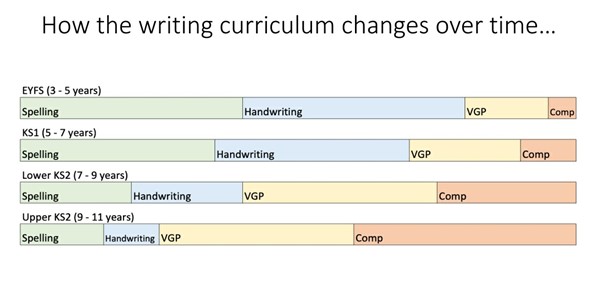
Then in 1996,  the National Literacy Taskforce was established, ushering in the National Literacy Project and then Strategy. This really focused on phonics for both reading and spelling,  text structures, including a whole gamut of non-fiction text types, and knowledge of written language.  For example, the excellent publication Grammar for Writing was a game changer, providing well thought out strategies for teaching children to write well at the sentence level.  These were exciting times. Levels of attainment shot up. However, this shift came with trade-offs, the school day only having a finite number of hours. Because teachers were spending more time on phonics, sentence and text structure, the emphasis on sharing texts with an audience beyond one’s teacher reduced.

There was, however,  a new ‘audience’ in town, and one that had demanding requirements. Writing standard assessment tasks – SATs were introduced in 1995, ushering in an era of the marker as  prime audience.  Being held accountable for standards of writing did help to improve attainment – but over time the emphasis on text structure – or genre – began to eclipse all other elements, aided and abetted by the requirements of the National Curriculum of the time.  The abolition of the writing SAT in 2012 did not actually change this, since it was replaced by a system of moderated teacher assessment that was just as heavily focused on genre. Even when the National Curriculum removed the requirement to study numerous genres, the focus of teaching multiple genres lingered on.

Over time, learning to write morphed into learning how to achieve the requirements of the teacher assessment framework.  This involved producing writing that ticked various boxes. Writing became an exercise in producing something that enabled boxes to be ticked. Teaching writing turned into a process where the teacher shared some writing and showed how it ticked various boxes – maybe with some discrete teaching on how to tick a particular box – and then children were given a shopping list of things that they had to include in order for their audience – the mark scheme – to be satisfied.  Redrafting work in order to rectify unticked boxed also became a big thing, accompanied by angst about how independently this had been done.

The dictatorship of the mark scheme as audience meant that a genuine sense of writing for an actual reader disappeared. Choices about vocabulary, syntax, structure or syntax were replaced by choices based on harvesting marks. When writing was assessed by Sats, spelling hardly contributed any marks at all, with a concomitant lack of emphasis in terms of curriculum time. Ditto handwriting.

The introduction of the SPAG test (that’s spelling, punctuation and grammar to those who do not know the joys of this assessment) did help shape teaching away from being almost exclusively focused on text level structure and coherence towards thinking a bit about the sentence. It did mean children were actually taught about grammar and about different ways of structuring sentences. This was an improvement. There were however two problems. The first was that the scope of the grammatical features 11-year-olds were meant to be able to identify strayed beyond the useful and into the abstruse. I’m old enough to have been taught grammar at school and to have learned Latin. However some of the knowledge children are tested on gets me second guessing myself. For example, the difference between a propositional or adverbial phrase or between an embedded  or relative clause does not come to me automatically but something I have to talk myself through. Linked to this is the second problem. The test is great at getting children to be able to feature spot. It is less good at getting children to be able to use features purposefully in their writing. It was however, eminently teachable. At the school where I was headteacher, despite our challenging demographic, our scores in the SPAG test were sky high. This did not translate to children deliberately choosing to use embedded clauses or prepositional phrases to make their writing clearer or more interesting for the reader. The sense of a reader as a reader – as opposed to marker – had completely disappeared. The inner author was better equipped and hence freer than when explicit teaching was frowned upon. It was, however, a rather limited kind of freedom.

The result of all these different approaches is that a relatively large minority of children are not very motivated to write because either they have not been given all the tools they need with which to be successful and the effort involves seems to far outweigh any reward or the enterprise lacks meaning – digging ditches in order to dig ditches.

There have been various approaches to motivate children to undertake the hard work necessary in learning to write.  The first of these involves the quest for the most irresistible stimulus about which children will be so desperate to write that, adherents of this approach believe, all other concerns fall away. Give something exciting to write about and the other barriers that make writing hard will magically fall away, or at least become less of a hurdle. A second is the reward of an audience who will appreciate and admire your work. A third is the satisfaction of producing something beautiful. A fourth is amplifying the importance of writing for future exams and employment success.  All of these will work to some degree for some children and all of them have some merit. However, collectively they fail to get to the root of the problem. They all try to motivate children to do something hard by dangling a reward at the end of the process. None of them seek to make the process less arduous in the first place.

Producing a piece of text involves doing several different things at once.  The cognitive load involved in trying to orchestrate all of these in rapid succession is immense. A different solution is to isolate each component, and teach these separately initially, so that finite cognitive resources are only having to focus on one thing at a time. Children experience success which is highly motivating. Then, when at least some of these processes have become automated, children can begin to integrate the various process together.

The drawback of this approach is the inverse of those outlined above. By focusing on one process at a time, it effectively removes the motivational effects of producing an actual piece of writing. For some processes, it also makes the reference point of the reader more tangential. Yes, when you are learning to spell, you are learning to spell in order that a reader can understand your writing. That’s less obvious that when you write an actual piece of text for a specific audience.

However, this drawback can be remediated by providing scaffolding that does the work of some of the processes for the learner, allowing learners to concentrate on just one or two processes at a time while still enjoying the motivational benefits of creating something worthwhile that is shared with others. For example, while Reception children need to focus a great deal of time in developing competence with the transcriptional enablers of technology, this should not mean that they are not also able to spend time  composing for an audience, whether orally or via using drawing and possibly emergent writing. For example, the app Chatta provides an easy way for children to record, replay and share  their early attempts at writing sentences. 

Striking a balance between devoting time to working on discrete components in isolation  and time to use components together in more complex tasks of meaning making is the key curriculum challenge when teaching writing. Different schools may come up with slightly different emphases. We should be wary of decrying those who deviate  ever so slightly from our preferred solutions with a little more or a little less of the component or the complex than our own answers to this problem.  For example, I would see both the work of Andrew Percival and Stanley Road Primary in Oldham and the work of Ross Young and Felicity Ferguson at The Writing for Pleasure Centre  as thoughtful responses to trying to give appropriate weighting to both  the technical and the creative, (though I tend more to Team Percival, for now at any rate.)


[1] Telling the story: the English education subject report – GOV.UK

[2] Telling the story: the English education subject report – GOV.UK

[3] This sequence is based on chapter X of The Writing Revolution

  • [5] Ashbee, R (2021) “Curriculum Theory, Culture and the Subject Specialisms” Routledge

[6] This whole section is indebted to Article: Substantive and Disciplinary knowledge – e-Qualitas Teacher Training with particular thanks for the C.R.Milne quotation.

[7] I could have added in further adjectives such as analytic but decided for the sake of clarity to restrict myself to just four. Balancing the non-present and unknown reader’s desire for clarity with their potential desire for nuance and comprehensiveness is always an authorial challenge!

What are we teaching when we teach writing?

Oracies not oracy

It’s now official, with the election of a Labour government in the UK, oracy is now the Next Big Thing about to preoccupy schools in England. (England rather than the UK as a whole, because authority for education is devolved to each of the four nations in the United Kingdom, so this is about England rather than Scotland, Northern Ireland or Wales)  This is not a bad thing at all, except in the way that all Next Big Things can be bad things in that schools often rush to adopt superficial aspects rather than engaging deeply with the underlying rationale in a way that genuinely makes things better. Many schools have a regrettable tendency to prioritise observable and auditable actions over fostering deep understanding of strategies introduced with the best of intentions. In what follows, I will attempt to set out how we might think about oracy in ways that strengthen our educational offer as well as highlighting ways in which these might be mutated into unhelpful ends.

Oracy is a curricular as well as pedagogical concern

James Mannion, one of the authors of the Oracy Skills Framework, writes that oracy is more than learning through talk.  Children also need to be taught how to talk.  Indeed James writes that perhaps it would have been better to call the oracy skills framework the oracy skills and knowledge framework and that ‘there is a significant body of knowledge that underpins the development of spoken language and communication,’[1].  Oracy is both a curricular and  a pedagogical concern. Intelligent thinking about oracy therefore need to reflect upon the roles (plural) of speaking and of listening in pedagogy and its roles in the various subject curricula. Oracy is not a ‘thing’ that we do in a performative ‘look-at-us-doing-oracy’ dance, it is a range of teaching practices, whole school routines and subject specific curricular objects.  Hence oracies not oracy.

There are broadly three main reasons why oracy is advocated. The first is around self-confidence. Education, it is argued,  should enable children to develop into self-confident individuals who can communicate with ease in a range of social situations, beyond the narrow confines of their peer group. Children should feel able to express their ideas, ask questions, voice opinions, engage in conversation with an unfamiliar person or group of people and do all of these constructively and effectively with the requisite politeness the situation demands.

The second reason is about teamwork and collaboration. Education should enable children to work with others to achieve goals.  For this to happen children need to be able to participate in a discussion as an equal partner, listening attentively, building on the contributions of others and disagreeing amicably when appropriate.  It is about balancing one’s own self-confidence with the right of other voices to be heard.  We might note, in passing, that at least in part,  the first of these is about encouraging the more reticent to speak, the second is about reminding the more loquacious to listen!

These first two reasons have both pedagogical and curricular implications. Having regular opportunities to learn through talk, whether through routines such as talk partners, or group work or whole class discussion, provide contexts within which speaking and listening can be applied. However, students also need to learn how to talk and how to listen. When explicit teaching about this is omitted, and children just left to get on with it, this is very likely to go wrong. As the oracy skills [and knowledge] framework reminds us, there are four major strands of learning to speak and listen well; the physical, the social emotional, the linguistic and the cognitive. While the linguistic and cognitive may be included within subject teaching, the physical and social emotional may well be overlooked, or assumed to be ‘natural’ so not in need of explicit teaching.  In the same way that schools should  have a behaviour curriculum that teaches children the detail of how to behave in a pro-social, pro-learning manner, schools should also explicitly teach the physical and social emotional granular detail of how to speak and listen well. One reason this may be overlooked is that outside of the Foundation Stage, it does not have an identified curricular ‘home’, though the English, drama and PHSE curricula all provide natural contexts for explicit teaching about how to speak and listen. This learning can then be consolidated and applied across the curriculum, when appropriate in pedagogical and curriculum terms.  Explicit structures and expectations such as outlined in accountable talk or habits of discussion, can scaffold and reinforce this prior learning.

The third  reason is around learning effectively. There is substantial evidence that oral language competence underpins cognitive development; talking and thinking being intimately entwinned. [2]  Below, oracy as pedagogy  expands upon how oracy can be deployed pedagogically to strengthen learning by enabling checking for understanding, developing fluency in the language of analytic thought and by causing children to think hard and think with taught content.

A fourth seldom expressed reason is that to different degrees depending on the subject, the omission of learning how to communicate orally does violence to the essence of that subject.  Drama without speaking and listening is unthinkable, learning a modern foreign language without learning how speak it and understand its spoken form is an emaciated form of language learning. The study of English is seriously impoverished unless it includes study of the spoken word as well as the written word. The extent to which the internal logic of other subjects should include curricular objects concerning speaking and listening is discussed later. This is separate from discussion of the use of oracy as pedagogy. Muddled thinking about whether oracy is being used for curricular or pedagogical reasons is a sure sign that things are about to go very wrong. The section on oracy as curriculum expands upon this.

Oracy as pedagogy

Teachers have a range of pedagogical tools at their disposal and are faced with the professional challenge of making judicious choices about which tools are best suited to which tasks, subjects and age of pupil and at which point in a lesson.[3] There is an opportunity cost to any decision. To choose to use speaking means there is less time to apply writing or digital skills for example, and in a given situation writing or a digital technological tool might be a more effective choice for learning something than the alternatives. The rationale behind such decisions is not often articulated and yet being able to  weight and justify one’s pedagogical choices is the best insurance against their misapplication. Given that oracy is often advocated in the belief that getting pupils to justify their assertions is an inherent good, then we should expect proponents of oracy to be eloquent at justifying their pedagogical choices.

Building belonging

There are a raft of reasons for using oracy as a pedagogical tool.  First of all, the use of oracy in the classroom can be done in such a way as to build a sense of belonging and of shared purpose in a way that is superior to using alternatives such as writing or digital technology. Which is not to say that neither writing nor digital technology cannot also be used in the service of building belonging – for example online writing collaboration tools allow these two to be used in combination. However, oracy has a particularly strong contribution in building belonging. After all, we use expressions such as ‘having a voice’ and ‘being heard’ as crucial aspects of being respected as a person. The language we speak is a central part of our sense of  identity.  Therefore, being listened to, having one’s voice respected and valued should be a fundamental part of every school’s ethos. The oracy benchmarks of Voice 21 has as its second benchmark the valuing of every voice.

‘ The teacher supports all students to participate in, and benefit from, oracy in the classroom. The teacher listens meaningfully to students, encouraging them to develop their ideas further, and creates a culture in which students do the same.’

Doug Lemov in his book Reconnect for Meaning, Purpose and Belonging writes about teaching that amplifies the signals of belonging. He discusses pedagogical routines such as turn and talk and habits of discussion as ways of building a sense of belonging, valuing every child’s voice and providing a context for children to learn to expand upon and justify their reasoning. A classroom with the emotional safety that enables every child to share their voice is a classroom where is it safe to take risks and make mistakes.

Clearly, building belonging is important in its own right. There is however a further contribution that a sense of belonging provides – though it sounds a little  instrumentalist if not outlined without first stressing its non-instrumental moral necessity.  Feeling you belong is one aspect of what drives motivation and teaching is much more effective – and rewarding – with motivated learners than with unmotivated learners.

Checking for understanding

A second reason why a teacher might make a decision to use oracy as a pedagogical choice is in order to check for understanding. Learning is invisible so teachers rely on proxies in order to try and work out if their teaching is having the desired learning outcome. There are three main ways teachers could check for understanding; children could write their answers, possibly on a mini whiteboard, children could choose an option either on a digital device or by using a physical signal, moving to a certain place, showing a coloured car or number of fingers or whatever, or by talking – to a partner or to the class as a whole. All of these have their merits and drawbacks.

Choosing options is only suitable for simple yes/no, true/false or multiple-choice questions, but because it is an all-learner response system, (as opposed to asking for ‘hands up who knows the answer routines’), it gives the teacher instant data on the extent of understanding across the class as a whole. This is powerful data which empowers the teacher to  flex their teaching in the moment to address misconceptions. 

Writing on a mini white board or quizzing technology such as Carousel allows for slightly longer answers and still provides the opportunity for the teacher to check for understanding. The challenge of so doing increases with the length of the answer, so there is a law of diminishing returns here once answers become longer than a simple sentence.

Similarly, using talk partners allows for  both short and slightly longer answers and provides a context for teachers to sample understanding across the class if used alongside all learner response systems such a cold calling (done warmly, naturally).

This may make it sound as if checking for understanding involves questions with simple, closed answers is in some way inferior to asking a question that involves a longer, more open answer. This is not the case. Closed questions play a vital role in checking and reinforcing key knowledge and in building confidence with subject content, both of which underpin a learner’s ability to answer a more open-ended question.

It is usually easier to check for understanding when asking an open-ended question by using spoken answers as a means of participation than the above alternatives. However, as there usually are with pedagogical decisions, there is a trade-off to be made.  Put simply, a teacher can either attend to one learner giving a longer answer or many learners giving short written or signalled answers. Both have their place, depending on whether the teacher wants to know whether everybody understands or whether child X specifically understands. (There are of course  reasons other than checking for understanding for engaging in extended, probing verbal exchanges with one child.)

In practice, teachers manage these different trade-offs by using techniques in combination. For example, an all-learner response system such as using mini white boards or a multiple-choice quiz is used and then the teacher selects a child to answer verbally. Another strategy is using what Adam Boxer calls ‘indicator’ children, those children who the teacher is aware are more likely to find learning more challenging and use these children as a way of sampling understanding more generally.

Proponents of dialogic teaching such as Robin Alexander, for example, are dismissive of checking for understanding routines, or what they call IRF (Initiation by the teacher; Response by a student of students; Feedback from the teacher).  Checking for understanding is disparaged as  ‘reporting on someone else’s thinking  rather than think[ing] for themselves.’[4]  However, checking for understanding is a vital tool in an inclusive classroom and has a specific rationale: that of providing the teacher with information about whether they need to clarify or give more practice to an area of learning. The idea that ‘thinking for themselves’ is possible without deep immersion in ‘someone else’s thinking’ is somewhat fanciful and seems to dismiss the foundational role of knowledge in thinking. Unless we are expecting each and every child to rediscover the cumulative legacy of human meaning making afresh then learning other people’s thinking is here to stay. Be very wary of those who are dismissive of the power and necessity of oral checking for understanding routines and who are overly enthusiastic about open-ended, exploratory discussion to the exclusion of anything else. Open-ended exploratory talk is important both pedagogically and in terms of the curriculum in some subjects, but it is not the only thing that is important.

Speaking: writing codependencies

A third pedagogical reason for using oracy is to enable learners to reframe and extend their initial thoughts into a more formal speech mode. Formal speech has structural and lexical differences with conversational speech and is inextricably linked with writing.  I have written about this in detail in this blog which  I really urge you to read in order to fully understand the co-dependency that exists between speaking and writing.

The formal mode is the communication mode that is optimised for analytical thought. It uses sentence-based idiom and technical vocabulary and is more polished – more formal – than its conversational progenitor. Sometimes such language is described as being ‘higher quality’ or ‘better.’ [5]  But these adjectives are context specific – a more formal full sentence is better in some contexts and inappropriate in others. In the classroom, there will be many occasions when we wants students to recast their initial, fleeting thoughts into something more polished, more considered and more analytical. Here, exploratory talk gives space for the learner to reflect upon and recast their initial thoughts into something more organised. It gives space for thought to be listened to by others, questioned, and developed further.

Academic language – whether written or spoken –  is written in sentences. Conversational language is not. Exploratory talk in the classroom provides a way of bouncing between the two.  Respect the role of both in communication. Be wary of approaches that either insist that children speak in full sentences all the time, or who conversely do not appreciate the need to be able to talk in full sentences when it is appropriate to do so.

Being able to communicate in sentence-based idiom is no one’s natal tongue. Learning to do so requires thoughtful scaffolding as well as many, many opportunities to practice. Just giving curriculum time to children talking together without scaffolding is not going to enable them to learn how to communicate in this new idiom.  To paraphrase James Britton’s oft cited , ‘sentence-based writing floats on a sea of sentence-based talk!’ If you can’t say it in full sentences, you can’t write it in full sentences. The fact that in conversation we do not speak in full sentences is a complete red herring. There is a valuable place for exploration of ideas in the classroom that does not insist in full sentences  and there is also a perhaps even more valuable role for learning to articulate ideas in formal academic mode. There is also a curricular dimension to articulating thought in more formal idiom because not only the vocabulary but also the grammar choices are deeply shaped by the subject within which one is communicating. This is examined below.

(I urge you once again to read this blog where I expand upon this in more detail.)

Thinking hard

A fourth, closely allied pedagogical reason for using talk in the classroom is that it has the potential, done well, to  enable learners to think hard – or think with – the content that has been shared with them. It also has the potential to enable learners to avoid thinking hard, particularly because the transient nature of a class full of students all taking at once provides is hard for teachers to monitor whether or not this hard thinking is actually taking place. Unless a teacher is skilled in pre-emptive strategies to address this,  a class full of talking students provides easy cover for students seeking to avoid the hard work of thinking. Such pre-emptive strategies for creating an ethos for productive talk exist and need to be understood, modelled and practised if the use of talk is going to be pedagogically productive. For example,

‘Accountable Talk practices are not something that spring spontaneously from students’ mouths. It takes time and effort to create an Accountable Talk classroom environment in which this kind of talk is a valued norm. It requires teachers to guide and scaffold student participation.’[6]

These caveats aside, talk between peers has the potential to get students thinking hard about content. When students think with content – having to mentally translate it from one context to another – in this case from the teacher’s words into their own words and the words of their peers, this involves the kind of effortful thinking likely to lead to effective learning.

Using talk as a way of getting students to think hard – and think with – content, using talk, can also be structured through skilled extended probing, sometimes of just one student, with other students attentively listening – and benefitting – from the exchange. For some, this is the oracy motherlode.

The advocacy oracy providing the means for children to  ‘think for themselves’ warrants some unpicking because there is often a conflation between two different concepts occurring when it is championed. There is a first sense in which it means something like ‘make sense of what you have just learnt by integrating it within your preexisting mental schema, making new links.’ It involves the learner engaging in cognitive activity  – what I have called thinking with new content above, in order to make sense of it. Generative learning strategies, as researched by Fiorella and Meyer, are ways of enabling such thinking and often either involve talk or have the potentially to be done in pairs or small groups using talk.

The second sense is more about having your own opinion about something, making decisions whether to accept or reject a proposal, justifying one’s line of reasoning and so on. However, such considerations take us deep into curricular territory. Voicing opinions, for example, forms a larger part of the cognitive architecture of some subjects than others and so the amount of time deployed should vary accordingly. Voicing one’s opinion of the meaning of a poem is an integral part of the English curriculum; voicing one’s opinion about whether or not F=ma is not part of what it is to learn physics.

At this point you may be thinking, but what about the value of exploring ideas with peers per se – quite apart from the role of talk in either cementing learning or learning how to express oneself in academic idiom. What about a space for provisionally, for turning over ideas and opinions? For this, we need to explore oracy within the curriculum as reasoning, explanation and opinion giving are not generic abilities. They are shaped by the subject within which they are taking place.

Oracy as curriculum

That most schools in England now embrace the idea that having a coherent curriculum is a necessary if not sufficient component of a good education is a major achievement. However, there is more to understanding curriculum than appreciation that knowledge is important and should be sequenced in a way that reinforces and deepens prior learning while making connections to and preparing for new learning. An aspect of curricular understanding that is less well developed is that concerning how the different subjects are different and the implications those differences have for how and what we teach.

More often we hear concerns about ‘teaching subjects in silos’ without understanding that knowledge is structured differently in different subjects for good reasons which makes a degree of containment – or siloing if you will – not only inevitable but important.  Each discipline is a search for meaning, a particular truth quest.  As Ruth Ashby explains in her excellent book Curriculum: Theory, Culture and the Subject specialisms  ‘a discipline’s practitioners look out at the word in unique ways; they notice certain types of things, they ask certain types of question…’ If we try and blur the distinctiveness of the different disciplines, we lose specific ways of noticing and narrow the range of ways in which we can make meaning. As Ruth describes, we can describe these quests after meaning as fitting into four different categories; descriptive, interpretative, expressive and problem solving.

Some disciplines describe the world, seeking to ‘find facts and to make meaning from then; to distil, interpret, reduce or generalise.’ Science and maths in particular, and some aspects of geography, history and religious studies follow descriptive quests, using logic and empiricism in the service of truth seeking. Objectivity is assumed to be both possible and desirable.

Some subjects interpret the world. In interpretive quests, subjective interpretation is valued, truth being sought through reasoned argumentation. Much of history, theological aspects of religious studies, literacy criticism, art and some aspects of geography ‘all have explicit interpretive aspects to their quests, and do not seek objectivity or single-truth in the way that science and mathematics do.’

Yet other subject quests are expressive – for example the arts – and seek approval not just from the subject community but also from curators, critics and the interested public. This is very different from truth-seeking grounded in empirical testing as used by the sciences. Finally we have the problem seeking quest followed by design, computing engineering, food technology and so on.

It is important to notice that a single subject may straddle more than one ‘quest.’ History, for example, is both descriptive and interpretive. English is by turns descriptive (for example, in phonics), interpretive (for example when seeking to understand a text) and expressive (for example when writing or voicing a personal response to a poem).

In a broad and balanced curriculum, children learn to make meaning in all these different ways. Part of the curriculum in a subject in learning how meaning  is made, how knowledge is accepted, contested or refuted. Subjects with interpretive and expressive quests require space in which the ability of children to engage with and in interpretation and expression in a way that descriptive and problem-solving subjects do not. 

Even within interpretive subjects, while diversity of thought and subjective opinion is integral to the subject, that does not mean that all opinions are equally valid and that there are no wrong answers. Opinions are not just aired; they are justified with respect to evidence. One way in which oracy can go very, very wrong is in the wrong-headed belief that expressing opinions is good in itself, regardless of what knowledge may tell us and without the expectation of rigorous thinking. A notorious example of this occurred on Twitter, when a prominent headteacher championed children voicing doubts about the moon landings because he appeared to value having an opinion and challenging accepted narratives over having due regard for evidence. This is to promote a conspiracy theory curriculum which should have no place in any school.

The University of Pittsburgh promotes a practice called Accountable Talk. Children -and one would hope their headteachers – are accountable ‘to the learning community, to accurate and appropriate knowledge, and to rigorous thinking.’

They write about how talk is used in different subjects here.

‘Disciplines vary in the types of evidence they value. When students are digging into a good poem or story, for instance, they might be trying to sense how the words and rhythms create tension or convey emotions. No one expects a student to provide a “proof” for her claim that a verse evoked a particular emotional response. However, if a student provides an interpretation of the motivation behind a character’s actions, we expect that student to cite multiple pieces of textual evidence to support that interpretation. Within a social studies lesson, students may marshal historical facts to support a position that begins as an “opinion.” But if a student explaining his thinking about a fractions problem were to say, “I think the 4 stays the same because it just feels right that way,” he is not being accountable to the standards of evidence that apply in the discipline of mathematics. That it “feels right” might be recognized as an intuition and valued as such as a starting point. But it would be appropriate to ask the student to examine this intuition and push for a more mathematically relevant basis for it. There are thus different standards of evidence in different fields, and students need to be inducted into those different kinds of academic communities.’[7]

 Or as Shanahan and Shanahan put it

Disciplines differ extensively in their fundamental purposes, specialized genres, symbolic artifacts, traditions of communication, evaluation standards of quality and precision, and use of language.

With regard to language use, different purposes presuppose differences in how individuals in the disciplines structure their discourses, invent and appropriate vocabulary, and make grammatical choices.

Shanahan and Shanahan 2012[8]

Oracy and opinion

Devoting space to enabling the voicing and listening of each other’s opinions is sometimes seen as the pinnacle and main purpose of oracy. Robin Alexander talks about dialogic teaching that ‘extend[s] thinking through collective, reciprocal, supportive, cumulative and purposeful classroom talk.’[9]  The whole purpose of this piece however is to argue there is not one purpose for oracy. Rather there are several different purposes – or several different oracies if you will – and being clear about why we are doing what when is crucial if things are to be done well, rather than in a fit of breathless, modish enthusiasm.

Insofar as talk promotes the integrity of the discipline, and genuinely extends thinking without exerting a disproportionate opportunity cost, then it is to be recommended. However, talk can sometimes be eagerly adopted without sufficient understanding of what promoting the integrity of the subject involves.

For example, the role of opinion in history is often misunderstood.  Within history, developing student’s ability to voice informed opinions about differing interpretations is an important curricular goal. The National Curriculum for history states that part of the purpose of study is to:

‘…equip pupils to ask perceptive questions, think critically, weigh evidence, sift arguments, and develop perspective and judgement.’

In this concept cartoon from Voice 21, the four fictitious characters voice different reasons, all drawn from historical sources, which contributed to Hitler becoming Chancellor. Crucially, children are not being asked ‘why do you think Hitler became Chancellor?’ They are being asked a question that might initially appear as only slightly different ‘which of these [historically evidenced] causes do you think were most influential in Hitler becoming Chancellor?  They are being asked to voice an opinion that is grounded in historical evidence, and how to weigh different pieces of evidence.

Compare this with the example below, also from Voice 21.  This asks the children for their opinion about whether or not it was right to evacuate children during World War 2. But this is not a historical question!  Here, children are not being asked to make historical judgements. Answers to historical questions must be grounded in historical evidence. Where opinions are discussed and weighed, these should be the differing opinions of those living through events as they happened. The sort of question which looks back at the past from the standpoint of the present and makes judgements about whether or not they did the right or wrong thing is what is called ‘presentism’ and is NOT history!  Whether or not Tamana thinks some cities were dangerous is irrelevant, unless Tamana is a citizen in 1939 whose views we have access to. Were this cartoon redrawn to reference differing opinions from people at the time, based on evidence, then it would become an appropriate tool for use in a history classroom.

If opinion giving is valued without understanding the role of knowledge in each subject in informing those opinions, and what kind of opinions are appropriate and inappropriate, then we are stepping into dangerous territory.

The arts, and some aspects of English, are subjects with an expressive quest. Here, the personal responses of others to a piece of work, as well as the ability to articulate an informed personal response oneself, is part of the curriculum. Here, we might say ‘there are no wrong answers’ (though clearly there can be naïve,  or ill-informed answers). We might say as a matter of principle, in this context learners have the right to make their own interpretation that may differ from their peers or their teacher.  Diversity of thought and  absence of consensus are acknowledged and may even be championed. This is quite different from the descriptive quest subjects where there are very definitely wrong answers. Within descriptive quest subjects, the viewpoint of the knower is irrelevant. Single truth is assumed to be possible and desirable. Similarly in interpretive subjects, there are wrong answers. The opinion that the moon landings did not happen is discernibly false, for example. Indeed, subjects with a strong interpretive quest are perhaps most at risk from misunderstanding about opinion, precisely because scholarly opinion does differ and debate between scholars is constitutive of the subject. But unlike the expressive quest, while this diversity of opinion is acknowledged, it isn’t championed in the same way it is within the expressive quest. Access to a single historical truth might be impossible, but historical opinions are bounded by evidence and are not infinitely flexible.

That said, the curricular rationale for exploratory talk in  subjects with interpretive and expressive quests is relatively straightforward, and will be focused on developing the ability to provide informed opinion. But this is not to say that exploratory talk does not have a role in descriptive subjects such as maths and the sciences. However, within descriptive subjects, giving one’s opinion is unlikely to be  a curricular object. In maths, justifying one’s reasoning with reference to logic or being able to give a proof is an important part of the maths curriculum to which oracy needs to contribute.  One of the aims of maths is described in the National Curriculum as developing the ability to

‘…reason mathematically by following a line of enquiry, conjecturing relationships and generalisations, and developing an argument, justification or proof using mathematical language.’

NCETM in their article Four ways to create better mathematical talk in your classroom propose that as well as checking for understanding teachers should create:

opportunities to talk about something other than ‘the answer’ can create a more discursive atmosphere and reduce inhibitions by removing the anxiety of being ‘wrong’. For example – classifying, comparing, focusing on method rather than solution. Questions such as ‘What do you notice?’ or ‘What do you think would happen if…?’ can be useful.’

 The curricular importance of this is that there is more to maths than finding answers. Being able to think mathematically and communicate that thinking to others is central to what it is to learn maths. This article by Mike Askew is an interesting account of how he does it as well as potential pitfalls.

 In science the National Curriculum has a section on spoken language which says

‘The quality and variety of language that pupils hear and speak are key factors in developing their scientific vocabulary and articulating scientific concepts clearly and precisely. They must be assisted in making their thinking clear, both to themselves and others, and teachers should ensure that pupils build secure foundations by using discussion to probe and remedy their misconceptions.’

If we unpick this using the lens of pedagogy and curriculum, we can see that a curricular object includes

  • Articulating scientific concepts clearly and precisely

 This is clearly not about giving opinions.

Pedagogically teachers are to

  • Ensure that pupils build secure foundations by using discussion to probe and remedy their misconceptions.’

 This is classic checking for understanding

And then, straddling both the pedagogical and the curricular

  • Making thinking clear to themselves and others

Articulating scientific concepts clearly and precisely  involves both the pedagogical use of talk as a way of framing and extending initial thoughts and also learning the ways in which specifically scientific discourse uses particular structures. The Ofsted subject review for science said that

‘To learn about science, pupils need to learn about the different ways in which scientists engage in their work: through reading, talking, writing and representing science.This is called disciplinary literacy. It is not the same as teaching generic literacy strategies needed to interpret any text. Instead, it involves pupils learning how individuals within a discipline‘structure their discourses, invent appropriate vocabulary and make grammatical choices’.

This is where talk can be used in the science classroom as a prelude to writing scientifically, developing confidence with the vocabulary and grammar of the subject.

Juli Ryzop of the Knowledge Schools Trust has analysed the different grammatical patterns used in history, geography and science. I strongly recommend her training on this. [10]

Here is a slide from her training:

In order to write like a scientist, or historian and so on, we need to also be able to use disciplinary talk. While this may start out in exploratory mode, the goal is to recast it into formal scientific sentence idiom.

What we need to avoid is the imposition of forms of talk appropriate in one subject into another without regard for the structure and linguistic demands of that subject. We don’t want science teachers to be dragooned into watching English classes giving their opinions about a charged piece of writing and expected to do similar when students are learning about charged particles. We don’t want maths lessons where giving different methods of solving a problem is over-valued to the extent that giving a different method becomes an end in itself rather than a useful way of exploring mathematical thinking.

Curriculum and phase

As well as thinking about how the subject shapes oracy, we also need to consider how the age of the child influences choice of curricular objects.

In the Early Years Foundation Stage, communication and language is an area of learning in its own right. Because children are at the earlier stages of learning to communicate, oracy curricular objects predominate.  These include not only the cognitive and linguistic aspects of oracy, but also the physical and social and emotional.   For example, see this from Alex Bedford and Julie Sherrington’s [11]EYFS: Language of learning

These ways of communicating should then built on in key stage one as children receive a curriculum planned to enable them to develop the ability to

  • talk to inform and listen to information
  • talk to entertain and listen to entertainment
  • talk to discuss and listen to discussion

and then in key stage two deepen all of these in progressively more challenging contexts as well as learning how to

  • talk to persuade and listen (critically) to persuasion.  

I have written about this in a bit more depth and how they link to different subject areas  in the ResearchED Guide to Primary Literacy which is due to be published in October 2024.

In almost all primary schools, the same teacher teaches many subjects to the same children.  Because the use of accountable talk requires an investment of time before it is able to be used well, it may be easier to establish in a primary classroom where the same routines and have the same expectations can be applied across several subjects than in a secondary context where one might expect that implementation will be harder and opportunity costs potentially higher.

Some of the strategies from Voice 21, work well across all phases. Others are more appropriate to earlier stages of language development. Learning how to use ‘because’ when talking to give reasons is an appropriate curricular object in the Foundation Stage and year one and crafts readiness for the later use of conjunctions when writing narratives and when reasoning in subject specific ways. Playing a ‘because’ ice breaker in year nine is closing the gate several years after the horse has bolted.[12]

Oracy and assessment

Don’t get bogged down in how to assess oracy. Effective learning is not dependent on being able to quantify it with some sort of data label or being able to ‘provide evidence.’ As always, formative assessment that allows teachers to respond in real time in the classroom is by far and away the best use of assessment. This requires teachers to have a good mental model for what if means to get better at speaking and listening, informed by specific subjects. The mental model is provided by the subject curriculum, not an assessment rubric.

However, having some  way of summatively evaluating standards of talk is something that is being explored. For example, Voice 21 have written this on the subject.  No More Marking, the comparative judgement experts, have written this. What is interesting here is that progression is given via the complexity of what is talked about, rather than the fools errand of trying to describe progression in skills, which invariably ends in trying to make adverbs discriminate between performances, in an entirely subjective and ultimately meaningless way. Whereas if the curriculum is the progression model, increasing challenge involves the same skill being applied in progressively more challenging contexts. This is why ‘oracy’ curriculums where oracy is hived off from what is being talked about don’t really work for the linguistic and cognitive strands.  For example, see this example.  Year one are asked to offer reasons for opinions.  But it makes a lot of difference to the level of challenge whether you are being asked to give reasons for why you like a playing football or why you think economic reasons were the chief cause of the rise of Hitler. The complexity of the knowledge one is being asked to talk about is what provides the level of challenge. This probably matters less for the physical and social and emotional strands, though even here being asked to read with prosody a page from Dear Zoo is going to be easier than the prologue of Macbeth. Encouraging everyone to contribute is much easier on relatively uncontroversial topics and much more challenging when the subject matter is hotly contested.

In conclusion

  1. Oracy should contribute to, rather than detract from or be seen as in competition with, knowledge building. If oracy in the classroom isn’t playing a role in building knowledge, then it is likely to be misplaced. [13]
  2. Building knowledge does not preclude exploring knowledge. Exploring knowledge is sometimes a good strategy for building knowledge. And sometimes not.
  3. Oracy includes checking for understanding. Closed questions have a valuable pedagogical role in this. Viewpoints that are dismissive of such exchanges as ‘not proper oracy’ should be viewed with scepticism
  4. Be wary of approaches that either insist that children speak in full sentences all the time, or who conversely do not appreciate the need to be able to talk in full sentences when it is appropriate to do so. Don’t forget to read my blog about this!
  5. Learning to communicate in sentence-based idiom requires thoughtful scaffolding  such as sentence starters and sentence builders. Just getting children to talk about stuff won’t be sufficient.
  6. Approaches to oracy that reduce it to giving opinions are facile. This is even more the case when the opinions are not grounded in knowledge.
  7. Be aware of how the knowledge architecture of subjects drives the kind of talk that is appropriate. Discussion and argumentation based on differing opinion  is integral to interpretive and expressive subjects. Within descriptive subjects the emphasis is on explaining reasoning.
  8. Whole school oracy practices need to  take into consideration subject and age considerations rather than imposing generic expectations that run roughshod over these.
  9. Beware assessment. Something is not more or less valuable if it is summatively assessed. There are lots of reasons to teach through or about oracy. Teaching oracy in order to generate evidence is not one of them. That way lies madness.
  10. Voice 21 have some good resources and some not so good resources. Regardless Listen to other voices such as Doug Lemov and Adaptable Talk as well as Voice 21.

[1] The transformative power of oracy – ORACY CAMBRIDGE

[2] See page 11 of Oracy-across-the-Welsh-curriculum-July-2018.pdf (oracycambridge.org) for a summary of key research findings.

[3] I say at which point in a lesson because sometimes things get misconstrued and what is intended to be a technique used for say 5 minutes within a lesson is understood as being the only technique used at all! As if actual teaching with clear explanation of content could be replaced by non-stop cold calling and talk partner routines!

[4] Alexander, Robin (2020) A Dialogic Teaching Companion. Routledge p15

[5] I’m looking at you ECF framework.

[6] From the University of PittsburghAccountable talk® sourcebook: for classroom conversation that works

[7] From the University of PittsburghAccountable talk® sourcebook: for classroom conversation that works page 6

[8] TLD200095_HR (shanahanonliteracy.com)

[9] Alexander, Robin (2012) Moral Panic, Miracle Cures and Educational Policy: what can we really learn from

international comparison?, Scottish Educational Review 44 (1), 4-21

[10] Juli can be contacted via @juliryzop.bsky.social  Her training is equally suitable for secondary and primary practitioners.

[11]  EYFS: Language of learning.

[12] Though clearly may be appropriate for children with moderate or severe learning difficulties or for children learning to communicate  in a language that is very new to them.

[13] I’ve talked of the role of oracy is building belonging. One can build belonging while building knowledge. these two are not in competition.

Oracies not oracy

Understanding oracy, understanding writing.

Talking floats on a sea of write

 ‘Writing floats on a sea of talk’ said James Britton in the 1970s.’  If you can’t say it, you can’t write it. This being the case, teaching children to write articulately will necessarily involve teaching children to speak articulately.

This is true but it is not the whole truth. Because the converse is also true; talking floats on a sea of ‘write.’  If you can’t write it, you can’t say it.

I can imagine you looking askance at his assertion and thinking, ‘Sealy’s lost it.’ After all, you are bound to know a four-year-old who doesn’t stop talking but can’t yet write very much.  And for thousands of years there have been pre-literate cultures and civilisations that thrived without having any form of writing. Socrates refused to write because he thought it was a pernicious invention that would erode memory. Clearly Socrates could talk!  So why the provocative assertion?

Britton’s  assertion that teaching children to write articulately necessarily involves teaching children to speak articulately assumes that writing is transcribed speech. First a child learns how to talk then later they learn ways of transcribing that talk. However, because speech and writing are produced in very different communicative situations, there are significant differences in how they are structured. What is more, writing enables a different type of more formal speech. Exploratory talk and presentational talk, to use the categories first proposed by Douglas Barnes and then expanded upon by Neil Mercer, are different from every day, conversational talk. More formal ways of talking are dependent upon writing.  If you can’t write it, you can’t say it.  Or as Quintilian said in the first century, ‘By writing we speak with greater accuracy and by speaking we write with greater ease.’ Talking floats on a sea of ‘write.’

Clearly, the ability to participate in everyday conversation is not dependent on being able to write. But if we are talking about talking in an educational context, talking about the place of oracy in the curriculum for example, then we probably mainly mean something different from the sort of informal, conversational language we use every day.  This is not to disparage the everyday vernacular, which is fundamental to our identity, to our sense of self.  If we had to choose between only being able to communicate in the everyday vernacular or only being able to communicate in formal, sentence-based academic idiom, then the everyday would win, hands down. Humanity has existed for 300,000 years but has had written communication for only about 8,000 years. Mass literacy is a very new phenomenon, less than two hundred years old and far from universal even now. But there is a reason why mass literacy is seen as desirable. Becoming literate not only involves learning to read and write, it also involves learning to

 In the same way that Michael Young talks about every day and powerful knowledge, we can distinguish between everyday vernacular and powerful disciplinary ways of talking. Some ways of powerful talking enable children to describe and elaborate, others to reason logically and yet others to empathise or imagine, to use the language functions outlined in the 70s by Joan Tough and revisited in Alex Bedford and Julie Sherrington’s EYFS: Language of learning. In the same way that Young’s powerful knowledge is specialised knowledge that gives students the ability to think about, and do things that otherwise they couldn’t, powerful talk is specialised talk that gives students the ability to talk about and hence think about things that otherwise they couldn’t. And these powerful ways of talking are inextricably linked to writing.

Differences between writing and speaking

There is one obvious difference between talking and writing that profoundly influences the nature of what each is able to communicate.  Talk is transient, fleeting, ephemeral.  Writing is durable; it has permanence. Spoken words appear and then disappear in the moment, vanishing without trace. Since working memory is fairly limited, the transience of speech means that it is challenging to articulate and organise complex thoughts or to revisit the complex thoughts of others. Speech is transient, ungraspable, intangible and therefore easily  forgettable.  The development of the technology of literacy extended working memory by outsourcing it to an external memory field – the written word – giving humans the ability to store and retrieve ideas efficiently and accurately.

Preliterate cultures had their own ways of hacking the limits of working memory. Through rituals, folktales, song, ballads, chants and poems, the transience of talk was captured and became memorable and transmissible via mnemonic tools such as repetitive and rhythmic language patterns. However, with nowhere[1] to store information outside of human minds, huge amounts of energy had to be devoted to keeping the oral culture alive. Socrates was opposed to writing because he could see that once culture could be stored externally, it would be evicted from the human mind.

The development of the technology of writing removed the limits on information storage and enabled information sharing across cultures and generations.  As a result, human consciousness was now able to devote more energy to thinking about what was remembered rather than keeping the information alive. This shift from the wetware of the human brain to the hardware of tablet, scroll, page (or latterly – screen) enabled knowledge to be shared, contested, refined, elaborated and refuted.

The very fact that writing could store and enable retrieval of ideas resulted in a new type of communication related to, but different from the spoken word. Because everyday speech and writing are produced in very different communicative situations, there are differences in how they are structured. Both types of communication involve trade-offs. Because writing is durable and has permanence, unlike speech, it does not usually involve live interaction with a listener. This has the advantage that it is possible to communicate across time and space – through writing even the dead can communicate with us! Though this distancing also has drawbacks. Whereas with face-to-face speech, the speaker receives immediate feedback and can add in more details should their listeners appear confused, writers receive no immediate feedback from their readers.  This places a responsibility on writers to explain things much more clearly and explicitly than when talking. Everyday conversation usually takes places between people who share a context. The speaker can make assumptions about what the listener already knows that a writer cannot.  The potential for differences of culture or history between author and audience has structural implications for writing as a mode of communication. Vernacular ways of speaking work fine in a local, immediate context. But for written material that may be read by a reader at some remove in time or space from the author, standardised ways of writing need developing that mitigate linguistic differences.

Spoken language has its own drawbacks. It’s transient nature places burdens on the working memory not only of the speaker but of the listener. Spoken language therefore includes characteristics that are there to work around the limits of working memory and help the listener understand what is being spoken. For example, when speaking, we build in thinking time both for ourselves and our listener by using voiced hesitations such as ‘um’ and ‘ah’. We pause, repeat and rephrase so that listeners have time to absorb the spoken message and to give ourselves time to plan our next utterance.  These hesitations are not only acceptable, they are necessary. The fixity of writing means these working memory workarounds are not necessary. The written word does not vanish once uttered. The reader can revisit written utterances. It is the reader who hesitates, who pauses, who rereads. Because writing is an asynchronous mode of communication, the reader can in effect ‘rewind’ the communication stream. The writer is expected to have already rephrased their thoughts into the clearest utterance possible prior to publication. Repetition, so necessary in spoken language, is frowned upon in writing.  Writers deliberately try and use synonyms rather than repeat the same word within a sentence.

Speaking involves thinking on the spot. Writing gives you take up time to monitor and edit your thoughts. You can write a sentence, pause, reread it, reword it, change the order, extent it, abridge it or delete it.  You have time to think about word choice, literacy devices, removing repetition, adding in rhetorical devices, changing sentence length. Writing can be polished in ways that conversational speech cannot. Writing is expected to be polished in ways that conversation speech is not.

To recap, writing needs to be clearer, more explicit, more standardised, less repetitive and more polished than spoken utterances.  Writing therefore uses syntactical structures that are quite different from those used in conversation. Fragments abound in conversational speech. In writing, the sentence rules. The basic unit of spoken language is what is called a tone group, not the sentence. A tone group is a group of words said in a single breath and carrying a single thought. The permanence of writing permits more complex sentences, including those with subordinate clauses. Sentences frequently carry more than one thought, so need ways of indicating to the reader the boundary between one thought and another. In speech, tone of voice, timing, volume, stress and timbre in spoken communication communicate not only meaning but also attitude and emotion. These have no direct correlate in writing. Instead, punctuation plays a crucial though not entirely straightforward role in communicating meaning and emotional intent. Adverbs and adjectives are also much more common in writing, since emotion and intensity cannot be inferred from tone, stress or volume.

The profound structural differences between writing and everyday speaking mean that that learning to write is really complex. Learning to write isn’t just about learning to transcribe transient spoken utterances into permanent representations, it is about learning to communicate differently, using a very different syntax.  When we learn to write, we are learning a new language, a language that is no one’s natal tongue. This language is what I’m a calling the language of ‘write.’ And it is a language we need to learn to speak not only in order to write – maybe AI will do much of that for us in the future – but in order to think the kind of complex, extended thoughts that writing makes possible. If you can’t write it, you can’t say it. So no, you don’t need to be able to write to be able to engage in everyday conversations. But learning to write is not just about actually writing. It is about learning an additional language, a language that allows the organisation and extensions of thought, a language that turbocharges the ability to think abstractly and analytically.[3] When we teach children to write, we are doing more than teaching them to represent their thoughts on paper. We are teaching them new ways of thinking.   As Gunther Kress has written, it involves ‘learning new forms of syntactical and textural structure, new genre, and new ways of relating to unknown addressees’.[4]  These new ways will be used not only when writing, but when discussing ideas in class.  This is why it is important to help children develop the ability to discuss ideas using full sentences. Sometimes this is criticised on the grounds that we do not use full sentences in everyday conversation. This misses the point. Learning to discuss in class is learning to express oneself using this new language, because this language is better suited to abstract and analytic thought than the vernacular. This is not to disparage the vernacular. It’s not inferior. It is just different and has different strengths. Vernacular, everyday speech is at the heart of being human. It is central to identity. It should be respected and cherished. But if we believe that all our children belong in academic spaces, then we need to empower them to speak the powerful language of ‘write’.[5]

In everyday speech, we use words like ‘right’, ‘so’, ‘well’ or ‘anyway’ ‘I mean’ ‘mind you’ ‘look’ as discourse markers to connect and organise our thoughts. When writing, we use different discourse markers: ‘first’ ‘in addition’ ‘moreover, ‘to begin with’ ‘on the one hand.’ Since spoken communication takes place in a social context, spoken rituals to establish and maintain relationships bookend interactions. Known as phatic communication, examples include ‘How are you?’  or ‘You’re welcome,’ or talking about the weather. Such phatic communication is present in written communication of a social nature – in emails or letters for example. But since writing chiefly exists to enable communication without social interaction, phatic communication is redundant in most writing events.

This language of ‘write’ can be spoken as well as written. If you are listening to a speech or a documentary or a talk at an educational conference, you are probably listening to the language of ‘write’. But at some point, maybe many years ago, this oral event was written before it was spoken.  There’s script or an article, or a blog or a book or a plan behind the spoken event. People just don’t talk at length in extended and coherently joined sentences without either having written it down first or having read and remembered the writing of someone else. Probably both. Our working memories are too small to enable us to talk in extended prose for long periods.  Or at least, to talk well.  Spontaneous, conversational speech uses vernacular forms of expression; prepared and planned speaking usually uses the language of ‘write.’ And of course, it is possible to write using the vernacular, particularly when the writing has a social purpose – a text message, an email, a letter, for example.

Having begun as a way of communicating at a distance, formal academic writing adopts language structures that assert this detachment through removing the grammar of the personal.  Far from perceiving the absence of social interaction as weakness, formal academic writing sees its deliberate impersonal stance as underpinning objectivity.  The focus is on what is written rather than the writer. Academic thought is  – or at least should be – an ongoing truth quest untrammelled by group loyalty or personal circumstance.[2]  It therefore explicitly rejects tell-tale signs of social interaction, codifying detachment from the sphere of social influence by such devices as writing in the third person, using  passive voice constructions and nominalised forms of verbs (invasion rather than invade, decision rather than decide) deliberately impersonal. Modal verbs convey the provisional, tentative and  challengeable nature of written thought.

Implications for teaching writing

When people talk about the importance of oracy in the curriculum, different people mean different things. Some people mean by this that there should be more place for spontaneous, informal, interactive talk. Others that we should give children the tools to be able to present their ideas orally to audiences.  Some people think that oral presentations should have more prominence than written work in the mistaken belief that because speaking is natural whereas writing has to be explicitly taught, allowing children to express themselves orally is easier and fairer. But when we ask children to articulate academic ideas, they need to be able to do so using academic syntax – the language of ‘write’. This is not easier orally. In fact, its harder. It’s expecting people to use complex language structures developed for communication expressed in durable and easily revisable form, in a spontaneous, unplanned manner, using a different language from that learnt in the home. No wonder many people find this kind of more formal speaking anxiety-inducing.  Indeed, some people even prefer text message to phoning, partly because writing gives you time to think and space to revise your thoughts.

The oracy skills framework – maybe better named as James Mannion says as the oracy knowledge and skills framework – goes some way to helping here. It describes four different dimensions of oracy: physical, linguistic, cognitive and social and emotional and describes some of the forms of knowledge each dimension necessarily includes. I think it is quite a useful starting point to think about oracy in curricular terms. (Mannion’s distinction between learning to talk and learning through talk in the above blog is also useful).  However, like many graphics representing different aspects within a curriculum, by having similar sized boxes, it is open to the misinterpretation that size of the box indicates relative important. So if  all the boxes are the same size, then all of these elements are equally important and demand equivalent curricular time. Whereas, since learning to speak the language of ‘write’ is akin to learning another language, the language aspects within the linguistic box is far more important and should take up much more time than many of the others. And by separating out oracy as a curricular thing, separate from writing, obscures the dependence of one with the other. Talk – or at least academic talk –  floats on a sea of writing. Learning about this interdependence is useful. Learning that why trying to talk ‘write’ is particularly challenging (given you are attempting to speak spontaneously in the medium designed for asynchronous communication) might be helpful.

When using exploratory talk in class, it may be appropriate to use vernacular spoken forms. Written idiom is too clunky for spontaneous, social interaction, and plain weird used within conversations. Exploring ideas with others in the moment means participants need the thinking time that voiced hesitations and repetitions provide. The choice of register is dependent on the communicative function. However, we may also want to help children take their spontaneous utterances and translate them into the more formal, more explicit, language of ‘write’, not because spontaneous language is inferior but because it is less suited to the extended thought of academic discourse. So this may involve spontaneous utterance, commitment of spoken utterance on paper or white board, and then recasting of that utterance into written idiom.  Once written in durable, revisable form, the utterance may then be spoken to an audience in a more formal way.

(One reason children like white boards is because they act as an ‘no man’s land’ between transient speaking and formally phrased sentence. It enables fleeting phrases to be captured, revised and recast into sentenced-based written idiom, and then – and I think it is this bit that is particularly appreciated – the evidence of that revision is erased.)

Learning to use the grammar and register of academic writing – whether writing or speaking, is going to take a lot of investment.  Children arrive in school speaking in tone groups, not sentences. No wonder so many children write in fragments. There is so much more to understanding and using sentence constructions than full stops and capital letters. In order to learn the language of ‘write’, children will need repeated exposure to the language patterns of writing through exposure to high quality children’s literature and  copious amounts of non-fiction. Learning through talk, though valuable, is not by itself going to be enough to enable children develop the syntax of the language of ‘write.’  That comes through hearing an adult read to you. Decodable texts are vital for learning to lift words of the page. They are not going to teach model the language patterns of writing – they are not intended to.

Alongside immersion in the language of ‘write’, children also need opportunities to focus in on its syntactical structures. If learning the language of ‘write’ has similarities with learning a new language, then it is useful to explore what might  be learnt from language teachers. In particular, from the ‘extensive processing instruction’ or EPI approach articulate by Gianfranco Conti and others. Clearly since learning to communicate in the idiom of written English is not exactly like learning to communicate in French, not every element applies.

The EPI approach provides learners with chunks of communicatively useful, highly patterned language and repeats these again and again, making tiny changes as the same structure is applied in minimally different contexts. Children are ‘flooded’ with simplified, repetitive, highly patterned, tightly controlled chunks of language. Unlike previous approaches to teaching modern foreign languages, there is little emphasis for beginners on encountering authentic texts.  The curriculum structure provides a scaffold to enable success. Language structures are at first modelled, then  reading and listening activities are provided that enable receptive processing, then highly structured opportunities to produce language in writing and orally. Only once all of this has been done to a point where all children are able to be successful are learners expected to use what they have learned autonomously and creatively.  Competence in receptive language – reading and listening – come before expecting competence in productive language – writing and speaking.

This ‘receptive before productive’ journey is useful thinking about how we might teach children the language of ‘write’. The reading curriculum in primary schools, and through embedding the reading of texts in subjects in the secondary curriculum (where this is disciplinarily appropriate), we can expose children to unfamiliar language structures of the language of ‘write.’  Then we can use sentence frames and sentence builders to provide highly structured opportunities for writing and speaking. Instead of rushing headlong into expecting children to produce unstructured extended writing or talking, the curriculum deliberately scaffolds learning. The early emphasis on extended writing in primary schools is misplaced. Being expected to use writing or speech to communicate extended though, when children are still novices in learning the syntax of this new language sets many up for failure.

It is not just syntax that early writers need to learn. The transcriptional elements of both handwriting and encoding sounds into words in spelling, both need – separately – to receive prime curriculum time alongside highly structured and short writing opportunities based on extensively modelled, communicatively useful language structures.

Like reading, writing is a multi-component process.  Scarborough’s reading rope graphic depicts the multiple components of reading as strands in a rope. As students develop skills in these components, they become increasingly strategic and automatic in their application, leading to fluent reading comprehension. Joan Sedita proposes that a similar “rope” metaphor can be used to depict the many strands that contribute to fluent, skilled writing, as shown in the graphic below.

I think this graphic is useful. However, like the oracy framework graphic, it could potentially mislead insofar as it could lead people to think that learning about all strands is equally important at every phase of learning. However, for novice learners, there are two key strands, the transcription strand (though I’d prefer this strand to be further split into two different strands since they need to be learnt separately[6]) and the syntax strand. The text structure and writing craft strands are developed through receptive language activities – through the reading curriculum rather than through the writing curriculum. Many primary schools expect children to write at length long before they have the tools necessary to do so well.  Not only does this undermine their ability to write, it also interferes with their ability to learn to use the language structures of writing that underpin much analytical and abstract thinking. While children should encounter a wide range of genres in their reading, it is counterproductive to teach them to write a wide variety of genres. Alongside learning how to spell and produce legible handwriting, children need explicit and systematic teaching about what it means to craft written sentences.

Andy Percival, deputy headteacher at Stanley Road Primary in Oldham, has developed a sentence knowledge curriculum, adapted from Step Academy Trust and available on completemaths.com. See here for the structured activities that help children internalise these structures. Andy has described how the emphasis on the different strands integral to learning to write might change from the Early Years Foundation Stage to year 6. VGP stands for vocabulary, grammar and punctuation and is where much of the sentence knowledge curriculum is taught. Comp stands for comprehension.

This writing curriculum is complemented by a reading curriculum that exposes children to high quality models of children’s literature and opportunities for oral development. Rather than expect children to write at length in ks1, composition opportunities could include the oral retelling of stories, possibly using story maps to scaffold memory of the plot (as in a Talk for Writing approach).

Another strategy for scaffolding sentence development  – the of Slow Writing – is described here by David Didau, this time in a secondary school context. David write that not only does this make students better at writing, it makes them better at thinking.

I rest my case.


[2] I’m not saying it always achieves this, but that is its aim.

[3] Some caution is need here. Anthropologists have demonstrated that abstraction and analysis is not the sole preserve of western literate societies. There is, for example, scientific thinking and non-scientific thinking within all societies.  However, the invention of writing not only enabled cross cultural and cross generation sharing of ideas, but also strengthened the belief that striving after the truth was an ethical endeavour

[4] Gunter Kress, Language of Writing, Routledge, 1993

[5] This phrase comes from Zaretta Hammond.   Thanks to Sonia Thompson for introducing me to it.

[6] Indeed, handwriting itself is a multicomponent process involving four different strands.

Understanding oracy, understanding writing.

Adaptive teaching – the four verbs approach

The older I get, the more I see how good ideas undergo distortion as schools seek to implement them. Collecting achievement data morphs into half termly data drops, an Ofsted focus on curriculum distorts into swirly whirly tube maps, intent statements and thinking this means learners – rather than staff – being able to explain curriculum progression, ‘fidelity to the programme’ in phonics mutates into people thinking they cannot deviate from any aspect of any programme at all (when it’s about not mixing and matching the sequence of phoneme:grapheme correspondences), dual coding gets reduced to putting icons on everything, retrieval practice limited to start of lesson quizzing, giving pupil feedback mutated into crazy triple marking rituals and so on and so on.  The concept of differentiation has undergone such far-reaching distortion and has spawned such unhelpful practices that it has been replaced by adaptive teaching . Entirely predictably, adaptive teaching itself is already beginning to experience lethal mutation.

Differentiation was originally intended as a process of planning teaching in order to meet a range of learning needs.  Sadly, the concept followed a well-worn path – what was once a good idea gave rise to counter-productive practices. These distortions of the original good idea set a ceiling on achievement for some learners[1] who were always given easier work whilst simultaneously massively increasing workload for teachers who had to plan multiple different activities. However, the original challenge of meeting a range of learning needs remains.

Enter adaptive teaching, the new solution to an old problem. Whereas traditional differentiation focused on individual learners or small groups of learners, adaptive teaching focuses on the whole class. Instead of providing different activities for different learners, adaptive teaching advocates teaching the same lesson to all, by providing scaffoldsto those who need additional initial support in order to access the same ambitious curriculum and meet the same high expectations. Crucially, additional support offered through scaffolding should be reduced over timeso that all learners can become increasingly independent.

‘Provide scaffolds’ is doing a lot of work here. If an adaptive teaching approach is to really help teachers meet the range of learning needs, it needs a lot more unpacking. How does it do this and what are the limits of this approach? We need to avoid the magical thinking that sees it as a way of teaching that can always and everywhere meet every need, no matter what. Adaptive teaching is not a miracle cure. There will always be a very small minority of learners whose learning needs are very, very different  and for whom all the scaffolding in the world won’t be enough. And there may also be one or two in a school every so often who find learning really easy and for whom extension activities alone are not going to be sufficient. As adaptive teaching becomes the new orthodoxy, we must be alert to moves to proclaim as heresy any suggestion that for a specific learner, adaptive teaching alone might not be the most appropriate response.

The big difference between adaptive teaching and differentiation is that with differentiation, it was expected that a large minority of your class were not able to access the same work as the majority, so needed something notably different.  Indeed, it was often expected to group your class into ability groups, each getting a different activity, something like this:

SEND group   Very easy activityLower group   Easier activityMiddles   Core activityTop middles   Quite hard activityTop group   Very hard activity

With an adaptive teaching approach, by contrast, being given different work becomes rare rather than routine. Adopting adaptive teaching as the main way of meeting a range of learning needs does not mean that no learner can ever be given a different task or learning objective from other learners. In a very small minority of classes, there may be an individual whose additional learning needs cannot be met through adaptive teaching alone. There is also a difference between what is achievable in cumulative subjects like history and hierarchical subjects like maths.

Adaptive teaching, properly understood, helps teachers address a range of learning needs without lowering expectations or generating massive workload.  It’s an ‘upstream’ approach, that reduces rather than abolishes the need for ‘downstream’ ‘additional and different interventions.[2]  Quality first teaching may have been a clunky phrase, but the word ‘first’ is quite right. First of all, let’s teach everyone as effectively as we possibly can. Then, and only then, if we are sure we’ve really done that, do we then look to what else might be necessary on top of quality teaching, for a small minority of learners. But unless we unpack what terms like adaptive teaching and scaffolding really involve, they will just become pious words uttered performatively and judgementally.

In what follows, I explore the role of adaptive teaching in supporting cognitive additional learning needs. Adaptive teaching also has a role in supporting other needs such as physical, communication and SEMH needs – but that’s not my focus in this piece.

Adaptive teaching: adapting memory demands

In an adaptive learning approach, learners have same learning objectives and do same tasks, but level of challenge can be increased or decreased according to need (including adaptions made in real time in the light of in the moment feedback gathered in lessons). To unpack what this actually involves,  I’ m going to start by using the work of  Adam Boxer on what it means for work to be more or less challenging. You can read about it here, and also in more detail in his brilliant book Teaching Secondary Science, a book that is well worth reading even if you don’t teach science or secondary.  Adam’s examples are – obviously – all drawn from science but here I am going to use the same approach to examine what are the factors underpinning whether something is more or less challenging. Adam outlines four factors that determine cognitive challenge, which, in a similar fashion to Adam’s work, we will explore one by one.

Factor one

For each example, which is the more challenging?

Example 1.

  1. Why did the Fire of London spread so easily?

Or

  • Give two reasons why the Fire of London spread so easily?

Example 2.

  1. What are the typical features of a mammal and the typical features of a reptile?

Or

  • What are the typical features of a mammal?

Example 3.

  1. Learning to read a clock using the minute hand and the hour hand

Or

  • Learning to read a clock using just the hour hand

Example 4.

  1. Measuring the length of a curved road using paper on an Ordnance survey map

Or

  • Measuring the length of a curved road using paper on a simplified map featuring only roads.

Answers:

Example 1.

  1. is more challenging because it is more open ended so as well as thinking of the answers, you also have to think if there are any more answers.
  2. is less challenging because it tells you how many answers to give so that is one less thing to think about

Example 2

  1. is more challenging because it asks you to think about the typical features of both a mammal and a reptile
  2. is obviously less challenging because it only asks you to think about the features of a mammal

Example 3:

  1. is more challenging because you have to think about both the hour hand and the minute hand
  2. is less challenging because you have to think about only the hour hand

Example 4:

  1. is more challenging because the Ordnance Survey maps contain a lot of visual information, much of which requires screening out in order to concentrate on the road
  2. is less challenging because the amount of visual information has been reduced, so it is easier to concentrate on measuring individual roads

The first factor that determines challenge is therefore:

The greater the number of things to think about, the more challenging the task

This was the factor that was usually changed in traditional differentiation. Some learners were asked to think about fewer things than others.

Factor two

For each example, which is the more challenging?

Example 1:

  1. explaining why day and night happen

or

  • explaining why the seasons happen

Example 2:

  1. add together two [positive] numbers

or

  • add together two negative numbers

Example 3:

  1. give two reasons why the Fire of London spread so easily

or

  • give two reasons why the Protestant Reformation spread so easily

Example 4:

  1. Write three sentences which tell the reader about Lady Macbeth

or

  • Write three sentences which tell the reader about Red Riding Hood

Answers:

Example 1:

  1. is less challenging than b) because it is less complicated. You can model day and night fairly easily with a couple of balls and a torch. The reasons why we have seasons is much more complicated and difficult to model.

Example 2:

  1. is less challenging than b) because positive numbers are more familiar and more easily represented through concrete resources than negative numbers

Example 3:

  1. is less challenging than b) because the causes are  easily relatable to everyday experience (dry weather, flammable materials,  houses close together, no fire brigade) than the complicated and contested factors that led to the Protestant Reformation. Here factors are far removed from our experience.

Example 4:

  • is less challenging than a) because the motives of Red Riding Hood (visiting a grandma, disobeying your parents) are more immediately relatable than the motives of Lady Macbeth (wanting power and control mediated through her relationship to her husband in a patriarchal society).

The second factor that determines challenge is therefore:

Some content is inherently more demanding than other content  (usually because its more abstract)

Factor three:

For each example, which is the more challenging?

Example 1:

  1.  
  2. 2+3=
  3. 4+1=
  4. 5+0=
  5. 1+4=

Or

b)

  • 2+3=
  • 4+1=
  • 5+0=
  • 1+?=5

Example 2:

  1. Why did the Fire of London spread so easily?

or

  • Why did the Fire of London spread so easily?
  • flammable
  • close together
  • fire brigade
  • weather

Example 3:

  1. What are the typical features of a mammal and the typical features of a reptile?

or

  • What are the typical features of a mammal and the typical features of a reptile?
mammalreptile
skin
breathing
reproduction
heat

Example 4:

  1. Write three sentences which tell the reader about Red Riding Hood
  2. RRH wore…
  3. Her grandmother needed food so …
  4. Because of the dangerous wolf, …

or

  • Write three sentences which tell the reader about Red Riding Hood
  • RRH wore…
  • She carried …
  • Her mother warned her …

Answers

Example 1:

  • is more challenging than a) because we’ve removed the predictable pattern

Example 2:

  • is less challenging than a) because we have provided a word bank

Example 3:

  • is less challenging than a) because we have provided a graphic organiser

Example 4:

  1. is more challenging than b) because the writing frame involves complex sentences

The third factor that determines challenge is therefore:

Challenge can be altered by providing or removing external support for memory demands

Factor four:

Which is the more challenging?

  1. What are the typical features of a mammal and the typical features of a reptile?
  2. Learners asked to answer question immediately after teacher has explained the differences

or

  • What are the typical features of a mammal and the typical features of a reptile?
  • Learners are asked to answer this question 6 weeks after teacher has explained the differences

Answer: clearly a) is less challenging than b)

Which brings us to the fourth and final challenge factor

Challenge is determined by the things a learner knows

  • If a child knows the information better, then the same question on the same stuff will be less challenging
  • If a child does not know the information as well, then the same question on the same stuff will be more challenging

The four challenge variables are therefore:

  1. Having to think about more things
  2. The intrinsic demands of the content
  3. How much external support for memory demands is provided
  4. How much the learner knows

We can therefore use this to adapt what we teach, decreasing or increasing the challenge by:

  1. Adapting the number of things learners have to think about
  2. Planning a curriculum that reinforces and builds on previous knowledge: connecting new learning to previously learned content and preparing for and improving access to future learning
  3. Providing support for memory demands
  4. Ensure learners  know enough to access the lessons AND have a robust culture of retrieval so knowledge is remembered long term

We know that working memory is small and easily overwhelmed. When working memory is overloaded, information isn’t transferred to long term memory: learning fails to take root.  For learners with cognitive additional learning needs, working memory is likely to be even smaller. Some fortunate learners will have sufficient prior knowledge to compensate for teaching that underestimates the memory demands of the task in hand. They therefore have more resilience to such sub-optimal teaching. However, even cognitively privileged learners are likely to benefit from learning that has been planned with memory demands in mind. Such an approach is useful for all and vital for some.

This is the shift. Because some privilege learners succeed despite teaching approaches that are likely to overwhelm working memory, the all too human temptation is to see the problem with some learners not being successful as lying within those learners rather than the result of our teaching.  Ruth Ashbee’s excellent blog makes this point well.  She imagines a restaurant where there is an outbreak of E Coli.  Babies and the elderly end up hospitalised. How should the restaurant respond? By targeted sterilising of equipment for babies and extra long cooking for older customers?

‘What the restaurant needs to do of course is sort out the hygiene in its whole operation. It doesn’t need to change what it does for the key groups. It needs to change what it is doing at its core. Elderly people and babies aren’t getting ill because the restaurant isn’t catering properly for their unique needs. They’re getting ill because they are more susceptible to the problem to which everyone is being exposed: the E. coli.’

The same point is also made in this blog by Monica Nowers which features this useful graphic.

We can work to make our teaching less imperfect by

  1. Reducing memory demands (and thus reducing the number of things learners have to think about at the same time)
  2. Anticipating memory demands (by having a curriculum that is sequenced to reinforce, connect, prepare and deepen)
  3. Support memory demands (by scaffolding that ‘holds’ some of the memory demands for the learner, allowing them to think with the same content as everybody else)
  4. Strengthen memory (through a robust culture of retrieval so knowledge is remembered long term and by ensuring learners know enough to access lessons – which may involve interventions if fundamental building blocks of learning are not in place)


It is important to note that much of this is not just the responsibility of individual teachers and involves school wide systems and culture. Curriculum design that anticipates memory demands, having a clear teaching and learning policy, creating a robust culture of retrieval and running appropriate interventions are whole school decisions. Because adaptive teaching features in the DfE Teaching Standards, I can imagine a tick box, compliance focused performative approach to checking for adaptive teaching where the onus is all on individual teachers. Indeed, I have seen a lesson planning proforma which included a box for adaptive teaching! Yet, to use the familiar iceberg metaphor, observable teaching is one small element of adaptive teaching – there is a whole raft of whole school stuff below the surface, not least training teachers well so that they understand what adaptive teaching means in a way not shot through with lethal mutations.

Reducing memory demands

As mentioned above, this is the approach that underpinned much of traditional differentiation. Some learners were expected to think about fewer things than others.  A notorious example of this did the rounds on Twitter a while back when teachers were asked to share an example of the worst feedback they had ever received after a lesson observation. After a lesson on the five pillars of Islam, an RE teacher got the feedback that maybe they should have given the ‘lowers’ just one pillar rather than all five – thus managing to be offensive not only to the learner deemed ‘lower’ but also to Islam!

The place for reducing memory demands in an adaptive teaching approach is not on an individual basis but by thinking about the memory demands we are imposing on  all  learners, particularly during the explanatory – or “I do” – phase of the lesson.  All learners will learn better if we make sure we:

  • explain  the learning rather than explaining activities
  • break learning into small steps
  • are explicit – don’t assume learners already know the prerequisite knowledge essential to understand what you are teaching.
  • make sure visual information – for example on slides – is clear, legible and uncluttered
  • be aware of the transient information effect. Spoken words disappear as soon as uttered – leaving no trace. Information on PowerPoints disappears when the next slide is clicked. We can reduce memory demands by having information written in more permanent form – on flipchart paper or in a booklet on the desk for example

So to return to the five pillars example, thinking about reducing memory demands would involve:

  • having really clear, succinct explanations
  • chunking explanations so the whole class learn about and then apply their learning one pillar at a time
  • ensuring learner understand terms like pillar both literally and metaphorically
  • using clear, legible, uncluttered visual information which adds to your spoken explanation without introducing extraneous visual noise
  • giving learners more permanent access to this information via written materials

Reducing memory demands can further be considered during the ‘we do’ phase through checking for understanding and reteaching as necessary. Even with our explanation broken  down into small steps, clear visuals and mitigations for transience, there may well be some learners for whom this was still too much too soon. We need to be aware of who needs further explanation and practice. We need to repeat until everyone is enabled to be successful.  The “I do>we do> you” do sequence may more helpfully be thought of as the “I do> we do>we do>we do> we do> we do > we do> you do” sequence, because adaptive teaching involves adapting teaching in real time, flexing in the moment in the light of information we are gathering in the course of the lesson. Finally, in the “you do” phase of the lesson, we need to ensure we give everyone sufficient time for practice and avoid giving memory-intensive,  open-ended tasks too early. There is a time for problem solving, but that comes once the material necessary for solving problems is secure in long term memory. The amount of time allocated to practice should be thought about and planned for in advance, rather than a consequence of whatever time happens to be left in a particular lesson.[3]

There may be a very small minority of learners whose needs as such that they do  need to think about fewer things than their peers. For example, a child with a moderate learning difficulty might learn about the five pillars without encountering the Arabic terms for them and in narrative rather than explanatory form. Where learning needs lie beyond what adaptive teaching can achieve, differentiation by task is appropriate.

Anticipating memory demands

We can anticipate memory demands by having  a coherently sequenced curriculum that deliberately crafts readiness for more abstract content. The curriculum should reinforce and build on previous knowledge: connecting new learning to previously learned content, deepening understanding of concepts as they are revisited in different contexts.  As well as looking backwards, the curriculum should prepare for and improve access to future learning. Anticipating future memory demands is the ultimate adaptive teaching hack. Seemingly abstract concepts become less abstract through familiarity and when the prior curriculum deliberately and explicitly teaches learners enabling knowledge. The responsibility for this does not divide neatly into primary and secondary school blocks. Primary schools have a responsibility to craft readiness for the secondary curriculum and secondary schools have a responsibility  to  make connections with and build on the primary curriculum.

If we want learners to understand deposition and transportation of materials in rivers in key stage three, then they need to have learnt about erosion within  key stage two and before that, about rocks and soils. Hands on experiences in the Early Years playing with mud, sand and water prepare learners to understand in abstraction what they have encountered first hand.

If we want learners to understand the reproductive cycle of flowering plants in key stage three, then they need to have learnt about  – and this includes practical experience of – the germination of a range of plants in primary school. Not just once, by growing a bean, but experiencing and talking about the process of germination in seeds and bulbs. What changes over the course of the primary years is the expectations around use of technical language and ability to generalise across different plants.

If we want learners to be able to understand a variety of different musical scales in key stage three – major, minor, chromatic, blues and world music scales for example, then they need  to have learnt about and performed music of different pitch in key stage one, laying the ground for learning about pentatonic melody in lower key stage two before learning about octaves in upper key stage two.

You may of course quibble about what I am putting where – but the point is, if we want learners to build progressively more complex schema and to grasp abstract ideas with confidence, then we need to lay the appropriate  foundations through coherent, well sequenced curriculum design. Obviously creating such a curriculum is a whole school undertaking and not the responsibility of individual teachers.  The responsibility of individual teachers lies in knowing what comes before and after rather than just knowing the curriculum for the year groups they are teaching, so that they can build on or revisit  previous learning and also prepare for subsequent learning. Giving teachers time to do this would be very effective CPD.

Supporting memory demands

We can support memory demands through using scaffolding to  ‘hold’ some of the memory demands for the learner. The term ‘scaffolding’ is bandied about as the go to strategy for adaptive teaching, without really making it clear how it actually enables learners with cognitive challenges to access learning. The difference between reducing memory demands and supporting memory demands is that when we reduce memory demands, we deliberately plan to teach less initially, by breaking things up into small steps as a strategy to manage cognitive load. This can then lead to more being learnt eventually. When we support memory demands, everybody has the same opportunities to apply knowledge.  Scaffolding provides ways of supporting memory demands so that the learner doesn’t have to hold too much in mind all at once but can still think in sophisticated ways. There should always be a plan to reduce scaffolding over time. This may involve strengthening memory which we will visit in the next section.

Ten strategies to support memory

These strategies learn heavily on Andrew Percival’s 12 Teaching Tools.  During a learning sequence, several of these strategies may used, but always with the aim of independence with scaffolding being withdrawn as learners become more confident and successful.   

  1. Matching

Matching supports learning because learners only have to think about the links between items – not remember the things themselves. This can be used with quite sophisticated material.  The first two examples are taken from Juli Ryzop of the Primary Knowledge Curriculum Trust.

Here the learner matches the main clause with the correct subordinate clause.  Neither clause needs to be held in memory (yet), so working memory is freed up to consider which main clause matches with which subordinate clause.

In this more challenging example, there are three items to be matched. Memory is supported both in  terms of factual information, and in how to construct a complex sentence.

This example borrows the sentence builder strategy familiar to MFL colleagues. The learner has choice about which sentences to match with the stem sentence and conjunction. The learner is supported to think about nine different aspects of the Fire of London and how to write a complex sentence. This scaffolding could be faded out over the course of a few lessons by gradually blanking out either the conjunction, or the second part of the sentence (or part of the second part).

  • Sorting
  • Learnerren only have to think about the properties – not remember the things themselves.

Sorting supports memory demands because learners only have to think about properties, and not the things themselves which are held in memory for them. This can be used to sort information into examples and non-examples, or to sort into categories or sequences by time.

In this example, memory is supported because learners do not have to count out quantities, possibly losing place or dropping equipment. These are given through a pictorial image which further supports memory by enabling  subitising rather than counting. All the learner needs to think about is deciding whether a representation is more, less or equal to five. Once this is done, of course a learner could make or draw their own examples.

 Here’s an example from the science curriculum:

MammalsNot mammals
                

Tiger

Snail

Seagull

Cat

Elephant

Worm

Mouse

Goldfish

Human

Whale

Crab

Here memory is supported as the learner does not need to think about how many different sorts of animals they know  – which are likely to mainly be mammals anyway – but instead can think about whether or not each given example is or is not a mammal – focusing finite mental resources on categorisation not how many animals they know. Again, once this is done, some learners will be able to challenge themselves to add in further examples that they have come up with independently.

Sequencing events or processes are other examples of scaffolding via sorting.

  • Graphic organisers

Graphic organisers support memory by holding the categories into which information is sorted for the learner so learners only need to think about where the information goes and not how to categorise it as well. In fact, graphic organisers are really just sorting done better – the tables in the two examples above are in fact graphic organisers themselves. Oliver Caviglioli in Organise Ideas explains how ideas can be categorised as being either ‘container’ or ‘path’. Container is where we sort ideas either by chunking into categories or by comparing them. Path is where we sequence ideas or think about causes, effects and consequences. Oliver has generously shared many resources such as the Dual Coding to Organise Ideas PowerPoint here – though I strongly recommend buying his book.

Particularly useful ‘comparison’ examples are the target map and the Venn diagram.

These target map examples are thanks to Karl McGrath Curriculum Task Design Lead at Benton Park Primary and all the teachers there who have provided examples.  See the Primary Task Design Facebook group for more ideas of how to use this model.

In this example, we can see how the target model has scaffolded the longer piece of writing.

And here we can see how it has been used in maths

Venn diagrams are used in this example to organise information into aspects that are the same and aspects that are different about dark and light speckled moths, having read this text.

Different levels of scaffolding can be provided with more or less text given up front.

  • Word banks

Giving information in word banks prior to asking learners to write an explanation holds the memory demands of the information so that the learner can think about crafting sentences, spelling and handwriting.

What characteristics do mammals have?

  • Fur or hair or blubber
  • Breathes with lungs
  • Gives birth to live young
  • Makes own heat

In this next example, a graphic organiser – a simple table- is combined with a word bank for some more complex sorting.

  • Sentence starters

Providing sentence starters holds the memory demands of both aspects of the story or information  and/or different sentence types.

Red Riding Hood wore…

She carried …

Her mother warned her …

Her grandmother needed food so…

Because of the dangerous wolf, …

Similarly as a scaffold to write about the water cycle:

Heat from the Sun causes water to …

Evaporation occurs when liquid water …

Warm water vapour rises up through …

As the water vapour rises higher and higher, the cool air of the atmosphere …

This process is called …

When a cloud becomes full of liquid water, it …

Rain and snow then fill …

The process then…

As part of gradually withdrawing scaffolding, in a subsequent lesson the activity could be repeated with lighter scaffolding, then finally withdrawn altogether.

Heat from the Sun…

Evaporation …

Warm water vapour …

As the water vapour rises …

When a cloud …

Rain and snow …

The process …

For writers at the very earliest stages of learning to use phonics in writing, a strategy called Russian scaffolding can be used. I have no idea why it is described as Russian!

  • Fix the error

In fix the error, text or a calculation with (or possibly without) an error has to be thought about and errors identified and rectified. Here the learner’s working memory is focused on reasoning and sense making rather than generating or remembering content.

The Great Fire of London many days.

One reason was that houses was very flammable.

Another reason was that the weather hot dry.

The strong wind the flames from house to house

Or

6=2+3

5=3+4

6=2+4

Here’s a science example, revisiting a graphic organiser from earlier.

  • Sentence jumbles

Like fix the error, jumbled up sentences ask the learner to deploy working memory to think about sense rather than generating content.

days of The London burnt many Great for Fire 

have Reptiles skin scaly snakes as such

  • Complete the fragment

As in the two previous examples, the focus here is on sense making though with learners also having to transform the fragment into a sentence.

burnt  for many days

were very flammable

was hot and dry

The wind cause the flames to

  • Sentence combining

Learners are given two sentences which they then try to combine by using appropriate conjunctions. Here memory is again focusing on sense making rather than generating content, which is held for the learner.

The Fire of London burnt for many days. Once fire breaks had been made it could not spread any further

The Fire of London burnt for many days. The weather had been hot and dry for a very long time.

The Fire of London burnt for many days. Many people lost their houses and became homeless.

  1. Bringing it all together through chunking

Once learners have experienced success in learning content and making sense of it, they are then ready to bring what they have learned together in a longer piece. Here scaffolding holds the memory demands of how to organise a longer piece of writing so learners can think about what they now know and how they can craft clear sentences to communicate their knowledge.

For example, see this from @MRMICT (also from Benton Park Primary and admin for the Primary Task Design Facebook group  and the person who generously shared this and the above images with me).

Or this example from @MRA_RQT (apologies for cutting off the right hand side of the image).

Structure strips are another way of holding the memory demands of text organisation for the learner, freeing them up to think about content.

Strengthening memory demands

There are two aspects to strengthening memory, a general aspect of benefit to all learners and a specific aspect vital for learners who do have not yet acquired the pre-requisites upon which all subsequent learning depends, for example phonics, number bonds, handwriting, aspects of speaking and listening.[4]

The general aspect arises because forgetting is not, as we might imagine, an annoying hindrance to learning. Forgetting is, as counter-intuitive as it may seem, as Carl Hendrick explains brilliantly here, an integral part of the learning process.  We may have an episodic mental model of learning whereby lessons teach objectives that are then remembered (or not). However learning does not happen in this linear fashion, lesson by lesson, keeping pace with coverage. It’s much messier than that. Material is encountered, forgotten (which is really about it being lost rather than disappearing) refound  – or as we all call it, retrieved (from the French retrouver to refind). The reason why retrieval practice is important is because the very act of refinding the information forms new and possibly more useful associations between the thing remembered and relevant cues.

As Henrick puts it,  ‘You don’t learn something when you encounter it, you learn it when you forget it-remember it-forget it -remember-link it to something else you know and so on… Think of learning as something which happens over 6-12 months not in a single lesson.’

Strengthening learning therefore needs a strategic approach that plans for forgetting and builds in retrieval opportunities. This is useful for all but absolutely vital to learners with smaller working memories who can compensate for this by having a well-stocked and well organised long-term memory. Effective organisation of long-term memory is the result of both deliberate curriculum design that anticipates forgetting and future association and also through planned opportunities to refind – retrieve – previously forgotten content in contexts likely to forge helpful associations.  

The more specific aspect concerns the learning of key prerequisites such as phonics or number bonds to the point of automaticity. Once something is known to automaticity, it takes up very little room in working memory. This frees up the brain to engage in more complex forms of thinking.  Automaticity is a gateway to being able to think critically. It is therefore imperative that all learners – and in particular learners with smaller working memories – are given the practice time needed to acquire automaticity. For learners with smaller working memories, the acquisition of automaticity may take  longer and need more practice, often through what we call interventions. There is however a tension here – the more we take learners out of class for interventions (or outerventions as I’ve heard them called in parody) the more we deprive them of learning the same as their peers, potentially widening the gaps rather than reducing them – in effect reducing their curriculum. Such decisions are weighty ones, not to be made lightly and certainly not as a strategy of first resort.  Ideally this extra practice time is led by a teacher and while the rest of the class are also practising something – independent reading for example – rather than learning something new.

Traditional differentiation  – at least in its mutated form – tended to fatalism about the learning potential of a sizable proportion of each class. Some learners did not know enough to access the content that most of the class were learning so therefore needed easier – reduced – content. That was just how things were. An adaptive teaching approach on the other hand believes reducing the level of challenge should be rare rather than routine. Before we make the serious decision to limit what we teach a particular learner, we should be really sure that the other levers open to us – a curriculum that anticipates, teaching strategies that support and strengthen memory – are either being effectively deployed or cannot possibly overcome the barrier to learning that a specific learner faces. These kind of far-reaching decisions should not be left to individual teachers but at the very least should involve SENDCos and possibly other professionals too.


[1] I’ve thought long and hard about whether to use the term learner, child, pupil or student. This blog is meant to apply regardless of phase. Learner is the most generic, so I’ve somewhat reluctantly chosen that.

[2] Peps McCrea explains upstream and downstream well here. (1) Peps on X: “The best teachers and leaders tend to think ‘upstream’. What do I mean by that? Here’s what you need to know: ↓” / X (twitter.com)

[3] From Ofsted maths subject report. ‘Pupil practice is sometimes limited in quality and quantity in both primary and secondary schools. This happens when leaders see practice as an activity, rather than focusing on its outcomes – whether pupils have practised until they have learned, to automaticity, the intended mathematical knowledge. There is often no consensus among leaders about benchmarks for optimal quality and quantity of practice that gives assurance that pupils have learned what is intended.

[4] As mentioned previously, in this blog I am only talking about the cognitive aspects of learning. Clearly there are also physical, communicative and personal, social and emotional aspects that may also strengthening or supporting and should be anticipated and at times, reduced. Handwriting for example, is dependent on physical strength and flexibility.

Adaptive teaching – the four verbs approach

The Handwriting Revolution

There is a reason some children dislike writing. Communicating through writing is a hugely complex, composite task that requires competence in each of the underlying component skills to do well. It is the most complex thing we ask children to do. Yet too often, children are expected to work on complex tasks before they have the necessary skills. While some children are fine with this and find the act of communicating motivating enough to put their fledgling skills into practice, for others it can result in frustration and demotivation.  

Joan Sedita’s Writing Rope describes 5 component strands that each need attention when learning to write.  One of these strands is transcription and that strand is composed by two further strands: spelling and handwriting/keyboarding. Handwriting is not something many teachers know a lot about. It’s a bit of a Cinderella area of the curriculum, both in terms of time allocated and teacher expertise.  Yet children in primary school spend a large amount of time with a writing implement in hand. So my hunch is this is a massively important area of learning that needs a revolution in teacher CPD.  And it so happens that Ofsted have just published a research review that argues that transcription in general and handwriting in particular needs much more attention if we are going to enable all children to be successful at writing.

This blog is my contribution to this revolution. Teachers deserve to be evidence-informed about what is most likely to work in this area of teaching. In order to understand what the evidence says, this blog in based on an interview I did with Margaret Williamson who is an absolute fount of knowledge of all things handwriting related. Margaret works for Kinetic Letters, a company that provides CPD for teachers and a teaching programme on handwriting. However, this is not intended as a puff piece for that particular product. It’s about helping teachers understand what handwriting entails and what to do so that children find it easy and it isn’t a barrier to learning. The rest of the blog is therefore written in question-and-answer format. Margaret and I did  this interview before Christmas – so long before the publication of the Ofsted research review – but it has taken us a while to whittle it down from the 80  pages of transcript into blog form!

CS: So, my first question is why is teaching handwriting important? The curriculum is really crammed and everyone’s fighting for their little piece. Probably handwriting is quite marginalised in many schools but here comes Margaret saying it needs to be brought out of the shadows and given a proper emphasis. Why does it deserve quality curriculum time?

MW: Handwriting is the fundamental foundation for writing success. Pupils need automaticity in handwriting so that when they are required to write, their brain is free to concentrate on what they’re wanting to say rather than being distracted by physical discomfort, or issues with producing the letters. It deserves quality curriculum time, since in order to master this complex interaction of cognitive and motor skills, pupils need careful, systematic teaching of the skills involved, and the time to practise them. In addition to promoting automaticity, psychological research confirms that handwriting actually develops connectivity patterns in the brain, producing optimal conditions for learning. And the physical dexterity acquired through handwriting helps pupils with handling tools and typing.

When pupils master the physical and written elements of handwriting, resulting in legible script, it not only benefits spelling development but also gives writing a genuine purpose. Their friends and teachers are able to read their thoughts and ideas which otherwise may have remained unexpressed or not acknowledged. Automaticity in letter production, combined with a strong, stable writing position and comfortable pencil hold, enable the speed and stamina to convey all their thoughts within the time allotted to the task. Teachers can then praise progress, assess their understanding, and plan next steps for their learning. All these factors boost the pupil’s self-esteem, encouraging further engagement and expression because they know that their ideas are important and valued.

In sharp contrast are those pupils who despite being able to express themselves well orally, when asked to write, their engagement and enthusiasm drops. For others, underlying anxieties may come into play- that they’re not going to be successful, or that writing makes their hand ache, or that it’s a pointless activity as no-one can read it. This may prompt them to start misbehaving, or simply try to avoid the situation.

CS: And do you think that is all down to handwriting or partly down to handwriting?


MW: I think handwriting is a huge factor. If pupils are engaged during verbal discussion, but enthusiasm dwindles when you ask them to write, then handwriting is going to be a significant player. Of course, there are other factors – are they finding it easy to spell the words, or construct sentences? However, these elements become moot if you can’t actually get your ideas down on paper. So I would say that handwriting is the foundation of writing, that then enables those other very important skills to begin to flow.


CS: I think that some people would agree with the diagnosis of the problem but have a different solution and say that therefore we should just do much more orally. I don’t agree with that myself.  Part of it is just practical. If it’s written down, the teacher can see what you’re thinking, but they can’t hear simultaneously what 30 people are saying, it’s just not feasible. It’s the difference between talk which is a synchronous communication mechanism, and writing which is asynchronous. The transient nature of speaking provides all sort of logistical challenges in the classroom. Whereas writing allows thought to be made permanent, or at least semi-permanent, which means more people can have access to your thoughts – your peers as well as your teachers. Which isn’t an argument against also developing and valuing oracy, but it can’t replace communicating through writing.

MW: Exactly, and of course there are some pupils for whom writing could become the easier way to communicate. Children who are slower at processing for example can find that by the time they are ready to say something, either somebody else has already done so, or the conversation has moved on. Others lack the confidence to speak out loud but writing gives them the way to rehearse and refine their ideas.

CS: Because writing is a tool for thinking extended thoughts.

MW: The ability to write helps you engage with education, develop as a person, and improve confidence in your own thoughts and arguments. Handwriting is communication- if it’s legible, others can read your ideas. If you can read your own writing, then you are able to edit and polish your work, expand, rephrase, and make your communication clearer.

CS: So what does learning to handwrite actually entail? I think teachers tend to think it’s learning a letter formation scheme. But it’s way more than that, isn’t it?

MW: That’s right, because it requires both motor and cognitive skills. The motor skills require postural strength in order to maintain an effective writing position; to sit still enough to concentrate and hold the pencil comfortably whilst controlling tiny movements accurately and at speed. The cognitive involves learning correct and consistent letter formation through systematic teaching, with sufficient time to practise and build automaticity. However, it also involves learning how to space letters properly. Incorrect spacing within and between words, or sentences that sprawl haphazardly over numerous lines, makes writing hard to scan or edit.

CS: This corresponds with what we know about saccades – the jumps that our eyes make when we read. Our eyes don’t move smoothly along text but make sudden jumps then fixate on a few characters then jump again. The spaces between words help us navigate those jumps. If they are the wrong size, or within words, then we make the wrong size of jump which is why incorrectly spaced writing is less legible.

MW: Spacing also helps the speed and flow of writing, and eventually joining. When letters are correctly spaced, it is easier to extend the finish into the next one without creating big loops in between, making it easier to read. This is also really important because another misconception in writing is that when you join letters, you join every single one.

CS: Yes- I was listening to handwriting expert Steve Graham a few weeks ago and he was saying that

exclusively cursive writing is not faster than non-cursive (manuscript). In fact, the fastest writing was a mixture of some joined letters, some not. Which is not what I have always been told – but apparently the idea that cursive is faster is a myth. Adults write faster than children because they’ve had more practice. Coincidentally they tend to use cursive but it’s the practice and not the cursive that’s behind the speed.

I don’t work in England anymore, so joining is not a problem here in Guernsey but in England cursive is in the National Curriculum. It’s in the assessment criteria. So there’s a real push to do it. Do you think that’s counterproductive?

MW: I think it’s completely counterproductive until the foundations of the formation, heights and spacing of letters are automatic. Once they are, and pupils are writing faster, they will often intuitively start to leave the pen on the page between letters, which of course is all joining actually is. At this stage other joins are simple and quick to teach, building systematically and progressively, rather than pupils thinking they have to learn a whole new way of writing.

CS: So, what should be going on in Reception for handwriting?

MW: It’s important to create enabling environments to build physical and cognitive foundations for writing. Modern life is becoming increasingly sedentary and so pupils need to build the postural strength and stability to be able to sit still and control writing implements. Hand and finger strength is dependent upon postural strength; it enables manipulation and dexterity of the fingers, and this again needs targeted provision to systematically develop children’s control. Manipulation of different sizes and resistances of tools and materials, increasing the complexity of their use, builds this organically.

CS: It’s like the STEP approach in PE, where you change the space, task, equipment, or people to increase or decrease challenge. So it’s not just saying ‘Oh yeah, they’re doing that for gross motor or fine motor’. In the same way that the profession over the last few years has really thought about the granular detail of the knowledge that a child might need to know in geography or whatever, it is fundamental to know the granular detail of what physical progression for handwriting looks like.

MW: Yes, exactly. The progression is essential. One of the biggest questions I always get asked by teachers of older pupils is, ‘how can we break the bad habits they’ve acquired in handwriting?’ Well, the answer is not to inadvertently encourage the bad habits in the first place, by rushing to provide writing activities for which they don’t yet have the skills!  It’s counterproductive, and it tends to be an adult desire, rather than the child’s. However, children love making marks, and there are many ways to provide for this, for example simply using hands or huge brushes rather than writing tools that require a tripod grip, before they have the physical skills and have been explicitly taught how to do that. Then, when tools become appropriate, they should be slim to suit small hands, and long enough to be supported across the hand. Also, there should be limits to how long pupils use them for until they have built the stamina to maintain the tripod grip. The initial scaling down of letters from whole body movements, can be achieved by writing with their fingers in shaving foam, or shallow sand trays. If we think in terms of cognitive load, with this approach they’re able to focus on the formation, grounding, and heights of the letters, before having to also control the writing tool.

CS: I can envisage some people thinking this is dumbing things down- if we say we are not going to have a writing table too early and not to trace over letters, but it’s not. You can’t microwave children to develop physically quicker than they’re going to. I mean, you can help by providing environments and contexts that are very focused on specific strengthening of certain areas of the body. But thinking about handwriting in this way means that everything becomes purposeful. Adults trained in this method actually develop children who learn to write very quickly.

MW: Precisely. In my experience, when all this is taught systematically in line with their development, children are beginning to put letters into words, and even words into simple sentences, by the end of the first term of Reception.  So in fact you’re actually going to prompt significantly faster progression.

CS: Writing is always the aspect of the Early Learning Goals where more children struggle. Because results are lower, the temptation is to push children to try and write with a pencil. But it doesn’t work like that. Yes, we want them to do it, but there are some prerequisites, the developmental steps that just have to be there.

MW: Yes, and of course Reception is in fact a very long period of time in a child’s development. I believe that we should break the year down into smaller units with regards to handwriting expectations. In the autumn term, teachers provide very firm foundations in all of the aspects mentioned previously: gross and fine motor skills, and learning letter formation through movement of varying scales, first without tools and then with them. During the spring term, most can maintain a tripod grip to write correctly formed letters, and combine them into words and simple sentences which they can read themselves. Thus, by the summer term, handwriting automaticity is developing well. Writing speed and stamina can then be the focus in Year 1.

CS: What about phonics and handwriting?

MW: There is a helpful quote from the DfE Reading Framework which states that, ‘Some practices may confuse children, make it more difficult than necessary for them to learn or discourage them. Such as when the teacher asks children to write independently before they have the necessary skills.’So we don’t want them writing in a phonics session until they have the necessary skills. Throughout this blog we’ve been talking about the importance of pupils acquiring these systematically: the physical skill of positioning their bodies for holding the pencil, knowledge of how the letters are formed, placement of the letters correctly together in a word, and the understanding of comparative heights to avoid confusion when they try to read their work.

Early in the first term the cognitive load is more manageable if handwriting and phonics are taught and practised separately. After a few weeks, once pupils are writing letters that they themselves recognise as being the same as those they see the teacher writing, they will be able to benefit from writing in the phonics session. And equally of benefit, they will be able to use both handwriting and phonics skills in writing in the wider curriculum.

CS: My last question is what about learning to type on a keyboard? I’d argue that instead of obsessing about learning cursive we should teach children typing in key stage 2. Do you agree?

MW: I do, we need to teach typing, but in addition to handwriting, not as a replacement. Most children can master automaticity before they can master touch-typing. And there are practical problems with typing such as where do you buy a keyboard that fits a young child’s hand size.

Also due to research, we now understand more about the benefits of each. Studies using MRI scans or EEF recordings show how when writing by hand, the brain connectivity patterns are beneficial for general learning. Other studies indicate that children write faster and with more ideas, and students make more effective notes when writing by hand rather than typing. It benefits memory, recall and creativity when you’re handwriting a stream of consciousness that isn’t interrupted as it might be when typing, where the temptation is to keep pausing to edit individual sentences.

So it is clear that because in this digital age we have more choices for how to produce writing for different purposes, it is essential to equip our pupils with the skills to access both- by teaching automaticity in both typing and handwriting.

The Handwriting Revolution

 Don’t mix the six! Thinking about assessment as six different tools with six different jobs.


With the very best of intentions, assessment has gone rogue.

It’s hard to imagine now, but when I started teaching in the late 80s, we didn’t really do assessment. We didn’t do much by way of marking, there were no SATS, no data drops and GCSE results didn’t get turned into league tables.  A few years later I remember being incredibly excited by the idea that school improvement should be based on actual data about what was and wasn’t going well, as opposed to an unswerving belief in triple mounting as the benchmark of best practice. That seemed such a modern, progressive idea that would really help schools focus on the right kind of things.  Around about the same time came ideas about the power of assessing for learning.  Now we would actually know, rather than just assert, what really was effective practice.  Henceforth we would teach children what they really needed to learn. A bright new future beckoned. I was an enthusiast.

The ‘father’ of sociology Max Weber talks about routinisation. All charismatic movements have to change in order to ensure their long-term survival. But in changing they must give up their definitive, charismatic qualities. Instead of exciting possibilities we get routines, policies and KPIs as the charisma is, of necessity, institutionalised.

Exciting ideas are all very well, but of course they need, to use a ghastly word ‘operationalising.’ But what happens over time is that the originally revolutionary impulse becomes so well established in systems and routines that they become more important than the original idea. Powerful ideas arise to address specific problems. Once routinised, the specific problem can get forgotten. Instead, we get unthinking adherence to a set of practises, divorced from reflection on whether or not those practises actually serve the purposes they were set up to address.

One of the things that has gone wrong with assessment is that it has morphed into a single magical big ‘thing’ that schools must do rather than a repertoire of different practices thoughtfully employed in different circumstances. The performance of assessment rituals is perceived as creating the reality of educational ‘righteousness’ – by doing certain things, like data drops and targets and marking and so on and so forth, a school becomes good, or at the very least avoids being bad. Not having some big system comes unthinkable.

But assessment is not one thing. It is not a ritual to be performed. Assessment is a tool, or rather set of tools, not an end in itself. Assessment is the process of doing something in order to find something out and then doing something as a result of having that new information. Because there are lots of different things we might want to find out, and lots of different ways we might seek to find that information, assessment cannot be one thing. The term assessment covers a range of different tools, all with different purposes. Whenever we are tempted to assess something, we should ask ourselves what is it we are trying to find out and what will be done differently as a result of having this information? If we can’t answer those two questions, we are on a hiding to nothing.

So what are these different purposes? The familiar language of formative and summative assessment – or more correctly – formative and summative inferences drawn from assessments is a helpful starting point. Formative assessment helps guide further learning; summative assessment evaluates learning at the end of a period of study by comparing it against a standard or benchmark.

But if we are to remind ourselves about the actual reasons why we might want to assess something, I think we need to expand beyond these two categories. I’ve come up with six, three that are different kinds of formative assessment and three that our summative.  By being clear about the purpose of each different type and not mixing them up we can get assessment back to being a powerful set of tools, that can be used thoughtfully where and when appropriate.

Formative assessment includes:

Diagnostic assessment which provides teachers with information which enables them to diagnose individual learning needs and plan how to help pupils make further progress.  Diagnostic assessment is mainly for teachers rather than pupils. If a pupil does not know enough about a topic, then they do not need feedback, they need more teaching.  Feedback is for the teacher so they can adapt their plans.  Trying to teach a child who does not know how to do something by giving the kind of feedback that involves writing a mini essay on their work is not only incredibly time consuming for the teacher, it is also highly unlikely to be effective. Further live teaching that addresses problem areas in subsequent lessons is going to do much more to address a learning issue than performative marking rituals.

Diagnostic assessment involves checking for understanding:

  • In the moment, during lessons, so that teachers can flex their teaching on the spot to clarify and address misconceptions.
  • After lessons, through looking at pupils’ work, in order to plan subsequent lessons to meet pupil needs.
  • At the end of units of work, in order to evaluate how successful the teaching of a particular topic has been and what might need to be improved the next time this unit is taught. An end of unit assessment of some sort is one possible way of doing this. Another might be looking through children’s books or using a pupil book study approach.
  • In the longer term, in order to check what pupils have retained over time, so that we can provide opportunities for revisiting and consolidating learning that has been forgotten.

Diagnostic assessment should not be conflated with motivational assessment or pupil self-assessment. A lot of the problems with assessment have arisen because the various kinds of formative assessment have been lumped together into one thing alongside a huge emphasis on evidencing that they have taken place.  This has led to an obsession with teachers physically leaving an evidence trail by putting their ‘mark’ on pupils’ work – in rather the same way that cats mark out their territory through leaving their scent on various trees.

Diagnostic assessment is assessment for teaching. The next two forms of formative assessment are assessment for learning.  Assessment for teaching is probably the most powerful of all forms of assessment and yet has been overlooked in favour of afl approaches selected mainly for their visibility.

Motivational assessment provides pupils (or their parents/carers) with information about what they have done well and what they can do to improve future learning. For motivational assessment to be effective in improving future learning, it must tell the pupil something that is within their power to do something about. Telling a child to ‘include more detail’ when they do not know more detail is demotivating and counterproductive. To use the familiar example from Dylan Wiliam, there is no point in telling a child to ‘be more systematic in their scientific enquires’ because if they knew how to be systematic, they would have done it in the first place.

Only where the gap between actual and desired performance is small enough for the pupil to address it with no more than a small nudge, can feedback be motivating.  On the other hand, feedback about effort, attendance, behaviour or homework could provide information that may have the potential to motivate pupils to make different choices.[1]

Pupil self-assessment: Pupil agency, resilience and independence can be built by teaching subject-specific metacognitive self-assessment strategies.  Teaching pupils about the power of retrieval practice and how they can use this to enhance their learning is a very powerful strategy and should form a central plank of each pupil’s self-assessment repertoire. Retrieval practice is not one thing. There are a range of ways of doing it. Younger pupils benefit from a degree of guided recall, whereas as children get older, more emphasis on free recall is more likely to be effective.

 Pupils should also be taught strategies for checking their own work – for example monitoring writing for transcription errors, reading written work aloud to check for sense and clarity, using inverse operations in maths to check for answers, monitoring one’s comprehension when reading and then rereading sections when one notices that what you’ve read does not make sense.  Pupils need be given time to use these tools routinely to check and improve their work.

Summative assessment includes:

Assessment for certification.  This includes exams and qualifications. Some of these – a grade 5 music exam for example, state that a certain level of performance has been achieved. Others, such as A levels and to an extent GCSEs, are rationing mechanisms to determine access to finite resources in a relatively fair way. Unfortunately, some of these assessments have been used evaluatively.  This is not what these qualifications are designed for and all sorts of unhelpful and unintended consequences fall out of using qualifications as indicators of school quality. In particular, it distorts the profession’s understanding of what assessment looks like and leads to the proliferation of GCSE-like wannbe assessments used throughout secondary schools.

Evaluative assessment enables schools to set targets and benchmark their performance against a wider cohort. Evaluative assessment can also feed into system-wide data allowing MATs, Local Authorities and the DfE to monitor and evaluate the performance of the schools’ system at an individual school and whole system level.

It is perfectly reasonable for large systems to seek to gather information about performance, as long as this is done in statistically literate ways. This generally means using standardised assessments and being aware of their inherent limitations. Just because we want to be able to ‘measure’ something, doesn’t mean it is actually possible. (Indeed, I have a lifelong commitment to eradicate the word ‘measure’ from the assessment lexicon.) Standardised assessments have a degree of error (as do all assessments – though standardised assessments at least have the advantage of knowing the likely range of this error). As a result, the inferences we are able to make from them are more reliable when talking about attainment than progress because progress scores involve the double whammy of two unreliable numbers.[2] They are also far more reliable at a cohort level than for making inferences about individuals since over and under performance by individuals will balance each other out when considering the performance of a cohort as a whole.

Since standardised assessments do not exist for many subjects, it is not possible to evaluate performance for say geography in the same way it is possible as it is for maths. Non standardised assessments that a school devises might give the school useful information – for example they could tell the school how successfully their curriculum has been learnt, but they don’t allow for reliable inferences about performance in geography beyond that school.

Given these limitations – the unreliability at individual pupil level, the unreliability inherent in evaluating progress and the unavailability of standardised assessments in most subjects, schools should think very carefully about any system for tracking pupil attainment or progress. By all means have electronic data warehouses of attainment information but be very aware of what the information within can and can’t tell you. I’d recommend reading  Dataproof Your School to make sure you are fully aware of the perils and pitfalls involved in seeking to make inferences from data.

What is more, summative assessment in reading is notoriously challenging since reading comprehension tests suffer from construct-irrelevant variance. In other words, they assess things other than reading comprehension such as vocabulary and background knowledge. More reliable inferences could be made were there standardised assessments of reading fluency. However, the one contender to date that could do this – the DIBELS assessment – explicitly rules out its use to evaluate performance of institutions.

Evaluative assessment is just one type of assessment with a limited, narrow purpose. It should not become the predominant form of assessment.

Informative assessment enables schools to report information about performance relative to other pupils to parents/carers, as well as information to help older pupils make choices about the examination courses, qualifications and careers.  This is the most challenging aspect to get right when seeking to develop an assessment system that avoids the problems of previous practice. Often, schools use the same system that is used for evaluative assessment for accountability purposes. But evaluative assessment is most reliable when talking about large groups of pupils, not individuals, so  where schools share standardised scores, they need to caveat this with an explanation about the limits of accuracy.

Let’s ask ourselves, what it is that parents what to find out about their child?

Most parents what to know

  • Is my child happy?
  • Is my child trying hard?
  • How good are they compared to what you would expect for a child of this age?
  • What can I do to help them?

However, parents do not necessarily want to have the answer to all of these questions in all subjects all of the time.

The first question is obviously important and schools will have a variety of ways of finding this out. It is probably most pressing when a child starts at a school. For example, it would be an odd secondary school that didn’t seek to find out if their new year 7s had settled in well at some point during the autumn term.

The second question involves motivational assessment.  Schools sometimes have systems of effort grades. These can work well where the school has worked hard with staff to agree narrative descriptors of what good effort actually involves and what it means to improve effort. For example, as well as attendance and punctuality, this could include the extent to which pupils

  • Monitor their own learning for understanding and ask for help when unsure or stuck
  • Contribute to paired or group tasks
  • Show curiosity
  • The attitude to homework
  • Work independently

Thus they create a metalanguage that allows a shared understanding of what it means for a child to work effortfully. This can then be shared with pupils and parents.  This metalanguage is portable between subjects. To a large degree, to work effortfully in Spanish involves the same behaviours as working effortfully in art. The metalanguage provides a short cut to describe what those behaviours are and where necessary how they could be further built upon. If there is a disparity between subjects, it allows for meaningful conversation about what is it specifically that the child isn’t doing in a particular subject that they could address.

If this work developing a shared understanding work does not take place and individual teachers are just asked to rate a child on a 4-point scale, then inevitably some teachers will grade children more harshly than others. I am sure I am not the only parent who has interrogated their child as to why their effort is only 3 in geography, yet it is 4 in everything else? When maybe the geography teacher reserves 4 for truly exceptional behaviour whereas the others score 4 for generally fine?

But it’s the third question that is really challenging. Schools sometimes avoid this altogether and talk about effort and what wonderful progress a child had made which is all well and good but can go horribly wrong if no one has ever had an honest conversation with parents about how their child’s performance compares with what is typical. It shouldn’t come as a surprise to parents if their child gets 2s and 3s at GCSEs for example. This might represent significant achievement and brilliant progress but parents should be aware that relatively speaking their child is finding learning in this subject more challenging than many of their peers.

However many schools often go to the other extreme and give parents all sorts of numerical information that purports to report with impressive accuracy how their child is doing. The problem being this accuracy is not only entirely spurious but rests on teachers spending valuable curriculum time on assessment activities and then even more valuable leisure time marking these assessments. And why? Just so that parents can be served up some sort of grade or level at regular intervals.

Grades or levels are important for qualifications because they represent a shared metalanguage, a shared currency that opens – or closes – doors to further study or jobs. Pandemics aside, considerable statistical modelling goes into to making sure grades have at least some sort of consistency between years. Schools however do not need to try to generate assessments that can then be translated into some kind of metalanguage that is translatable across subjects.  The earlier example of effort worked because effort is portable and comparable. It is possible to describe the effort a child habitually makes in Spanish and in DT and be talking about the same observable behaviours. This is not the same for attainment. There isn’t some generic, context-free thing called standards of attainment that can be applied from subject to subject.  We can measure length in a variety of different contexts because we have an absolute measure of a metre against which all other meters can be compared. There isn’t an absolute standard grade 4 in a vault at Ofqual. Indeed, some subjects, such as maths, assess in terms of difficulty whereas others, such as English, assess in terms of quality. Even within the same subject it is not straightforward to compare standards in one topic with another. Attainment in athletics might not bear any relating to attainment in swimming or dance for example, let alone meaning the same sort of standard of attainment in physics.  So even if it were desirable for schools to communicate attainment to parents via a metalanguage, it wouldn’t actually communicate anything of any worth.

 Yet in many schools the feeling persists that unless there is a conditionally formatted spreadsheet somewhere, learning cannot be said to have taken place. Learning is not real until it has been codifed and logged.  But schools are not grade farms that exist to grow crops of assessment data.  What we teach children is inherently meaningful and does not acquire worth or value through being assessed and labelled, let alone assessed and labelled in a self-deceiving, spurious way.

But if we do not have a metalanguage of some sort, how can we communicate to parents how well their child is doing?

First of all, the idea that telling parents that their child is working at ‘developing plus’, at a grade 3 or whatever other language we use is helpful because it uses a shared language is fanciful. The vast majority of parents will have not idea whether a grade 3 or developing plus or whatever is any good.  Even if they do, we are very likely misleading parents by purporting to share information with an accuracy that it just can’t have. If we tell parents that their child is grade 3c in RE but grade 3b in science, does that actually mean their RE is weaker than their science? If in the next science assessment the child gets a 3c, have they actually regressed? Do they really know less they than they did previously? And in any case, is a 3b good, bad or indifferent?

Nor is the use of metalanguage particularly useful for teachers. What helps teachers teach better is knowing the granular detail of what a child can and can’t do. Translating performance into a metalanguage by averaging everything out removes exactly the detail that makes assessment useful. Teachers waste time translating granular assessment information into their school’s metalanguage then meeting with leaders who want to know why such and such a child is flagging as behind. They then having to translate back from the metalanguage into the granular to explain what the problem areas are.  All this just because conditionally formatted spreadsheets give an illusion of rigour and dispassionate analysis.  

While most parents will probably want to know how well their child is doing relative to what might be typical for a child of their age, this does not mean parents want this information for every subject every term. Secondary schools in particular seem to have been sucked into a loop of telling parents every term about attainment in every subject. Not only is this not necessary, it also actively undermines standards in subjects with lesser teaching time. Take music for example. A child might get 1 lesson a week in music and 4 lessons a week in maths. If both music and maths have to summatively assess children at the same frequency, then a disproportionate amount of time that could be used for teaching music will be used instead to assess it.

Instead, school could have a reporting rota system. For example, in a secondary school context it might look something like this:

October year 7: information about how the child is settling.

Effort descriptors for 4 subjects

December year 7: attainment information for English, maths and history

Effort descriptors for 4 other subjects

Music concert

March year 7: attainment information for science, geography and languages

Effort descriptors for 4 other subjects

Art and DT exhibition.

July year 7: attainment information for RE and computing, plus English and maths standardised scores

Effort descriptors for all subjects

with a similar pattern in year 8 and year 9, though with information for all subjects coming earlier in the year for year 9 to inform children making their options.

This reduces workload and allows teaching time to focus on teaching rather than generating assessments to feed a hungry data system.  It does not mean that teaches can’t round off a topic with a final task that brings together various strands that have been taught over a series of lessons if this would enhance learning. It makes this a professional decision. It may be that writing an essay or doing a test or making a product or doing a performance gives form and purpose to a unit of work. And it may be that the teacher then gives feedback about strengths and areas to work on. But the timing of such set pieces should be determined by the inner logic of the curriculum and not shoehorned into a reporting schedule. And they may not be necessary at all. Some subjects by their very nature need to be shared with an audience. Rather than trying to grade performance in art or music or drama, have events that showcase the work of all that parents are invited to. As well as celebrating achievement, this should give parents the opportunity to see a range of work and make their own conclusions about well their child is doing compared to their peers.

There is one metalanguage that could potentially be used to report attainment that is portable between subjects: the language of maths. If we are trying to provide a meaningful answer to the question ‘how good is my child compared to what you would expect for a child of this age?’ then we are taking about making a comparative evaluation. Where they exist, standardised assessments can be used. These allow parents to understand not just how their chid is doing in comparison to their class but in comparison to a national sample.  There is no point in doing this though unless the assessment assesses what you have actually taught them. This sounds obvious but I’ve heard many a conversation with parents about how they got a low mark because lots of the test was on fractions, but we haven’t taught fractions yet!

For those subjects which don’t have standardised assessments and where it makes sense to do so, assessments of what has actually been taught can be marked and given a percentage score or score out of ten. There will be a range of scores with the class or year group. Where the child lies within that range can be communicated by sharing the child’s score, the year group average, and possibly the range of scores. In the same way, standardised scores – which is their raw form may not make much sense to most parents – can be reported in terms of where the child lies on the continuum from well above average to well below average.

Some reading this part may flinch here, especially for children who find learning in a subject more challenging.  Yet if we want to give parents information about how well their child is doing compared to what we might typically expect, we can’t get away from the fact that some children are doing much less well than their peers. What we can do, and should do, is not let this kind of reporting dominate what we understand assessment to be. It has its place, but it is just once tool among a range. Other tools, such as those that  enable responsive teaching, share information about motivation, or that equip students with tools to assess and improve their own learning, are much more likely to actually make a difference.


[1] Some children may face additional barriers that make it much more challenging to make improvements in one or more of these arears. Young children are not responsible for their attendance for example. Some children with SEMH need more than information to help them improve their behaviour.

[2] See Dylan Wiliam p35 in The ResearchED Guide to Assessment

 Don’t mix the six! Thinking about assessment as six different tools with six different jobs.

How to speak truthfully about what it means to be human: a user’s handbook.

The purpose of schools is not chiefly or mainly to prepare children for exams or jobs. Rather, as Ruth Ashbee eloquently explains, it is to teach our children about meaning – about what it means to be human.[1] Through their curriculums, schools are custodians, curators and critics  of the magnificent legacy of human meaning-making. By engaging with humankind’s intellectual and cultural heritage, our children are enabled to join in with the great conversation about what things mean that has been taking place since the dawn of time.

This conversation discusses and disputes if there are reasons why things happen. Life isn’t a completely random and unpredictable series of chaotic events, it isn’t just one damn thing after another; there are, it appears, at least some patterns. Just exactly what is and isn’t a pattern is one of the main subjects of this conversation. Does the sun return after the winter because we have pleased the gods? Is that the pattern? Or is it caused by some other means?  Or is it completely random and unpredictable? Why do people do bad things? Can that be explained? What are the different answers that have been given to that question? Is it the stain of original sin, economic self-interest, demonic possession, psychological disposition, bad blood?

This conversation also expresses these patterns – or frustrating lack of pattern – in various symbolic forms. Sometimes visually, sometimes through story, music or dance. Humans want there to be patterns. We want there to be reason, meaning, coherence, sense. But sometimes things are, despite our deepest wishes, apparently random or meaningless.  One meta-pattern that weaves its way through the conversation is the idea of truth; the idea that our craving for patterns, for reasons, does not give us carte blanche to impose our desires about how we want reality to be, regardless. Pattern making by its very nature has rules that need sticking to, or it ceases to be a pattern. But different patterns have different rules and different vocabulary. So we need to learn how the rules differ depending on how we are looking at things, depending on the kinds of patterns we are looking for. Learning the rules and vocabulary and when they do and do not apply is an important part of learning to participate within the conversation. ‘Truth’ is shaped differently depending on which part of the conversation we are presently involved within. If we are looking for explanations about how flowers reproduce, we will use one type of pattern. If we are trying to make sense of our feelings by painting flowers – we will use others.

This is where different disciplines come in. Disciplines are different ways of making meaning. They are different because they seek to answer different types of questions and therefore do so in different ways. In various talks I’ve given using Neil Almond’s metaphor of the curriculum as boxset,  I’ve talked about renewable conflict. This is, as far as I have been able to find out, an idea from screenwriting. The idea is that if you want to write a successful long running series, you need to make sure it has a conflict at its heart that will never be ultimately resolved. So Lord of the Rings and the Harry Potter series do not have a renewable conflict at their heart as eventually evil is defeated but Game of Thrones does because the conflict at its heart is about who should rule the realm and how to cope with the woes of nature. Characters can come and go, live and die – and frequently do – but this central conflict endures potentially forever. Now I appreciate that Game of Thrones did eventually come to an end and I am not enough of a fan to know whether potentially that same conflict could fuel a future series, spin off, prequel or whatever. But I think the idea of a renewable conflict is interesting applied to the idea of different disciplines.

For example – and I am not saying that my attempts at formulating the renewable conflicts at the heart of various subjects is in any way definitive – I suggest that these questions could be seen as renewable conflicts for different subjects. See if you can match which question goes with which subject?[2]

  1. Natural phenomena vs evidenced explanation
  2. The past vs evidenced explanation
  3. Human desire to thrive vs physical processes
  4. What is the meaning and purpose of life vs conflicting answers vs impossibility of knowing for sure
  5. Physical competence vs sloth
  6. Creation of meaning/beauty vs taste vs technical competence
  7. Power vs people who want or need something
  8. Creation of something useful vs technical competence


Because education is about meaning, this can lead some people to believe it needs to feel meaningful and fulfilling at every moment along the way. But learning to participate within the great conversation requires learning conventions, becoming familiar with narratives, honing skills and acquiring vocabulary that will all take effort. If we are to understand complex ideas in meaningful, joined up ways, there will be points where components will need to be learnt in isolation. This isolation is but a step on the way to later integration[3], but this step may be perceived as less purposeful or meaningful by the learner. At these points, teachers should frame the meaning for their students.

This framing can be done more or less well. Framing something as ‘this is meaningful because it will help you pass the exam’ may not be entirely false but sells a cheapened, instrumentalist view of education, where proof of knowledge is but a bargaining chip, shorn from its moorings within the discourse of meaning making.  What is more, it can lead to risibly impoverished practices where learning various short cuts and tricks to pass an exam is more important than letting the subject change you, develop you. If I just study GCSE assessment objectives via various extracts of literature rather than by reading lots of different books, I don’t experience the power of literature to change how I see the world. I might be able to describe the effect a text has on the reader but have not been afforded the opportunity for the text to have an effect on me. [4] If I only learn mathematical tricks and tips, I might never experience maths as a powerfully predictive identifier of patterns and relationships but as a series of arcane and meaningless school based rituals. If I can recall historical facts and causes for the periods on the syllabus but don’t know much beyond this, I may never understand how historical argument actually works. Nor will I understand the shades of meaning of such loaded terms as ‘empire’ or ‘democracy’ unless I have at least some familiarity with the diverse historical narratives within which these terms are central.

But none of this means that I should never be taught tips, short cuts or definitions and that every instance of my education must be deeply imbued with ‘Meaning.’  The justified horror of the short-cut, exam-driven education is exchanged for an equally mistaken desire to short cut straight to understanding the big ideas all at once, without slowly, slowly building the necessary foundations. This may at times require patient practice of skills and facts learnt for a time in isolation from the bigger picture within which they can then be put to work to do their transformative work of meaning making.

Teachers can frame the meaning for their students during these times in different ways. A simple disposition of encouragement is fundamental. The enthusiastic celebration of incremental successes is important. So is the acknowledgement of the sense of frustration and powerlessness when things are hard and the reassurance that given time and practice (and possibly better explanation on our part), the fog will clear and success will come.

It is a mistake to try to frame meaning by coming up with far-fetched and outlandish potential future ‘useful’ practical applications of what we are teaching in some desperate attempt to try and persuade our students it is meaningful. Ben Newmark describes the silliness of this well:

‘What often follows is teachers parroting learned consequentialist justifications. In my subject, history, this might be a teacher saying “if you understand that people in the past had different views, then you’ll understand that people today have too and this will mean you get on with people better when you get a job.”  But trying to justify the content of our curriculum by its capacity for practical application is flawed. Beyond basic literacy and numeracy most of what is learned in school is not obviously useful in the wider world without making absurd leaps. This is something many of the pupils I have taught have been acutely aware of. While it can be amusing to try and construct contrived situations that justify the teaching of something pupils regard as obscure, for example, “if you become a baker and your till breaks and you have to work out how much Mrs Jones owes you and you don’t have a calculator, or a phone, and there’s no way you’ll be able to get one then this algebra is going to come in really handy. If you remember it. Which given you only learned it to pass an exam, you almost certainly won’t.”

Worse, by indulging this argument we suggest the only subjects which are important are those with a clear and direct link to practical tasks pupils might do in the future. While some might argue this is actually quite right, curriculum developed on this principle would be radically different to most of those we deliver in schools today. In with using Excel and developing a good phone voice! Out with Homer, Angelou and the irrelevant Renaissance artists!

Do we really want our young people to learn only what is practically useful?’[5]

Meaningfulness is not the same as usefulness.

If education is to be meaningful it needs to result in something deep and durable that lasts beyond the moment. There is nothing wrong with fleeting pleasures or momentary joys but these are not what learning is. To learn something is to be changed in some way that that lasts beyond the immediate. If we encounter momentary joy or fleeting pleasure along the way, so much the better. But it is the lasting change that makes learning purposeful. Learning enables us to see the world in a new way. Whereas before we only saw trees, now we see elms, oaks and sycamores. Whereas before we only saw rocks, we now see granite, limestone and sandstone.  Whereas before we only saw shopping, we now see profit, loss and externalities.  Whereas once we saw ‘one bad apple’, now we see the historical roots of deeply institutionalised patterns of injustice.

As we learn to ‘see’ in new ways, our very selves are changed. Our minds are changed, physically. Some view this power that education has to change an individual with deep unease. The words ‘brainwashing’ and indoctrination’ are mentioned. [6] However deeply we feel this, surely leaving people ignorant is far, far worse. But Lessing’s warning remains. The classic purported antidote to ‘indoctrination’ is to let students exercise some choice over what they learn. But to do this is itself an ideological imposition. It is not a neutral stance.  Children cannot know much of what they don’t yet know so the idea of choice here is somewhat meaningless. An uneducated choice is not an informed choice.

Some knowledge is more powerful, more empowering than others. As Michael Young describes[7], there is a kind of powerful knowledge that enables people to predict, to explain, to envisage alternatives, to think in new ways. There is a strange irony in using our power as teachers to deliberately withhold this kind of powerful knowledge because we believe we know best what is good for children.

What is more, there is something rather sinister in the idea of the learner as consumer, endlessly exercising ‘choice’ over what they wish to engage with, rather than engaging with a tradition that seeks to educate rather than placate them.

As Gert Biesta writes

We go to school, not to get what we already know that we want, but because we want to receive an education. Here, we would expect teachers not just to give students what they know they want or say they want or are able to identify as what they want, but to move them beyond what they already know that they want. We want teachers to open up new vistas, new opportunities, and help children and young people to interrogate whether what they say they want or desire is actually what they should desire. To turn the student into a customer, and just  work on the assumption that education should do what the customer wants is therefore a distortion of what education is about, a distortion that significantly undermines the ability of teachers to be teachers and of schools, colleges and universities to be educational institutions rather than shops.[8]

Education is not always comfortable. Education can confront us with realities we would rather remain ignorant of. Education should provoke, jar, push up against what we want to be true. It is easy enough to think of possible scenarios: the child who has been brought up to think that their country is superior and a bastion of justice and fair play encountering for the first time the evidence of its complicity in slavery and colonialism, the child who believes that their religion believes x or y to be terrible sins, only to learn in school that others within the same religion believe both x and y to be perfectly acceptable, the child who has been led to believe that their freedom of expression is the ultimate good, the child who has only ever viewed the world through the lens of their Guardian reading parents.

For Biesta, the power of education lies in introducing children to things that offer resistance to their desires, ideas and assumptions. Education is the process through which children work through that  which resists them and come to terms with it.

‘From the perspective of the student teaching thus brings something that is strange, something that is not a projection of the student’s own mind, but something that is radically and fundamentally other. The encounter with something that is other and strange—that is not of one’s own making—is an encounter with something that offers resistance.’[9]

If education is an induction into meaning making, then it is right and proper that questions of ‘whose meaning’ are held up to scrutiny and argued over. Schools may be custodians and curators of what they see as the best, the most powerful articulations of meaning from within humanity’s great conversation, but they also need to be both self-critical and open to critique. The curriculum must include the necessary tools to enable this. We need to borrow the idea from the Protestant theology of semper reformandum – always in need of reform.  Any curriculum can only ever share the tiniest fragment of the wealth of human thought so questions about why X has been chosen rather than Y or Z need to be reflected upon and held up for scrutiny. This includes inducting students themselves into the conflicts and assumptions within subjects and drawing their attention to the fact that the curriculum itself is but a partial selection that could have been otherwise. In curating a curriculum, we need to be sure to include those aspects that that give students some power over their own knowledge.[10] We need to draw attention to the parameters of truth telling within each discipline. Without these, students are powerless in knowing if these parameters have been breached. In other words, part of what we curate must include disciplinary knowledge as well as substantive knowledge.

Disciplinary knowledge is knowledge about how knowledge ‘earns its stripes’ and gets to be regarded as knowledge. It is about the rules within a subject that enable truth claims to be upheld, challenged, contested, refuted, superseded or rendered obsolete. Each discipline has its own rules of engagement which govern the kind of questions it is and isn’t possible to ask within a given subject. We need to teach children what those rules are so that children, over time, can join in the conversation about the significance of the content we are teaching them. As Christine Counsell explains:

Disciplinary knowledge… is a curricular term for what pupils learn about how that knowledge was established, its degree of certainty and how it continues to be revised by scholars, artists or professional practice. It is that part of the subject where pupils understand each discipline as a tradition of enquiry with its own distinctive pursuit of truth. For each subject is just that: a product and an account of an ongoing truth quest, whether through empirical testing in science, argumentation in philosophy/history, logic in mathematics or beauty in the arts. It describes that part of the curriculum where pupils learn about the conditions under which valid claims can be made, and associated conventions such as what constitutes evidence or argument in that subject.[11]

If we want children to appreciate that there are such things as truth claims rather than just a myriad of conflicting opinions, if we want them to see truth-seeking as an ethical endeavour that lies at the heart of human meaning-making, then we need to share with them how ‘truth’ works. This is particularly important when children encounter ideas in school that offer resistance to cherished assumptions.  As Michael Fordham outlines here (in the context of teaching issues such as racism and colonialism):

‘When we teach pupils things that can be uncomfortable for them to hear, it is normal in the classroom to get some pushback. Sometimes this even comes from parents. Questions such as “how do you know?” or “isn’t this just your opinion?” mightjustifiably be asked; more worrying still are those who think this but do not say it. When it comes down to it, what are our answers to these questions? To my mind, these answers must be based on truth, evidence and reason.’[12]

Different subjects have different ways of looking, of explaining which is why trying to teach generic skills of ‘observation’ or ‘explanation’ are misplaced. How we look in art is very different from how we look in science. Explanations in history are different from explanations in maths which are again different from those in geography or music. We need to be able to look at the world in all these different ways and know what we are doing, what assumptions we are making, when we do so.

If we want to nurture critical thinkers who have the requisite powerful knowledge, then we have to respect these subject boundaries, even when it is inconvenient. If we want to induct children into the various truth quests that each subject embodies, then we need to resist the temptation to marshal truth claims in one discipline to bolster cherished beliefs in another. Totalitarian regimes are infamous for violating this essential pre-condition for truth telling, for example, warping science to fit with religious convictions or history to fit with political ones.

While it is easy to cast aspersions on the ‘false news’ of Totalitarians, it is harder to keep away from doing so ourselves when it involves matters we care passionately about. For example, plastic pollution is an obvious scourge of our time and learning about how and why plastic ends up in our oceans and on our beaches, why this is problematic and how communities have responded are all appropriate subject matter for a geography curriculum. Campaigning against plastic pollution is appropriate subject matter for citizenship.  But not for geography. History, geography, science, are disciplines for establishing truth; disciplines don’t prescribe the ‘ought’, i.e. what we do about them, only the ethical ‘ought’ of truth-seeking itself.  PSHE, assemblies, citizenship, and school councils are places where schools engage with the products of those disciplines and build moral sensibility for individual and collective action.[13]

As I write, a statue of the 18th century slaver trader Edward Colston has just been toppled by protestors in Bristol. It is entirely appropriate within the context of history lessons to seek to answer enquiry questions such as ‘What was the legacy of the slave trade on the city of Bristol?’  Discussing arguments for and against direct action against contested monuments is completely appropriate within a citizenship lesson, but not within a history lesson. (Should the question be asked during a history lesson, the teacher might think it really important to engage with this question in the moment but should clearly signal that history as a discipline does not have the right tools for engaging with moral questions and that they are taking off the ‘glasses’ of historical discourse and donning the glasses of moral philosophy in order to discuss the issue.) What is important to note here is that in order to debate the moral issue in an informed way, the requisite historical knowledge is necessary. A decolonised curriculum is of necessity a knowledge-led curriculum (though a knowledge-led curriculum is not necessarily a decolonised curriculum). Any UK secondary school history curriculum that does not include detailed enquiry into both empire and slavery is an airbrushed curriculum. The establishment of truth in history depends on scrupulous efforts of avoiding ‘presentism’, the ahistorical and anachronistic judging of the past by contemporary standards. There are plenty of 18th century figures who stand in judgment over the pernicious and morally repugnant practice of slavery. These are the voices that should be heard in history lessons.

If the purpose of schools is to teach children about how to speak truthfully what it means to be human, then the conversation must encompass the breadth of humanity, especially those voices it is more convenient to ignore or suppress. It must tell the truth about shameful failings, obfuscations, denials, vested interests and inconvenient facts. And do so in ways that respect each tradition of enquiry and the distinctive way in which it pursues the truth.


[1] Ashby Ruth (2020) Why it’s important to understand school subjects – and how to begin to do so in Sealy Clare (ed.) the ResearchED Guide to the Curriculum.  Woodbridge: John Catt. . p41

[2] science, history, geography, RE, PE, the arts, politics, technology.

[3] Christine Counsell’s highlights the tension between isolation and integration in her chapter Better conversations with subject leaders in Sealy Clare (ed.) the ResearchED Guide to the Curriculum.  Woodbridge: John Catt.  p104

‘All curricular thinking amounts to either isolation or integration of components. Observing any moment of teaching, this is what we see – the (temporary, artificial isolation and/or integration which makes components functional in a larger set of journeys.’

[4] I have paraphrased and stolen this sentence from Christine Counsell’s chapter p108


[5] https://bennewmark.wordpress.com/2019/02/10/why-teach/

[6] http://www.notable-quotes.com/l/lessing_doris.html

[7]  Young M and Lambert D (eds) Knowledge and the Future School. London: Bloomsbury

[8] Gert Bietsa. European Journal of Education, Vol. 50, No. 1, 2015

[9]   Gert Biesta in Phenomenology & Practice, Volume 6 (2012), No. 2, pp. 35-49. Giving Teaching Back to Education: Responding to the Disappearance of the Teacher  file:///C:/Users/pc/Downloads/19860-Article%20Text-48221-1-10-20130620.pdf

[10] David Lambert ttps://discovery.ucl.ac.uk/id/eprint/10042097/1/Lambert_Who_thinks_what_geography.pdf


[11] https://impact.chartered.college/article/taking-curriculum-seriously/

[12] https://twitter.com/mfordhamhistory/status/1269726577534918656

[13] I am indebted to Christine Counsell for these last two sentences which she shared with me in a Twitter exchange as I sought to understand the role of disciplinary knowledge.

How to speak truthfully about what it means to be human: a user’s handbook.

Building a curriculum with firm foundations

Something that has always bemused me is the opposition that arises whenever it is suggested that what children learn in the foundation stage should prepare them to be ready for year one. The standard response to this is that the foundation stage is important in its own right and does not exist as a warm up for what comes later. It is there, so it is said, to lay the foundations for future successful learning in terms of child development rather than any specific content.

The passionate advocacy of the foundational role of the prime areas of communication and language, personal, social and emotional development and physical development for all future learning is something I would also champion. Abundant research finds that a strong foundation in the prime areas by the time a child is five is essential if a child is to thrive academically. Without these essentials in place, further learning will be drastically impeded. So any curriculum development that undermines the building of these firm foundations is foolhardy at best. Rushing to build the superstructure before the foundations are secure is a doomed enterprise: foundations being, er, foundational.

However, it is perfectly possible to assert this, and assert it vigorously, while at the same time thinking about the kinds of specific content which might provide a context within which the prime areas can be developed, content that might also be foundational for later more specific learning. It is a false dichotomy to think that it is a case of either promoting the prime areas or having a curriculum that includes specific knowledge and skills that will be built upon in the rest of schooling. Considering the latter does not necessarily undermine the former. It could, of course, done badly. Generally I’m against doing things badly.

For example, there are many concepts in geography where future understanding will be greatly strengthened if this can be built on prior experiences gained in the Early Years. For example, a child who has played with mud, sand and water in the mud kitchen will more readily understand concepts such as erosion and permeability than a child who has not has these first hand experiences. The concept of trade begins with role playing in a shop. Map work needs solid understanding of spatial relationships, and whether or not the revised Early Learning Goals for maths include shape, space and measure, the Early Years curriculum needs to include them as they are foundational for later geographical understanding. (They are foundational for later mathematical understanding too and should form part of any Reception curriculum, whether or not there is a corresponding Early Learning Goal.) Population and the complex idea of population density begins with a firm understanding of conservation of number. Understanding the concept of atmosphere needs foregrounding in experience of power of the wind, of talking about the weather, the sky, looking at clouds. Experiencing lots of different kinds of plants, flowers, trees, mosses, ferns, cacti, seaweed, pondweed, fruits and grains builds firm foundations for understanding the diversity of vegetation. Understanding the crucial role that water plays in our world is supported by experience of water tray play, freezing, evaporation, exploring puddles, rain collection as well as trips to whatever is local, be that a pond, a river or the sea.

Seeing a mountain might be an everyday occurrence for some settings and a logistical impossibility for others, but we can all read stories with a mountain setting and look at pictures and videos of mountains, deserts, marshes, rivers, jungles, the North Pole, the South Pole. We can all look at globes and maps and begin to learn about climate, learning that the poles are very cold and the equator very hot, and they we live in between the two. Don’t underestimate the role of small world either. It may or may not be easy to visit a farm, but everyone can experience small world farm animals, or play with tractors, or the Arctic or a jungle.

Apparently during a recent Ofsted inspection of a nursery, the inspector asked how the setting was preparing the children to be future geographers. Now I fully understand how different this line of questioning is and how at first glance one might be tempted to answer (at least in one’s head) with a rather rude response, as of course the prime areas are everybody’s first (or prime) concern and we are used to thinking about our provision in those terms. However, now that the question has been posed, why shouldn’t we also think about how the environment we provide, the things we talk about, the trips we go on and the books we read can play a part in building firm foundations for understanding the world? Why shouldn’t we think about what foundational geography might consist in? So I would suggest should any Early Years professional or geography leader be asked about how Nursery provision ‘prepares children to be future geographers’ they direct the questioner to the sand and water trays, the mud kitchen and the building blocks.

Physical geography and science are rather easier to think about in this way as they involve concrete things you can touch. (And hats off to the Reception class I visited last week which had a tuff tray full of root vegetables including what I though was an enormous, leafy, soil-encrusted carrot which I then learned was actually a sugar beet!) Foundational RE can use artefacts. Visitors and visits are easier for some locations than others. Stories of course are crucial here, and again small world play can reinforce what has been talked about or experienced first-hand.

History is necessarily more abstract in that the past is, by definition, not here right now. The familiar activities of thinking about one’s own development from babyhood (done sensitively of course with regard for those children whose early life is not typical) are central, but we don’t have to stop there. Just as with geography, there are historical concepts we can begin to lay the foundations of understanding for. Encountering kings, queens, princes and princesses in stories and in role play lays the foundation for understanding what monarchy means. Castles, knights, armour and shields may or may not be easy to see on a school visit, but we can all tell stories featuring these and provide role play opportunities to give children opportunities to use the new vocabulary they have learnt. Concepts such as democracy and government begin with personal, social and emotional development. Can we always get our own way? Why do we need rules? What do we do when two people want different things? Or the same thing but there is only one of them? Voting for things, talking about fairness, respect and tolerance are all essential pre-requisites for later historical understanding (as well as being important in their own right, of course).

Stories play a vital role in making the abstract past immediate. If we want young children to understand the world, we need to tell them stories that take them beyond the familiar, whether in time or in space, so that their world expands beyond what is immediate. So stories about notable people and events from the past need to feature in our Foundation Stage curriculum. Where there are places locally we can visit, then visit them, but not everybody is in a place to do this easily. Everybody can invite in an older person to talk about what it was like in the past (you know, the olden days, the 60’s). We can all easily share art works of people and places from the past.

None of this necessarily involves a particular pedagogy. I’m no advocate of a wholesale ‘in the moment’ planning way of doing things, but I can’t see why a well-resourced environment with knowledgeable adults couldn’t do ‘in the moment’ and simultaneously think along these lines. Yes, the prime areas are prime, but they can be expressed within contexts that expand our children’s worlds. I don’t know and have never visited @Oakwood Foundation, (nor know the extent to which they use in the moment planning), but I’d suggest having a look at their inspirational Twitter feed to see children who are being exposed to the wonder and variety of the world. Recent photos include children looking at photographs of various buildings from a ‘Beautiful Yorkshire’ book then using blocks to build a variety of impressive buildings (science, history and geography right there), some beautiful spider pictures after a child was curious about spiders (the setting has a collection of spiders in plastic blocks) and I will always remember being blown away by the fantastic art work the children did based on blood – red cells and capillaries galore.

The role of adults here is of course central, not just in planning the environment but in their own knowledge and understanding of the world.[1] If you want to extend children’s understanding about spiders, then you will have to know at least something about spiders. During an inset day looking at our Foundation Stage curriculum at my previous school, we spent time expanding our knowledge of wolves (since we were about to do some work based on fairy stories featuring wolves). This was not because we were going to have specific lessons on wolves, but so that we could extend children’s learning because we knew lots about them. Otherwise it was easy to limit our interactions to saying wolves were fierce. As a result, we found out, among other things, that wolves only live in the northern hemisphere. How easy it would be to show children a globe and explain that wolves only live in the top half ‘which we call the northern hemisphere’ but not the bottom half, ’which we call the southern hemisphere.’ Then another time that penguins live here ‘the South Pole, in the southern hemisphere’, and polar bears in North Pole, in the northern hemisphere.’ We made sure we knew the name of where wolves live, what their babies were called, how many babies they usually had, what different colours of wolves here are. We thought about the technical language used to describe wolves, that they have fangs and snouts and paws, that they were hunters, carnivores, predators. As a result, our own ability to talk about wolves was richer and more fluent. Then we did the same for other topics. Of course you can’t be an expert in everything a four year old might want to talk about, but you can do what you can, and that isn’t a reason for not doing it at all.

Since children build upon what they already know, it we want children later in their school careers and beyond to be able to think critically about population density, fair trade, sustainability and so forth, we need to ensure they already know the essential pre-requisites without which they will not be able to understand these more complex concepts. Some of this knowing will be the embodied knowing that comes from playing with sand or water. Some of it will be through listening to stories. Some of it will be through visits or listening to visitors. Some of it will because our teachers tell us about it. Lots of it will be reinforced through role play or art or music.

Curriculum development therefore should not start in year one, with the foundation stage cut off and isolated, detached from the rest of the school. We don’t call it the detached stage after all. Yes it has a unique focus in providing those essential foundations of child development upon which later learning will be build, and this should always be at the forefront of our minds. But that does not preclude also thinking about how our provision, our curriculum, prepares (lays a foundation) for what comes later in other ways as well. The two need not be in opposition. When a builder builds foundations, the kind of foundations are determined by what comes later. Light buildings have shallower foundations than tall or heavy ones. You don’t use raft foundations for skyscrapers or pile foundations of a one storey house. The foundation exists and is shaped by what comes next.


[1] Yes of course they also need to know about child development. Of course. That’s fundamental.

Building a curriculum with firm foundations

Curriculum planning: KS2 history

Part 4 in our series of blogs to help primary school teachers plan a coherent curriculum. As with the previous blogs, it is written with the assumption you are using the English National Curriculum, though it is still really useful if you don’t.

Credit as always goes to the author of these pieces Victoria Morris @MrsSTeaches . Details for how to get Victoria to help your school with curriculum development are available in part 1.

Part 1, on geography KS1 is here.

Part 2, on geography KS2 is here.

Part 3, on history KS1 is here.

Key Stage 2 History

In contrast to KS1, the majority of the areas of study for KS2 are stated explicitly. However, there are some choices that will need to be made before you can decide on the specific content you will teach in each unit, and place them in a logical sequence.

  • Select an ancient civilisation for in depth study (one of Ancient Sumer, the Indus Valley, Ancient Egypt or the Shang Dynasty of Ancient China)
  • Select a contrasting non-European society (one of Early Islamic Civilisation c.AD900, Mayan civilisation c. AD 900, Benin West Africa AD 900 – 1300)
  • Select an aspect of local history (depth study or study of change over time)
  • Select an aspect or theme in British history that extends beyond 1066 (depth study or study of change over time)

If your school is an academy or free school, you have slightly more flexibility, so you could select two examples from one of the lists, omit an objective, select two aspects that are later than 1066, or change the focus of some of the units. If you choose to do this, make sure that you can justify why this is best for your children’s learning.

The following are the factors I would suggest you take into account when making these choices of unit:

World history

  • Your pupils’ backgrounds. This could be either to reflect their countries of origin, for example by selecting Early Islamic Civilisation in a school with a significant proportion of Muslim pupils, or to promote diversity by selecting a contrasting culture.
  • The range of continents and countries represented when you consider the units you have selected as a whole – ensure you provide your children with knowledge of the most diverse range of cultures possible (considered in conjunction with choices in KS1 & in geography too)
  • Links to the geography curriculum. For example, Ancient Egypt would provide opportunities to apply knowledge of rivers and deserts if these had already been studied in geography.
  • The opportunities each study would afford for developing understanding of key concepts. Clare has developed a list of these (for history: civilisation, culture, empire, invasion, monarchy, tyranny, rebellion, oppression, democracy, society, community, taxation, source, evidence, chronology. Some of the geography concepts are also relevant to the study of ancient civilisations: trade, settlement and resources). (Developed from the list originally mentioned in this blog https://primarytimery.com/2017/10/28/the-3d-curriculum-that-promotes-remembering/)

British history

  • Are any of the useful examples provided in the National Curriculum particularly relevant in your locality?
  • What are the most significant aspects of history in your locality? (places, people, events or changes over time)
  • Are any of the British pre-1066 areas of study particularly significant in your locality? If so, you may decide either that this justifies an additional depth study, or that you will select a contrasting period from post-1066 for the local study.
  • Links to the science curriculum. Did any scientists live in proximity to your school? Were any scientific discoveries made nearby? If so, a study of their life and achievements could be enriching, particularly when combined with a trip to their house or a museum.
  • Are there any major gaps in the units of study you have already selected? The aspect of British history extending beyond 1066 is an opportunity to rectify this.
  • Links to UK geography. What region of the UK have you selected for the depth study and is there a significant aspect of British history linked to this region?
  • Themes that will help children to better understand how daily life has changed over time, and that are relevant to their own lives – houses and homes, school, transport, communication, toys, technology, jobs. Are any of these under-represented in your curriculum?

The introduction to the KS2 National Curriculum for history provides a useful description of what the curriculum should look like as whole, so it’s definitely worth reading closely (even though it’s tempting to go straight to the bullet points to see exactly what you need to teach). This states that teachers should combine overview and depth studies, so it’s important to ensure that you have included both across the key stage. While the examples provided in the National Curriculum are non-statutory, it’s worth considering whether any of these would be suitable for your setting, if only because there are likely to be more resources available for these units.

In order to select a clear focus for each unit, as there are limits on the time available, you could consider the following:

  • Use both the list of key concepts and themes referred to above – which ones were significant in the period of time being studied?
  • Fully exploit local places of interest
  • Look for opportunities to build on knowledge from previous units. For example, if you taught children about farming in Anglo-Saxon Britain, include farming, crops and food in your teaching of Ancient Greek life for comparison.
  • Check the wording of each objective carefully:
Unit Focus specified in NC
Stone Age to Iron Age Changes in Britain (so must involve an overview of the Stone Age, Bronze Age and Iron Age in order to compare)
Romans Roman Empire AND its impact on Britain
Anglo-Saxons Settlement in Britain

Separate from the next objective

Anglo-Saxon and Viking struggle for England Invasion

Spans the period from approx. 790AD to 1066

Ancient Civilisations An overview of where and when the first civilisations appeared AND a depth study
Ancient Greece Greek life AND achievements AND influence on the western world


Sequencing

There are two different ways you could choose to sequence the units you have selected:

  1. Chronological sequencing starting with the earliest period of time in Year 3.

Advantages – could help children develop a good understanding of chronology, which is one of the aims specified in the National Curriculum.

Disadvantages – the youngest children study the periods that are furthest in the past, with the least concrete evidence available, making them the most difficult to imagine.

  • where there are links with geography and science, sticking rigidly to chronological sequencing in history can result in less than ideal sequencing in other subjects, or useful links being lost (since science units are year group specific).
  1. Place units of study in particular year groups based on cross-curricular links and the complexity of concepts taught within them.

Advantages – maximising opportunities for building on prior knowledge and integrating new knowledge into larger concepts.

Disadvantages – more difficult to develop secure chronological understanding, so the ways in which you will do this will need to be planned for. For example, you could create a school timeline including all the periods of time that are studied, start units by identifying how they relate to previous ones, and provide opportunities for children to practise ordering key people and events from all the periods they have studied so far.

Earliest suggested year group units should be included in, so that knowledge is built cumulatively (this is not essential, just how I would ideally do it):

Year group When unit could first be included:
Year 4 Achievements of ancient civilisations (after the water cycle and rivers as all of these civilisations were built around rivers)

Romans (before volcanoes so that children better understand example of Pompeii; after overview of ancient civilisations)

Year 5 Ancient Greece (after science on forces, earth and space; complex concepts more suited to UKS2; builds on Romans even though it was earlier)
Year 6 Stone Age to Iron Age (alongside or after evolution and inheritance in science so that children have a good grasp on the lengths of time involved when studying prehistory; after the Romans as Roman invasion was end of prehistory)


Additional things to take into account when sequencing:

  • If possible, it would be useful for the units on the Anglo Saxons and the Vikings to come after the Romans so that these three are in chronological order. This way, children would be following the story of Britain before 1066 from beginning to end. However, these units could be placed before the Romans if necessary.
  • Depending on your choice of local study and post-1066 British history units, these may be best placed in Year 3, where they can build on knowledge of the more recent past that children began to develop in KS1.
  • If you selected early Islamic civilisation, it will be important to sequence this after children have learnt the basics of Islam in RE, and in particular about the life of Mohammed.
  • Links to geography. For example, trade, settlements and natural resources are key geographical concepts that are particularly relevant to the study of ancient civilisations. Will you sequence these units before or after children learn about these aspects of human and physical geography?

Unit Checklist

Does the unit include:

  • A geography lesson to orientate children to the place before learning about its history?
  • Opportunities for children to identify connections, contrasts and trends over time? For example, recognising that historically people have settled near water.
  • Historical enquiry questions? For example, ‘Why was the second Roman invasion of Britain more successful than the first?’
  • Opportunities for children to revisit and build on prior learning? For example, if studying the Stone Age to Iron Age after the Romans, children should revisit what they know about the Roman invasion of Britain when they learn that this event marked the end of prehistoric Britain.
  • Opportunities for children to develop secure chronological understanding? For example, regularly ordering people or events from all the periods of time they have studied so far.
  • Links to other subjects, particularly geography, science and RE, where these links enhance children’s learning. For example, children could learn about ancient Greek discoveries relating to the earth and space, such as Aristotle proposing that the Earth was a sphere and the proposal of the heliocentric model of the universe, if they have already covered this in science when learning about ancient Greece.


Curriculum planning: KS2 history

Curriculum planning: ks1 history

This is the third in this series of blogs helping you plan your primary curriculum from Victoria Morris @MrsSTeaches. This one is about ks1 history. You can catch up with the previous two on ks1 and ks2 geography here and here.

I think Victoria’s work here really exemplifies what the phrase ‘the curriculum is the progression model’ means. Curriculum planning is a long game; we lay foundations which others build on. For example, Victoria suggests  if you read Room 13 in key stage 2, you might want to do some light touch work on the dissolution of the monasteries because this will lay the foundation for understanding the history of Whitby Abbey, as well as being valuable in its own right. It would certainly help children no end in when studying secondary school history if they already understood what terms like monk and monastery mean, and have some idea that there was this big argument between the church and the king way back when.

I remember studying the Lady of Shallot with a very capable group of year 6’s, but being slowed down by having to explain terms such as knight which we could have made sure was introduced via small world play in the Early Years then built upon in ks1. I also had to explain about barley and why is was bearded, but that’s a point for addressing via the science curriculum. People who have heard me talk about the curriculum will have heard my anecdote about asking  rural eduTwitter for wheat to show year 1 in October (assuming that harvest took place when we have harvest festivals) and being educated that I was a couple of months too late. Then some kind soul somehow finding some and sending a large box of assorted cereals to school, much to the consternation of the school’s admin officer.

I  would never advocate doing something ‘for Ofsted’ but it is the ability to be able to articulate this kind of  coherent curricular thinking that I assume Ofsted are looking for when they do their deep dives.

ks2 history out next week.

Over to you, Victoria.

Key Stage 1 History

The National Curriculum specifies four very broad areas of study for KS1. As these objectives are so open, there are multiple ways that they can be translated into units of work when planning the curriculum. Each objective will be considered in turn, with suggestions about how to select units of work, and how they could be sequenced.

When making these choices, the following factors would be useful to take into account:

  • What will be studied in KS2 and KS3, as the KS1 curriculum needs to provide a good foundation of knowledge for children to build on later. You may want to consider planning the KS2 curriculum before you plan KS1, and if possible contact local secondary schools for details of their KS3 curriculum.
  • Any gaps that may exist in children’s general knowledge when considering the KS2 curriculum you have planned. For example, as the KS2 curriculum mainly consists of periods before 1066, children may not have an understanding of what knights were and features of castles, which they will probably come across in stories.
  • The texts you plan to teach across the school and the background knowledge needed to access these. How crucial is understanding the background knowledge to the plot? For example, when reading Room 13, a brief explanation of the dissolution of the monasteries to help children understand the history of Whitby Abbey would be useful, but it’s not necessary for them to have studied this in depth. However, if you intend to study Street Child, it would be important for children to have background knowledge of the Victorians in order to access the text.
  • The history of the local area – which figures were important in the history of the area? Did any significant events happen locally? Are there any significant buildings, historic sites or local industries? Thorough research here will help you select topics that are meaningful to your pupils and that can enhance children’s understanding of local geography too.
  • Themes that will help children to better understand how daily life has changed over time, and that are relevant to their own lives – houses and homes, school, transport, communication, toys, technology, jobs.
  • Promoting British Values and children’s moral, social, emotional and cultural development, as well as adding to pupils’ understanding of diversity. For example, selecting the nurses Florence Nightingale and Mary Seacole as significant individuals to study could provide rich opportunities for children to both develop empathy, and their understanding of how the nurses’ different backgrounds affected the opportunities that were available to them.
  • Note that there is no requirement to select only one unit of study for each of the four bullet points, so if you have time you may choose to select two or three examples to teach some of the objectives.

Changes within living memory

The guidance in the National Curriculum is that these should be used to reveal aspects of change in national life. The broad themes listed above (home, school, transport, communication and technology) provide a useful focus for this area of study. When selecting which one(s) to focus on, consider those that are most relevant in your local area. For example, if your school has moved to a new building, changes in school life over time may be a good choice, or if there have been significant housing developments, changes to the size of the town and type of housing being built would be relevant. Opportunities for trips and visitors may influence your decision, for example if you have a local dockyard museum, canal or steam railway, changes in transport may be a good choice.

A unit of work on this objective could either track a theme, such as communication, through the decades from the 1920s to the present day, teaching about communication before the telephone, when telephones were commonly used in ordinary people’s houses, the introduction of the internet, ending with the wireless devices and smartphones we use today, and identifying how these changes impacted on people’s lives. Alternatively, life in a particular decade could be contrasted with modern life, looking at several themes such as homes, transport and communication.

Events beyond living memory

The National Curriculum specifies that these should be significant either nationally or globally. Suggestions are the Great Fire of London or the first aeroplane flight, although these are not statutory. Again the history of your local area can help to guide your choices – for schools in London, the Great Fire seems like a logical choice. Alternatively, you may wish to choose an event that is linked to one of the areas included in your geography curriculum.

Another suggestion in the National Curriculum is learning about events commemorated through festivals or anniversaries, for example learning about the reasons why we mark Remembrance Day each year. Themes that are not covered within other objectives could help with your decision – if you aren’t covering transport elsewhere, the first aeroplane flight may be a good way of filling that gap. Finally, consider any gaps in the KS2 curriculum. Are there any events that children will not have learnt about, that you consider are essential for children to know before they leave Year 6? This could be an opportunity to include these.

Lives of significant individuals in the past

The individuals you select must have contributed to national or international achievements. The important thing is that the people you select enable you to compare aspects of life in different periods. This indicates that the pairs of individuals you select should be separated by time.

This objective can be used to ensure that children have sufficient understanding of the features of periods that will be studied later, or that will be useful to provide background knowledge for reading or for local study in geography. For example, if there is a significant amount of Victorian history in your local area, you may select an aspect of Victorian life to study in KS2. In this case, comparing Queen Victoria with another monarch would support more in depth learning about the Victorians later. As a considerable number of classic children’s books were written or are set in Victorian times, comparing the life of a Victorian author with an author from a different period would enable children to access these texts more confidently.

Alternatively, you could select individuals whose lives provided opportunities to build on knowledge in other areas of the curriculum. For example, if the lives of explorers were selected here, that would provide opportunities to reinforce world geography knowledge such as continents, oceans and North and South Poles.

Significant historical events, places or people in your locality

You may want to make this choice last, so that you can choose an aspect or aspects of local history that does not already fit within one of the above three objectives. What have you chosen for your KS2 local history study? Think about what children will need to know to be able to access this unit of work. Would it be beneficial to select a unit that would provide children with useful background knowledge in KS1? Or is there another significant aspect of local history that children will not have the opportunity to study in KS2?

Suggested sequencing

As a general principle, learning should be sequenced so as to move from concepts that are ‘closer’ to children’s experiences in Year 1, to learning about more abstract concepts that are further in the past in Year 2. If you choose to do this, a logical way to sequence the objectives would be to cover changes within living memory and local history in Year 1, with the more complex changes beyond living memory and comparison of significant individuals’ lives in Year 2. However, the way you choose to sequence the units you have chosen is completely dependent on the particular places, people and events you will be teaching. For example, if you have chosen to teach both changes to transport within living memory and the first aeroplane flight, you may decide to start with the first aeroplane flight and then track changes chronologically to the present day. Or if your local study focuses on a Tudor house, this would naturally precede learning about the Great Fire of London. Additionally, links to geography and science may influence your decisions about sequencing. For example, learning about the Great Fire of London is enhanced by children having an understanding of the properties of materials, so it would be useful to place this unit after Year 2 science on materials.

Unit checklist

Does the unit include opportunities to:

  • Identify similarities and differences between ways of life in different periods?
  • Develop children’s understanding of chronology?
  • Find out about the past from different sources of information?
  • Ask and answer questions (following lines of enquiry)?
  • Revisit and build on prior learning and key concepts (monarchy, source, community, chronology)? For example, remembering and ordering the names of previous monarchs studied before introducing a new monarch, or remembering the order in which significant events occurred, adding new events studied to the chronology previously learnt.
  • Develop a thorough understanding of what is important about your local area, and how it has changed?


Curriculum planning: ks1 history